






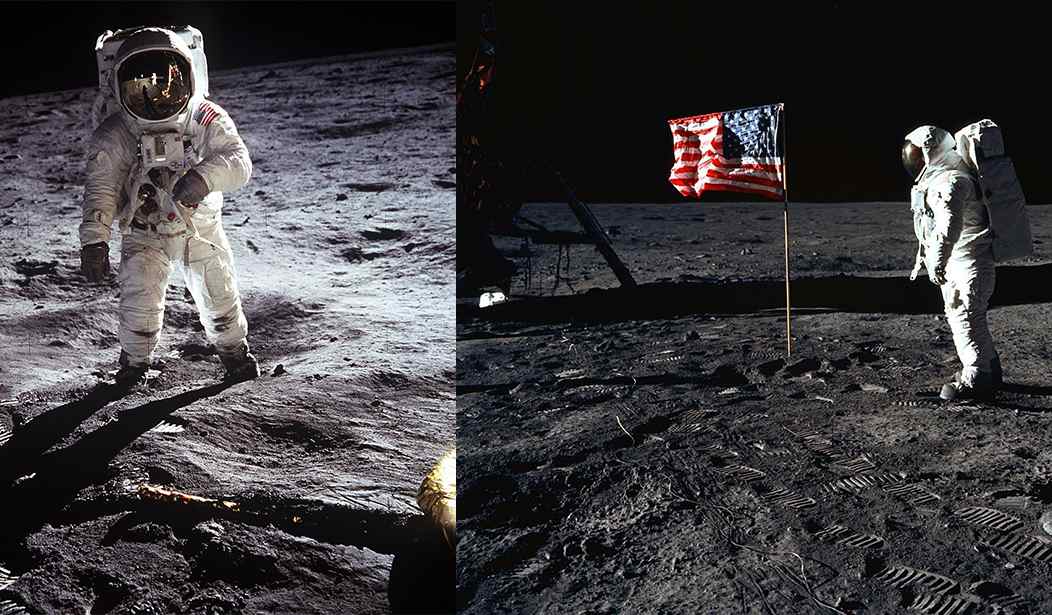
The United States remains the only nation to have ever sent men to the moon and brought them home, but we haven't done that since Apollo 17, in December of 1972; that's 53 years ago last month. I was 11 years old when that happened, and boy, howdy, a quick look at my profile photo will tell you I'm no spring chicken. But President Trump is determined that the United States is going to put men back on the moon, and fast. On Thursday, President Trump signed an executive order pointing us in that direction. There's a lot in that order, but here's the part about the moon:
Sec. 2. Policy. My Administration will focus its space policy on achieving the following priorities:
(a) Leading the world in space exploration and expanding human reach and American presence in space by:
(i) returning Americans to the Moon by 2028 through the Artemis Program, to assert American leadership in space, lay the foundations for lunar economic development, prepare for the journey to Mars, and inspire the next generation of American explorers;
(ii) establishing initial elements of a permanent lunar outpost by 2030 to ensure a sustained American presence in space and enable the next steps in Mars exploration; and
(iii) enhancing sustainability and cost-effectiveness of launch and exploration architectures, including enabling commercial launch services and prioritizing lunar exploration;
Just getting people to the moon is doable; we did it in the '60s and '70s, after all, and there have been a technological advancement or two in the last half-century. Imagine going into space in the spacecraft equivalent of a 1972 Ford Pinto, or even a 1972 Lincoln Continental if you prefer, and you'll have a pretty good grasp on that.
Read More: Reviving Trump's 'America First' Space Dominance, Hegseth Unveils Space Command HQ in Alabama
Trump’s Taking Us Back to the Moon, and This Time We Are Doing a Lot More Than Just Setting Foot
Of course, the trick isn't getting people to the moon. It's keeping them there. The Apollo missions were on the lunar surface for a matter of hours. But a colony? Humans on the moon for any length of time would have to contend with lunar gravity, which is about 1/6th that of Earth. A prolonged stay in that entails loss of muscle and bone mass; stay long enough, and you're never going home. Also, the moon's lack of an atmosphere would require some pretty serious radiation shielding, so that the lunar population doesn't start to glow in the dark.
We might remember, though, the words of President Kennedy, who aimed us at the moon in the first place; we do these things not because they are easy, but because they are hard.
The private sector, also, is making serious inroads into space travel. When humans do spread off-planet to stay, it's likely going to be the private sector that takes them there. There are enormous mineral resources out there, no farther away than the asteroid belt, which presents even greater technological challenges. Remember, though: We solve today's problems with tomorrow's technology.
First step will be one more giant leap for mankind, onto the lunar surface, and this time, mankind will be setting up installations - and probably having a lot of robotic help, which in and of itself solves some of those technical challenges. Interesting times, indeed.
Editor’s Note: Do you enjoy RedState's conservative reporting that brings you the best in the great technological advances of our modern American era? Support our work so that we can continue to bring you the truth.
Join RedState VIP and use the promo code FIGHT to get 60% off your VIP membership!



Join the Conversation
VIP members get the ability to comment on articles.