








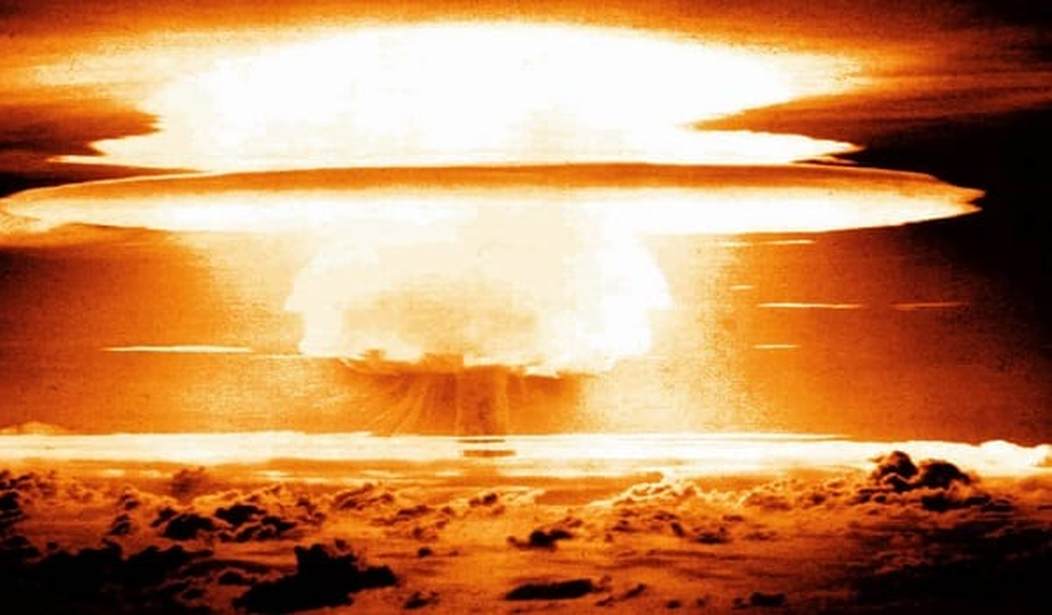
If you're a little long in the tooth, like me, you might remember a certain movie, the 1983 Matthew Broderick/Ally Sheedy grenade War Games, in which two teenagers hack into a Pentagon computer and nearly end up causing a global nuclear war. That film was intended as a cautionary tale about computerizing weapons systems.
But the people who made that film didn't know about the rise of artificial intelligence, which then existed only in the realm of science fiction.
China, now, is moving towards increasing artificial intelligence control over its fast-growing nuclear arsenal, and that should be viewed with alarm by American planners.
In May of last year, China rejected American proposals to limit the use of artificial intelligence for controlling the launch of nuclear weapons.
President Joe Biden raised this issue with Xi Jinping in California the preceding November and announced that AI was one of the areas where the two countries would hold further discussions. Beijing’s quick and adamant rejection of the American initiative, which occurred during talks in Geneva, was a signal that China’s regime had put itself on an exceedingly dangerous course.
“Our position has been publicly clear for a very long time: We don’t think that autonomous systems should be getting near any decision to launch a nuclear weapon,” Tarun Chhabra, then director of technology at the National Security Council, declared. “That’s long-stated U.S. policy.”
“We think all countries around the world should sign up to that,” he also said. “We think that makes a lot of sense to do.”
We can think all we like, but China doesn't give two hoots what we think. They have already rejected any calls to keep their nuclear arsenal completely in human hands. Part of their reasoning for this is that a long-standing nuclear tactic takes the form of a decapitation strike; the first round of weapons is aimed at destroying an enemy's national leadership, their military leadership, and all command and control centers. An AI backup control would allow a retaliatory strike even if the decapitation strike was remarkably successful. Think of it as one last "screw you" from a nation that has already been nuked into oblivion.
The Secretary of War, Pete Hegseth, recognizes the future of AI in warfare, as my friend and colleague Brandon Morse noted earlier on Tuesday:
Read More: Pete Hegseth Says AI Warfighting Is the Future, but We're Playing a Dangerous Game
But this idea, handing even partial control of nuclear arsenals over to an AI bot, may be the most dangerous of all.
“China is taking its nuclear arsenal to the next level by, among other things, marrying nuclear-tipped missiles to powerful artificial intelligence capabilities,” Brandon Weichert, author of Winning Space: How America Remains a Superpower, wrote to this author in June of last year.
“AI-controlled nukes would be far more devastating than your ordinary ones,” Weichert, also senior national security editor at the National Interest, stated. “The Chinese are behaving foolishly, though, because the chance for unintended consequences is high. Frankly, AI could easily lead to a nightmare scenario where China loses control of its nuclear weapons arsenal to a rabid artificial intelligence system.”
Here's the thing: China is growing desperate to seize any advantage over the resurgent United States that they can, militarily and economically, and they are betting big on AI to help them - as are we.
Read More: GM, Stellantis Tap New AI for $20M Savings in Race Against China
It's not just a matter of military and economic matters. China, in two or three more generations, may no longer exist as a coherent nation-state. The Chinese people are not having babies. Their birthrate has plummeted far below the replacement rate, partly because of the idiotic one-child policy that was in place for so many years. We were fortunate indeed that when the Soviet Union fell, none of the outgoing Soviet leadership decided to take the world down with them and launch a nuclear strike. Will we be so lucky a second time? Or will China's possible AI-controlled systems see the collapse of the Chinese Communist government as an existential threat and initiate a first strike? And what about the other nuclear nations of the world? North Korea has nukes and missiles that can reach, at least, Japan, Taiwan, and the Philippines, all nations friendly to the United States, and North Korea's demographic crisis makes China's look like small potatoes. And let's not forget India and Pakistan, two nuclear nations with a long history of playing snap-and-slash along their shared border.
None of these nations is as advanced in AI development as China, but we shouldn't rule out them obtaining such a capacity in the next few years. We should also never underestimate the danger of desperate men with nuclear weapons.
Artificial intelligence may well be a tool that China can leverage to make its military more efficient, particularly when it comes to its nuclear arsenal. It will, as noted, allow for a response even if the Chinese leadership is radioactive dust.
China is preparing for war against the United States. We'd better be preparing for war against them, too. And we should bear this in mind, always: A global, nuclear World War 3 wouldn't be like the previous two world wars; this World War 3 will be over in a matter of hours, and civilization will go with it.
Editor's Note: Thanks to President Trump and Defense Secretary Pete Hegseth's leadership, the warrior ethos is coming back to America's military.
Help us report on Trump and Hegesth's successes as they make our military great again. Join RedState VIP and use promo code FIGHT to get 60% off your membership.



Join the Conversation
VIP members get the ability to comment on articles.