






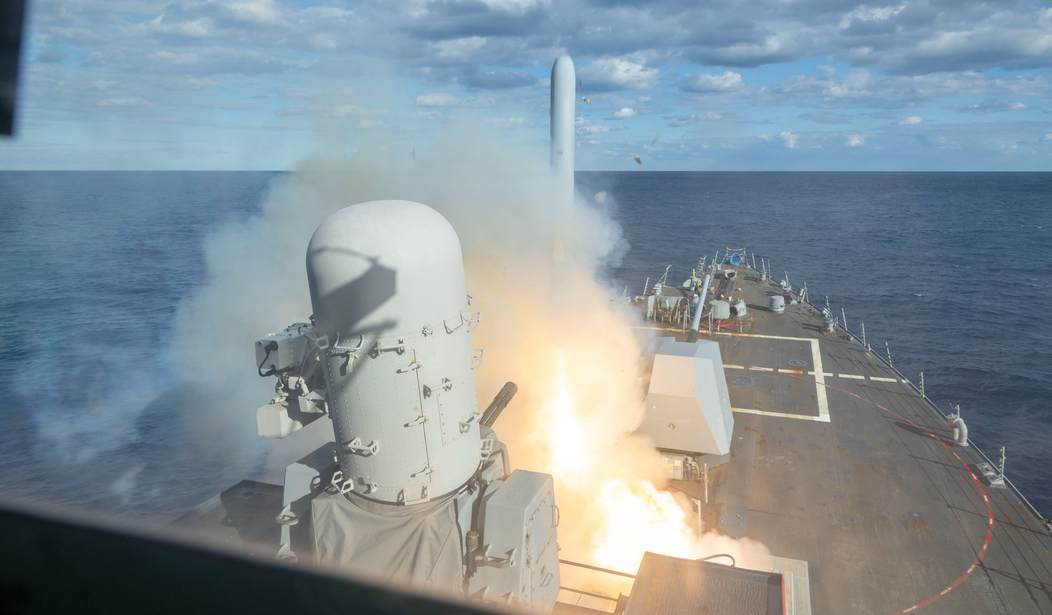
Operation Epic Fury has obviously dominated the headlines over the past 60-some-odd hours, and no doubt, will continue for quite some time. We know that many Democrat congressional leaders have determined that the operation is bad/wrong. (It must be if President Trump is the commander-in-chief, you see.)
But Monday morning, on NewsTalkSTL's Mike Ferguson in the Morning Show, we had the opportunity to speak to a former U.S. senator and a current representative (both Republicans) to get their insight on the matter, and I thought it might be interesting to share their perspective(s) with our readers.
First, we spoke with former U.S. Senator Jim Talent, who not only represented Missouri in the Senate but is also a nationally recognized leader on national security and military affairs. Here was our discussion with Senator Talent:
The full transcript of our interview with Senator Talent is included below, but here are the key takeaways from his responses:
On the Purpose of “Operation Epic Fury”
Initial strikes targeted remnants of Iran’s integrated air defense system.
Objective: render Iran vulnerable to follow-on precision strikes.
Strategic goal: eliminate Iran’s ballistic missile capability.
The timing was intentional because Iran was already weakened.
On Regional Dynamics
Iran made a strategic error by striking Gulf States.
Arab nations may now join or support operations.
Israel is the “dominant power” in the region.
On War Powers & Legality
Presidential authority for limited strikes is well-established.
Compared this action to Obama’s Libya operation (no prior authorization).
Congress typically becomes involved when supplemental funding is required.
Predicts operation will last “a couple of weeks maximum.”
On Strategic Objectives
The three pillars of Iranian power:
Nuclear program
Ballistic missile arsenal
Proxy forces (Hezbollah, Hamas, Islamic Jihad, Houthis)
The nuclear program was substantially degraded last year.
China has helped Iran attempt to rebuild capabilities.
The minimum outcome would be “defanging” Iran.
Possible regime alteration is a “big win.”
On Trump’s Strategy
All you need to understand it is to read the National Security Strategy and The Art of the Deal.
The approach is maneuvering adversaries into no-win scenarios.
Having a defined strategic end goal is key.
On Risk & Casualties
There have, unfortunately, been U.S. casualties, but he contends short-term losses will prevent larger future losses.
In his view, this action is both “the right thing to do” and “the obvious thing to do.”
Marco Rubio to Congress on Iran: 'Hardest Hits Are Yet to Come'
Later in the show, we spoke with Congressman Bob Onder, who happens to be a physician, an attorney, and currently represents Missouri's 3rd Congressional District. In addition to numerous subcommittees, he serves on the House Judiciary Committee, the House Education and Workforce Committee, and the House Transportation and Infrastructure Committee:
Again, the full transcript of our interview (as it relates to Operation Epic Fury) with Congressman Onder is included below, but here are the highlights of our conversation with him:
On Supporting the Strike
He fully endorses President Trump’s decision.
Iran is an existential threat to the U.S. and the West.
A nuclear-armed Iran would not be containable like the USSR.
There have been decades of Iranian-backed attacks on Americans.
Halting Iran's nuclear and ballistic missile programs is critical.
On Capitol Security & Domestic Threats
There is enhanced Capitol security.
He noted the Austin, Texas, terror attack.
He links the heightened threat environment to the need for DHS funding.
At least 400 individuals on the terror watch list entered the country under Biden.
On DHS Funding & Shutdown
He's critical of the Democrats for not funding DHS.
The shutdown could affect TSA, Coast Guard, and FEMA operations.
A prolonged shutdown could lead to airport disruptions.
On War Powers
Presidents historically use force without prior congressional approval.
Cited:
Thomas Jefferson and the Barbary pirates
Clinton (Serbia bombing)
Obama and Biden (missile/drone strikes)
A prolonged land war would require congressional involvement.
The president acted within his constitutional authority.
What's clear from our conversation with both Senator Talent and Congressman Onder is that they believe President Trump is acting within his authority and they believe this operation is justified.
Full Transcript — Senator Talent
Mike Ferguson:
Now joined by former U.S. Senator Jim Talent, and, Jim, really appreciate you being on the program here. Pete Hegseth is doing an update, basically as we speak right now, from Washington, D.C., on Epic Fury.
But first, I want to get your thoughts on the scope of this initial mission and this attack. When we talk about what was hit, like the president just referred to, what was the strategic significance of essentially this first wave — and then we can get into the why and the how and things like that — but why did we hit what we hit, and was it important to have other nations involved in this?
Sen. Jim Talent:
Yeah, that's a really good question, Mike. It goes to the heart of the purpose behind the operation. So what we hit initially was the remnants of their integrated air defense system. So the idea is to render the country completely defenseless, which I don't want to say it was completely defenseless, but their systems had already been largely knocked out. It's one of the reasons we're doing this now.
And then you move in, and you strike the military targets that you want to strike, which is we're taking the ballistic missile system, and the Iranians — have decapitated the leaders — and the object is to knock out our prime adversary in the Middle East at a time when they were already weak and extremely vulnerable. So that's the purpose behind it.
The Iranians, as one might expect in a situation like this, where the regime was already on the ropes, have made a number of mistakes, which is simply making the situation even more perilous. So they turned around and attacked the Gulf States. As a matter of fact, as of last night, they had shot as many missiles at their Arab neighbors as they had at Israel. So, of course, causing them now to come in and openly join us in condemning and probably they'll join the operations as well. So far it's going very well. This is the kind of operation we do very well. You give the American Navy and the American Air Force time to build up and engage in a extensive precision strike campaign, and you're gonna be in trouble, and that's not even counting the Israelis who have become the dominant power in the region.
Susie Moore:
Good morning, Senator. This is Susie Moore. Of course, one of the topics of conversation surrounding this is whether we are officially at war, what that means, what the president needs to do in terms of his authority, what he needs to clear with Congress. Could you give us some insight on that?
Mike Ferguson:
And Jim, here's something that Senator Chris Murphy, Democrat, said on NBC's Meet the Press to that effect.
Sen. Chris Murphy (clip):
He is busy getting us involved in quagmires overseas that already are becoming deadly to American soldiers. This is a disaster, it is illegal, and the president is obligated under the Constitution to come to Congress and ask for an authorization of military force. He wouldn't get that authorization if he asked for it.
Sen. Jim Talent:
Well, in terms of the legality of it, the issue is, does the president need congressional authorization for an operation like this? Nobody is quite certain and has been for generations exactly what the president's authority is. Senator Murphy was not complaining when Barack Obama engaged in, I think it was a seven-month Libya in 2011, with no congressional authorization.
So if an operation is sustained — here's what it means as a practical matter. If an operation is sustained for long enough and is expensive enough in terms of dollars that the administration has to go to Congress for a supplemental appropriation, that's when Congress always gets to weigh in — when you need extra money. That's not going to happen here. This operation is going to last a couple of weeks maximum.
A lot depends on what happens inside of Iran because the minimum we're going to get out of this is defanging Iran's ballistic missile system and decapitating the leaders. We've already done that a lot in the last couple of days. It's quite possible, however, that there's going to be a regime, if not change, then a regime alteration — the same kind of thing we're seeking and have to a substantial extent achieved in Venezuela — where somebody takes over who's wearing a military cap rather than a turban and who says, "Okay, we're going to play ball with you," because the alternative is we're going to be killed and we're going lose all everything we've looted from the Iranian people over the last 50 years.
So that's the big win. But the minimum we're going to get is basically knocking Iran completely out as a threat to the United States and America's interests in the Middle East. This is what Trump tries to do. I always tell people, if you want to understand what we're doing in foreign policy, read the National Security Strategy, which is about 25 pages long, and read The Art of the Deal. What Trump wants to do is maneuver the other party into a situation where their only options are a win for us. That's what's happened here. So I think this is not only the right thing to do. I think it would be almost, it's the obvious thing to do under the circumstances.
Mike Ferguson:
We are visiting with former U.S. Senator Jim Talent. So we go back to last June when we hit the nuclear facility in Iran. So did that not accomplish what it was designed to accomplish on a permanent basis? Is this something that should have been expected? Why wasn't that enough back then?
Sen. Jim Talent:
Yeah, I think it really did. I said at the time, it substantially destroyed the nuclear program. Now, since then, they've been trying to reconstitute it, which you knew they were going to do. The Chinese have been helping them because the Chinese wanted to destabilize the region and they're our adversary as well.
Part of the goal here was to knock out the remnants of the program. But there are three prongs to Iranian power. One of them was their attempt to get a nuclear weapon. The second is their ballistic missile arsenal, which, before Hamas made the mistake of attacking Israel, was thousands of missiles. And then the third is their support of these proxies, Hezbollah, Hamas, Islamic Jihad, Houthis, etc.
And so Trump's demands were you can't build nuclear weapons, you can't support the proxies, and you have to give up your ballistic missile system. So we're now knocking out the ballistic missile system, and the country is, Iran is in such a state that they're not going to be able to support the proxies anymore either. So again, either we defang them completely, that's the minimum result of this.
To our people, there is risk. We've lost three servicemen already as of last night when I looked — and that's, three casualties are three too many — but that's going to save hundreds and probably thousands of American lives going forward. So this is the right thing to do at the right time, and I have every expectation it's gonna be successful. And then we'll see what these people who are now criticizing it, what they say in a couple of weeks. I expect they'll just want the whole issue to go down the memory hole and everybody to forget what they said.
Susie Moore:
Senator, one of the things that seems to be distinguishing the military operations we're seeing under the Trump administration versus previous administrations is they appear to be moving with a clear goal. We're seeing quick strikes, end games, that sort of thing. I thought it was interesting that Senator Murphy decided to refer to what's going on in Iran for the past 48 hours as a quagmire. I think that might be a little premature to characterize it as that. But speak to the importance of having that end game, end goal in mind when you engage in activity like this and how that distinguishes some of our previous endeavors.
Sen. Jim Talent:
It makes all the difference in the world. We actually have a strategy. It's a global strategy. It includes regional goals. And again, page five of the National Security Strategy, I know what this sounds like, it's like I'm a think tank person. But it's so important that you have goals, you have a strategy, you've thought about the means by which you're going to accomplish something.
Our goals in the Middle East are to protect the United States, and that includes Americans abroad. We know what Iran has done for 50 years to Americans abroad. Anybody who wants to Google it can. You'll see a litany of attacks on the United States both here in the homeland and also abroad. There's a reason they've been labeled the chief state sponsor of terrorism.
We don't want an American adversary dominating the region, and the country that wants to do that and has tried to develop the means to do that is Iran. And we want to protect the free flow of goods in the region. We want the right of the United States to move trade and travel in the region on the same terms as everybody else, peacefully, and they're the major threat to that as well.
You heard a couple days ago, their proxy, the Houthis, saying, "We're going to seize up all shipping in the Persian Gulf." Now they can't do it, but that's what they want to do. And so this is an attempt to change the situation in the Middle East so as to protect our interest at a minimum. And of course, it also creates the possibility of a new balance of power in the Middle East that is peaceful going forward. That's what Trump is really aiming for. As I said before, he usually tries to maneuver the situation so he has a big win out there that he can get. But if he doesn't get that, he certainly gets solid victories as the alternative, which is what's happening right now.
As I said, Susie, I think given the history that we've had with Iran, this is not only the right thing to do. I just think it's the obvious thing to do. So obviously, we never like to put our men and women at risk, but this is a situation that's going to save a lot of lives going forward.
Full Transcript — Congressman Onder
Mike Ferguson:
Should Congress formally authorize the president to continue the strikes against Iran that started over the weekend? Of course, that's some of the calls that are being made. We'll get to that in just a moment, but let's get the bigger picture first.
We're now joined by Congressman Bob Onder. Bob, obviously, everything else that you're working on is going to be dwarfed by this, at least for the next few days, if not the next couple of weeks. Did President Trump make the right decision to launch this military strike in partnership with Israel? And we'll get to the other stuff in a little bit, but if so, why would that have been the right decision to make?
Rep. Bob Onder:
Good morning, Mike. It's great to be back. Yes, I believe Donald Trump made the right decision in launching Operation Epic Fury to halt Iran's nuclear and ballistic missile programs to keep America safe. Since 1979, when the radical Islamists took power in Iran, "Death to America" has been a continuous refrain of that government. And I believe they meant it. Thousands of Americans have died, tens of thousands more have been maimed at the hands of Iranian proxies in the Middle East. So I think it's absolutely essential that Iran not have a nuclear weapon. I don't think a nuclear-armed Iran would be susceptible to the kind of standoff we had with the Soviet Union for the decades of the Cold War. I think it is an existential threat to the West and to the United States. The missiles that Iran has were more than capable of hitting much of Europe. So I do support the President.
Susie Moore:
Good morning, Congressman, this is Susie Moore.
Rep. Bob Onder:
Good morning, Susie.
Susie Moore:
I saw reports that the security at the Capitol is now enhanced. Obviously, there are some concerns here at home. Do you have any insight or idea about what the necessity is for the enhanced security and what that means for you from a practical standpoint?
Rep. Bob Onder:
Yes, Susie. I haven't heard the details of the security enhancement. I, like you, did hear that security was being enhanced. I think certainly that the terror attack in Austin, Texas, this weekend that killed two and injured, I believe, fourteen others may well have been, whether directly connected with Iran, it may well have been an Islamist terror attack. We know that at least four hundred people on the terror watch list entered the United States under Joe Biden. So it really does emphasize the need for heightened awareness of our surroundings, of potential threats, but also it emphasizes the need for the Democrats to reopen the Department of Homeland Security, which they have refused to fund. Not only does that defund the Coast Guard, FEMA, TSA, but other programs and agencies that keep us safe from terror. So I think I'm hopeful we can get DHS funded this week.
Mike Ferguson:
Bob, what happens if the security alert level at the airports — you know, the color-coded security alert — goes up and the partial shutdown is continuing? Is that even doable, or will there have to be restrictions on flights?
Rep. Bob Onder:
I think at some point there will be restrictions on flights. Over 90 percent of Homeland Security employees are deemed essential, so they're not getting furloughed. They're expected to come to work every day without pay. But we all know from the 43-day Schumer shutdown in the fall that eventually people start having, you hate to say this, but people start to call in sick and drive Uber or DoorDash instead of showing up to their workplace to work for free, or at least work without pay temporarily. So that's what began to happen last fall, and I believe it was the approaching holidays and the potential for flight delays, cancellations, airports reducing their volume, disrupting holiday travel, I think that's what probably eventually got the Democrats to the table and got them to reopen the government in December. But it's a shame that the Democrats are playing politics with the safety of the American people and really looking out for illegal aliens and not the safety of Americans.
Susie Moore:
So, Bob, this puts the Democrats in kind of an interesting pickle. Not to make light of the situation at all. But obviously, they've been dug in on DHS funding, and most of them are voicing disagreement with the decision to strike Iran. But we're in a heightened threat situation at this point, and that's going to be a very delicate — a difficult line for them to walk, isn't it? Or is this going to maybe bring them to the table and get them to agree to go ahead and fund DHS?
Rep. Bob Onder:
I think it might. I think it might very well. You hate to say this, but how many terror attacks have to happen before the Democrats realize that DHS, which was an agency that was established after September 11, 2001, is an important agency in helping to keep us safe? Maybe I shouldn't be surprised because, after all, Democrats go to war to prevent criminal illegal aliens from being deported. So, I think President Trump, in the State of the Union speech last week, when he said, "These people are crazy," I think he's really right.
Mike Ferguson:
We're visiting with Congressman Bob Onder, and of course, some of the calls in the halls of Congress, mostly from Democrats but some Republicans as well, are that Congress should authorize military operations like this. So the question basically is: Was it legal? And how long is it legal before Congress needs to give its approval? What's the role of Congress in somehing like Operation Epic Fury?
Rep. Bob Onder:
Presidents have taken action to protect the safety of the American people since Thomas Jefferson sent the Marines to eliminate the Barbary pirates. Certainly, Republican and Democrat presidents alike have used the military to take actions against our enemies. That includes President Obama, President Biden with missile strikes and drone strikes against enemies in the Middle East. It includes Bill Clinton with weeks of bombing in Serbia. So, President Trump is acting in that tradition. Sure, if there is a prolonged land war, which I hope there will not be a land war at all, then at some point, it would require the involvement of Congress. But I think the president acted within his authority to keep us safe.
Editor's Note: Thanks to President Trump and Defense Secretary Pete Hegseth's leadership, the warrior ethos is coming back to America's military.
Help us report on Trump and Hegesth's successes as they make our military great again. Join RedState VIP and use promo code FIGHT to get 60% off your membership.

Join the Conversation
VIP members get the ability to comment on articles.