
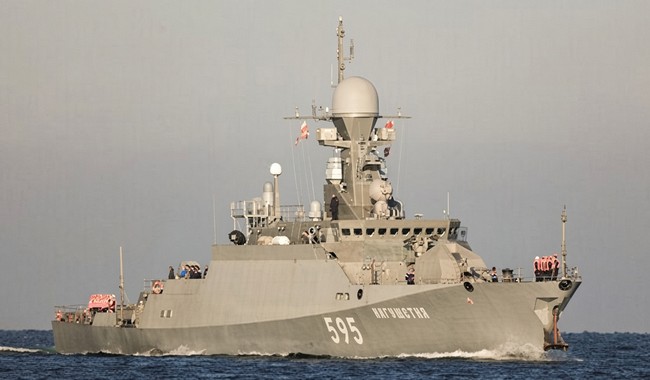
In the predawn hours of Wednesday, the Russian Baltic Fleet corvette Naro-Fominsk was transiting the narrow waters of the Gulf of Finland near heavily militarized Russian-occupied Gogland Island when a wave of Ukrainian drones hit it.
Commissioned in 2023, the Naro-Fominsk is a Project 21631 Buyan-M-class corvette among the newer vessels in the Russian fleet, armed with Kalibr cruise missiles and Oniks anti-ship missiles. Ukraine’s Security Service (SBU) claimed responsibility for the attack, asserting that its drones struck the ship and left a number of crew members dead and wounded. Ukraine has targeted Buyan-M-class corvettes in the past. In April 2024, a Russian sailor recruited by the SBU carried out an arson attack on one in the Baltic; see Putin's War, Week 111. Russian Offensive Grounds to a Halt and Ukrainian Refinery Attacks Pause – RedState and Putin's War, Week 123. F-16s Wait in the Wings, More Weapons Arrive, and the Momentum Shifts – RedState. This, however, is the first targeting of a Russian warship, outside the immediate area of conflict, while it was underway in a heavily traveled shipping lane. As such, it marks a quantum leap in the sophistication of Ukraine's maritime strategy.
Ukraine’s Security Service (SSU) says that the Buyan-M-class missile corvette Naro-Fominsk was struck during the November 11 operation against Russia’s Ust-Luga port in Leningrad Oblast. The vessel was launched in 2022 and is capable of carrying Kalibr cruise missiles. The extent of the damage remains unclear.
— Special Kherson Cat 🐈🇺🇦 (@bayraktar_1love) November 11, 2026
According to an assessment by Estonian Defense Forces Deputy Division Commander Colonel Aron Kalmus,
“It was hit by a significant number of drones. We know quite accurately how many. I will not go into details, because I would not want to make the enemy’s job easier by showing what and how we see,” Kalmus said, according to Estonian public broadcaster ERR.
Then, perhaps enjoying the announcement far too much, he went full-metal James Bond:
“However, more than one drone hit it, which for the military would be an accident. More than two, which would be a coincidence. And more than three, which for the military would already be a pattern.”
Estonian Defense Forces Colonel Aron Kalmus, deputy commander of the Estonian Division, has revealed new details about the Ukrainian drone attack on Russia’s Buyan-M-class missile corvette Naro-Fominsk in the Gulf of Finland on November 11, during the massive strike on Ust-Luga port.
According to Kalmus:
• Multiple direct hits: The corvette was struck by more than three drones. Estonian forces know the precise number, but Kalmus declined to disclose it.
• Casualties: The strikes damaged the warship, killing and wounding Russian personnel.
• Unable to return independently: The corvette initially headed toward St. Petersburg under its own power but later stopped and required assistance from another vessel to continue.
• Estonian airspace: Ukrainian drones briefly entered Estonian airspace during the attack, remaining there for just a few minutes.
• No interception: Estonia tracked the drones but chose not to shoot them down to avoid escalation and the risk of debris or interceptor munitions falling on Russian territory.
— Special Kherson Cat 🐈🇺🇦 (@bayraktar_1love) November 13, 2026
Estonian Defense Forces Colonel Aron Kalmus, deputy commander of the Estonian Division, has revealed new details about the Ukrainian drone attack on Russia’s Buyan-M-class missile corvette Naro-Fominsk in the Gulf of Finland on November 11, during the massive strike on Ust-Luga port.
According to Kalmus:
• Multiple direct hits: The corvette was struck by more than three drones. Estonian forces know the precise number, but Kalmus declined to disclose it.
• Casualties: The strikes damaged the warship, killing and wounding Russian personnel.
• Unable to return independently: The corvette initially headed toward St. Petersburg under its own power but later stopped and required assistance from another vessel to continue.
• Estonian airspace: Ukrainian drones briefly entered Estonian airspace during the attack, remaining there for just a few minutes.
• No interception: Estonia tracked the drones but chose not to shoot them down to avoid escalation and the risk of debris or interceptor munitions falling on Russian territory.
The corvette was left dead in the water and had to be towed into port.
A Simultaneous Strike at Ust-Luga Refinery and Terminal
This attack was not a one-off. As the Naro-Fominsk was ignominiously towed into port, another wave of Ukrainian drones hit the maritime terminal at Ust-Luga in Leningrad Oblast, a major export hub for refined petroleum products.
The barrage damaged five petroleum-product storage tanks with a combined capacity of nearly one million barrels, along with a hydrocracking unit (I had to look this up; it is the part of the refining process that converts heavy oil into jet fuel, kerosene, diesel, and gasoline) belonging to Russia’s number two oil company Novatek. The attack also hit associated transfer pipelines and sections of a nearby liquefied natural gas (LNG) facility. The strikes caused fires and a petroleum spill across the complex.
Russian regional officials acknowledged the damage and the dispatch of emergency responders, stating that three workers were injured. Moscow maintained that its air defenses had intercepted roughly 150 Ukrainian drones across the region during the overnight assault.
Not to put too fine a point on it, but Russia and Ukraine are allegedly in the throes of an "energy ceasefire", see 'He Better Damn Well Stop': Trump Calls for New Ukraine President After Zelensky Hits Refinery – RedState, Zelensky Feels 'Betrayed' by US-Russia Diesel Deal. Trump Lit Him Up for Refinery Attacks. – RedState and Trump Announces Energy Ceasefire Between Russia and Ukraine – RedState. And Primorsk, where the tankers in the Trump-Putin diesel importation scheme took on cargo (see Trump-Putin Diesel Deal Flops: Tankers U-Turn As Legal Risks Scare Off Buyers – RedState), is 50 miles away from Ust-Luga, directly across the Gulf of Finland.
Airspace Scrambles and Border Tensions
The strikes unfolded within miles of NATO territory, and Finnish defense forces tracked the operation as it developed. Next door in Estonia, defense officials reported that several Ukrainian drones entered Estonian airspace during their transit toward Russian targets.
NATO alert aircraft scrambled in response to the radar tracks. Estonian commanders, however, chose not to engage the drones, calculating that shooting them down near the border risked dropping debris into Russian territory and triggering a direct cross-border incident...and besides, they were headed in the right direction.
Russia scrambled helicopters and fighter aircraft in response to the drone attack and managed to shoot down two of its own helicopters and one MiG-31 fighter with a total loss of crewmembers.
Russian military bloggers say that St Petersburg’s air defenses, while failing to protect against Ukrainian drones, did manage to shoot down two Russian helicopters (Mi-8 and Ka-52), plus a MIG-31 jet fighter. https://t.co/p9Uxhpr7XU
— Yaroslav Trofimov (@yarotrof) November 11, 2026
Russian military bloggers say that St Petersburg’s air defenses, while failing to protect against Ukrainian drones, did manage to shoot down two Russian helicopters (Mi-8 and Ka-52), plus a MIG-31 jet fighter.
The Mediterranean Precedent
The Gulf of Finland assault follows a geographic widening of Ukrainian drone strikes against Russian-linked maritime logistics and sanctions-evading shipping. As far as I can tell, no exhaustive list of attacks exists. These are the ones reported on in open-source media:
- December 2025: The shadow fleet tanker Qendil came under drone attack off Libya, marking the first extension of Ukrainian anti-shipping operations beyond the Black Sea.
- January 2026: The sanctioned shadow fleet tanker Elbus was hit by an unmanned surface vessel off the coast of Turkey and sustained damage.
- March 2026: South of Malta, the LNG carrier Arctic Metagaz suffered an explosion and an onboard fire following an attack by an unmanned surface vessel; see Russia Blames Ukraine for Sinking Massive Tanker in the Mediterranean – RedState.
- Early September 2026: Long-range aerial drones struck the roll-on/roll-off vessel Lady Mariia, a sanctioned ship linked to Russian military cargo transport, in the Mediterranean between Crete and Libya and left it dead in the water.
Of course, the big daddy of sinkings was the freighter Ursa Major, carrying what was rumored to be components for a nuclear reactor for North Korea along with cranes and icebreaker repair parts, near Gibraltar on Christmas Eve, 2024; see Russians Blame Loss of Ship With Critical Cargo on 'Terrorism' – RedState.
Curious...
The attack on the Ust-Luga complex is sophisticated but routine. Ukraine has shown repeatedly that it can hit any target inside Russia it wishes (Ukraine Launches Massive Drone Attack on Russia, Including Hundreds Targeting Moscow – RedState and Massive Ukrainian Drone Attack Deletes a Third of Russia's Bomber Fleet and Sends a Warning to the US – RedState). To me, the curious aspect of the operation is that several drones, not just a single one, hit a Russian surface combatant, underway, at night, in a crowded shipping channel. I may have been born at night, but I wasn't born last night. There is no way this happened as part of a long-range strike package coordinated with the Ust-Luga attack. The foreknowledge of Russian ship movements required is just impossible to credit. The implication is that Ukrainian forces were observing the ship and timed the strike to coincide with the larger refinery attack. The strike was launched either from a disguised ship acting as a drone platform or from a temporary base the SBU established somewhere in or around the Gulf of Finland.
Strategic Reach and Vulnerability
This coordinated operation in the Gulf of Finland demonstrated that Russian naval vessels and energy infrastructure are vulnerable far beyond the primary war zone. It should serve as a reminder to the U.S. Navy, in case it has forgotten the USS Cole fiasco, that when a U.S. ship is at sea, it must act like it is at war because we don’t get to decide who attacks us, when, or for what reason.