
On the evening of October 9, 2026, President Donald Trump announced that he had just concluded a “highly successful” call with Russian President Vladimir Putin. The two leaders had agreed, Trump said, “that Russia would immediately release more than 300,000 metric tons, or 2.24 million barrels, of diesel onto American and global markets, with another 500,000 tons, or 3.73 million barrels, to follow in November and a further million tons shortly thereafter.” The same day, the U.S. Treasury’s Office of Foreign Assets Control issued General License 135, authorizing the “sale, delivery, offloading, and importation of diesel fuel of Russian Federation origin” through April 7, 2027. Russia, for its part, partially lifted its own diesel export ban. The stated purpose was straightforward: to ease soaring U.S. diesel prices ahead of the midterm elections. See Trump Strikes Russian Diesel Deal to Tackle Soaring Fuel Prices (Updated) – RedState and Trump Holds Off on New Russia Sanctions, Citing Ukraine Peace Talks – RedState for more.
So, how has that worked out?
As a policy, it was a bust. Diesel prices had skyrocketed from a national average of $3.46 per gallon in early January, before the current war with Iran kicked off, to a peak of $6.52 around September 21. President Trump announced that sanctions on imported Russian diesel had been waived, even though the U.S. was exporting about 1.2 million barrels of diesel per day. As we all lived through the electoral rout of the GOP on November 4, we can say, without fear of contradiction, that it didn’t have the hoped-for effect on the midterms; see Vance's Explanation for the GOP's Midterm Disaster Is a Little Too Neat and Tidy – RedState and Hot Takes: Dems See Their Opportunity Over the Trump-Russia Diesel Deal – RedState.
But how about the execution?
If the policy's desired result was sub-optimal, then the execution was an abject failure.
A tanker carrying Russian diesel that had briefly signaled the US made a U-turn about 400 nautical miles off New York, compounding uncertainty over deliveries to the North American market.
The Agioi Fanendes, hauling about 40,000 metric tons of ultralow-sulfur diesel, or almost 300,000 barrels, started to move away from the US East Coast and has been dawdling in a zigzag pattern since Monday, according to a port report and ship-tracking data compiled by Bloomberg.
…
The Agioi Fanendes signaled New York after departing Russia’s Baltic port of Primorsk in late October and later switched its destination to “for orders.” The tanker is still “proceeding for orders as the discharging port is not confirmed yet,” vessel manager Eastern Mediterranean Maritime Ltd. said in an email, repeating a previous response to a question about the ship’s movement.
What makes this story significant is that the Maltese-flagged Agioi Fanendes was the last tanker carrying Russian diesel to show a U.S. destination.
How it started
Three vessels began a voyage on October 22 after loading diesel at the Russian Baltic port of Primorsk, with a scheduled U.S. arrival date of November 7. The M/T Agioi Fanendes, the Sierra Leone-flagged M/T Leruo and the Russian-flagged M/T Talisman, all carried about 40,000 tons of diesel. The Leruo is under EU sanctions, and the Talisman is under U.S. sanctions. A fourth sanctioned tanker, the “shadow fleet” M/T Beast, followed later, signaling “Atlantic” rather than "New York" as its destination.
If you’re doing the math, you will see that the 300,000 tons of diesel Trump promised for “immediate” release on the U.S. market in October was actually zero tons, as the shipments weren’t due in the U.S. until November. Even then, the 500,000 tons for November was actually a maximum of about 160,000 tons in four ships, with no other ships in the loading process.
Barriers, you say?
Almost immediately, the shipments ran into a legal obstacle that no temporary license could easily remove. In the spring of 2022, after Russia’s full-scale invasion of Ukraine, Congress passed the Ending Importation of Russian Oil Act. The statute prohibits the importation of Russian-origin energy products covered unless the President, after consulting Congress, certifies
(2)… that the Russian Federation—
(A) has reached an agreement to withdraw Russian forces and for the cessation of military hostilities that is accepted by the free and independent government of Ukraine;
(B) poses no immediate military threat of aggression to any North Atlantic Treaty Organization member; and
(C) recognizes the right of the people of Ukraine to independently and freely choose their own government.
The law also required the import ban to remain in effect for 90 days after presidential certification. Needless to say, no such certification was presented.
This created an immediate conflict between the OFAC-issued import license and federal law. It potentially opened anyone handling the Russian diesel — ports, banks, importers, terminals, distributors, etc. — to massive civil and criminal penalties with a statute of limitations that would outlast the current administration. If New York Attorney General Tish James were willing to go after Trump over a commonly accepted business practice, no sane person would want to handle these diesel shipments. New Jersey Governor Mikie Sherrill told New Jersey port and terminal operators “that purchasing or unloading the illegal Russian fuel currently bound for the east coast of the United States at the urging of the Trump Administration would likely subject businesses and individuals to harsh penalties, both civil and criminal.”
Ultimately, this would have ended up in court, and the administration, if it were still in office, might have prevailed. However, in the meantime, the entire supply chain handling the Russian diesel would have been left dangling in the breeze, subject to arrest, imprisonment, and crippling civil lawsuits. Adding to the risk was that all the ships were bound for New York, hardly a favorable place to support a Trump policy that conflicts with another law. Ultimately, no dealers could be found who were willing to handle the Russian diesel at any price.
How it’s going
At this writing, the last of the tankers, M/T Agioi Fanendes, is making donuts in the Atlantic while signaling “for orders,” which means that it has a cargo but no buyer. M/T Leruo shows Manaus, Brazil, as its destination. M/T Talisman is showing El Dekheila, Egypt, as its destination. M/T Beast is also showing “for orders” and indicating that it is headed for Brazil.
Was this goat-rope necessary or even useful?
I have been a skeptic of this operation, as anything more significant than a Hail Mary play reacting to midterm polling. If we are exporting over a million barrels of diesel each day, then importing under 4 million barrels per month seemed negligible. While arguably that may have had some impact in New England and the Mid-Atlantic states, the only part of the nation that imports diesel (and that from Canada) because of a shortage of refineries, it wasn’t going to move the needle on national prices. All it did was give an air of desperation and a possible infusion of cash into Russia’s struggling economy so that it could better prosecute its illegal war against Ukraine.
Perhaps the most noxious part of the exercise was blaming Ukraine’s strikes on Russian refineries for U.S. diesel prices when we remained a diesel exporter; see 'He Better Damn Well Stop': Trump Calls for New Ukraine President After Zelensky Hits Refinery – RedState.
🚨BREAKING: This new chart from @TheStudyofWar overlays Ukraine’s strikes on Russian refineries with the price of diesel fuel. There is NO CORRELATION between strikes on Russian refineries and spikes in the price of diesel here in the U.S. They are not driving up prices here. https://t.co/PzWXxTrf5z
— Marc Thiessen (@marcthiessen) October 16, 2026
If you go back farther, the results are even more stark.
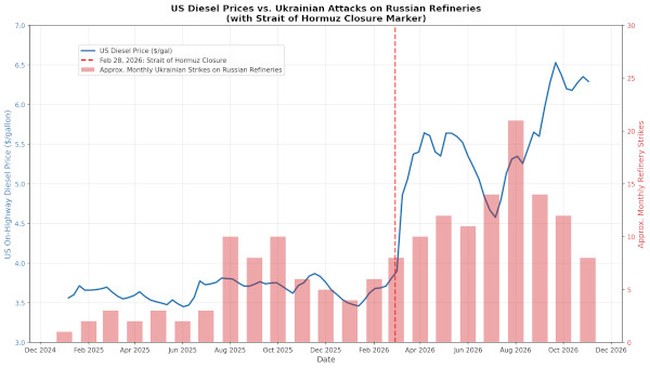 The caveat is that the number of refinery attacks comes from open-source reports and may be lower or higher than the full universe of attacks. It also includes attacks on refineries that do not produce diesel. Also, a strike on a refinery is just that. It isn't necessarily successful, nor does it mean that output stops or that the refinery wasn't subsequently repaired.
In retrospect, as it did at the time, the diesel importation scheme seems like a political stunt that never had any hope of producing results at the pump.
If that were all it was, it could be excused because everyone does it. But in this case,e Trump demanded that Ukraine put his domestic goals above its own defense at a time when Trump was openly hostile to aiding Ukraine; see Zelensky Feels 'Betrayed' by US-Russia Diesel Deal. Trump Lit Him Up for Refinery Attacks. – RedState and Trump Announces Energy Ceasefire Between Russia and Ukraine – RedState. Diesel drives the war machine of every industrial nation. Attacking its production is a legitimate target.
BREAKING: Trump to Zelensky: Zelensky has to do one thing. He has to stop knocking out diesel fuel in Russia. He is causing a shortage of diesel. This isn’t done by the Middle East. This is done by what’s happening between Russia and Ukraine. https://t.co/hF9TlBbRlq
— Clash Report (@clashreport) September 13, 2026
The deal gave Russia sanctions relief and, had the shipments occurred, we would've had the humiliation of watching three tankers, under sanctions from multiple nations, unloading diesel at some terminal in New York or New Jersey.
Hopefully, this sad episode is over. With the entire diesel supply chain afraid to touch Russian diesel and no shipments underway, that looks likely. The damage, however, is done, and the best one can say is that it was the act of a lame-duck administration that the next White House can easily set aside.