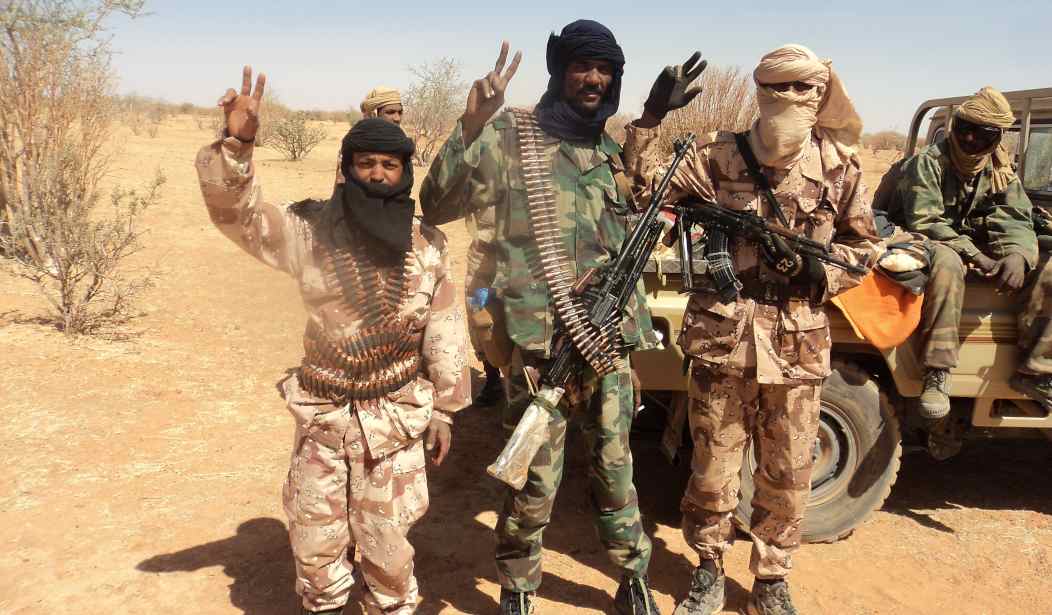

Islamist militants and separatists launched a coordinated series of attacks across the West African nation of Mali on Saturday, threatening to overthrow the ruling military junta and put a stick in the spokes of Russia’s Sahel strategy.
Since 2021, Mali has been ruled by a military junta led by General Assimi Goïta. Goïta overthrew a very weak and nominally constitutional government and inherited a dumpster fire of poverty, criminality, and insurgency. The French had provided a bulwark against the Islamist factions through the United Nations Multidimensional Integrated Stabilization Mission in Mali (MINUSMA), halting the 2012 Islamist advance, evolving into Barkhane (2014–22). By 2023, Mali had soured on the UN presence, and the Goïta junta expelled it shortly after taking power. This left Mali still in need of an effective military to combat secular Tuareg-Arab separatists in the Coordination of Azawad Movements (CMA, including MNLA) seeking autonomy or independence for Azawad, along with al-Qaeda (represented by Jama’at Nusrat al-Islam wal-Muslimin, abbreviated as JNIM) and the homegrown ISIS offshoot Islamic State in the Greater Sahara (ISGS). As we’ve seen elsewhere, the Islamists generally cooperate, but occasionally they have disagreements over who is the more radical and turn to internecine violence to settle the argument.
To meet this need, Mali called on Russia’s Wagner Group, a private military corporation. Wagner did what it does best: it proceeded to murder civilians and create more insurgents for the government to deal with. When Wagner Group staged its mutiny (see Russia Faces Either a Military Mutiny or Coup D'Etat From Wagner PMC Boss Prigozhin – RedState), the survivors were sent to Mali. Wagner Group’s involvement was part of a larger Russian “Sahel Strategy.” The purpose of this strategy was to offer “unconditional security assistance, insulating military elites from domestic opposition and international pressure, while simultaneously advancing Russia’s own interests: resource extraction, political influence, and great power posturing.”
Russia’s approach to the Sahel can be best described as opportunistic. Rather than advancing a coherent regional policy, Moscow has capitalized on its deepening security crises and deteriorating relationships between Sahelian regimes and their Western partners. Over the past decade, the Sahel has been plagued by multidimensional security challenges: a surge in jihadist insurgencies, ethno-nationalist independence movements, and severe resource and climate-based inequalities. These overlapping crises set the stage for a wave of military coups beginning in 2020, ultimately resulting in the establishment of military juntas in Mali, Burkina Faso, and Niger. France’s decade-long counterinsurgency mission, Operation Barkhane, further strained relations between Sahelian governments and their Western allies, as it failed to deliver meaningful security improvements. Barkhane’s limited successes made it particularly vulnerable to criticism, a vulnerability Russia quickly exploited. Through its mercenary proxies, Russia offered disillusioned Sahelian regimes an alternative security partnership devoid of democratic or human rights preconditions.
The strategy also includes fomenting the occasional coup; see BREAKING: Unconfirmed Reports of Wagner Group Personnel Aiding Coup in Niger – RedState.
Wagner Group proved no more competent in non-atrocity-producing operations in Mali than it had been in Ukraine. In July 2024, it got its butt spanked hard, and in a non-sexual way, by CMA fighters; see Russia's Wagner Group Suffers Major Defeat at the Hands of Tuareg Rebels in Mali – RedState. Somewhere along the way, Wagner Group’s African subsidiary was named, unironically, Africa Corps, perhaps thinking that naming Wagner Group after a competent organization would symbiotically create one.
That brings us up to today. The attacks concentrated on the core of government power in Bamako and the Russian military base at Kate, about ten miles northwest of the capital.
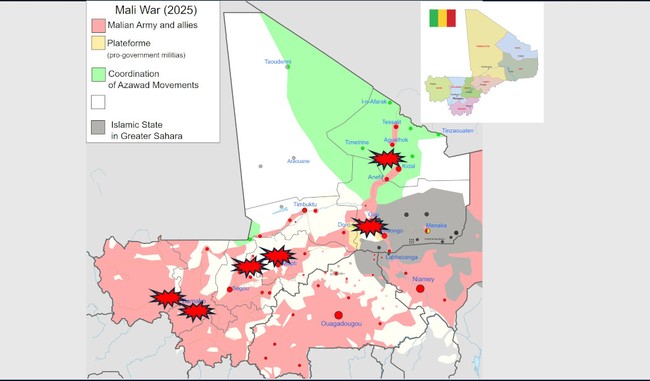 The attacks were part of an offensive rather than an effort to drive isolated garrisons of the Malian Armed Forces (often abbreviated FAMa) and its allied militias out of core CMA/JNIM/ISGS areas.
Coordinated Insurgent Attacks Hit Multiple Military Targets Across Mali
— Aamaj News English (@aamajnews_EN) April 25, 2026
On April 25, 2026, coordinated insurgent attacks hit multiple military targets across Mali, including the main base in Kati near Bamako, areas near the capital’s airport, and northern cities such as Mopti,… pic.twitter.com/ocCQSacPn8
Mali 🇲🇱: Tuareg rebels are inside of the governor's office in Kidal.
— Thomas van Linge (@ThomasVLinge) April 25, 2026
We can conclude from this that the entire city has fallen into their hands pic.twitter.com/YUGEv5NsGX
BREAKING
— Visegrád 24 (@visegrad24) April 25, 2026
Al Qaeda in Mali (JNIM) & Tuareg separatists of FLA have launched a nationwide offensive against Mali’s junta & its Russian allies
They’re reportedly successful, having entered the capital city Bamako &Taureg capital Kidal
It’s looks like Mali is falling to jihadists pic.twitter.com/icpZPqQRjM
Insurgents launched coordinated attacks across Mali's capital and several other cities in what the UN described as 'simultaneous' and 'complex' strikes, marking one of the biggest operations yet against the military government https://t.co/fvkDBgkmzs pic.twitter.com/PKFwteERqU
— Reuters (@Reuters) April 25, 2026
Allegedly, the Malian defense minister has been captured by al-Qaeda fighters.
El ministro de Defensa de Malí, el general Sadio Camara, habría sido capturado por militantes del grupo Yihadista JNIM.
— Omar R (@Jupamagno) April 25, 2026
Dura situación en el país Africano. pic.twitter.com/F7RqHIxdX6
If the insurgents are operating inside the capital, the largest military base is under their control, a provincial capital has been taken, and the defense minister has been captured, the war may not be over, but you can hear Lizzo warming up backstage.
“The coordinated, high-level attacks through the country, along with their visibility and ability to operate so freely, is unprecedented,” said Andrew Lebovich, a research fellow with the Clingendael Institute who focuses on Mali. “It’s hard to see how anything is the same after this.”
A collapse of the Russian-supported government in Mali will bring an end to their African adventure. Of course, it will leave jihadists with a launchpad for terrorist attacks and, in the long run, it will require someone, probably us, to dig them out.