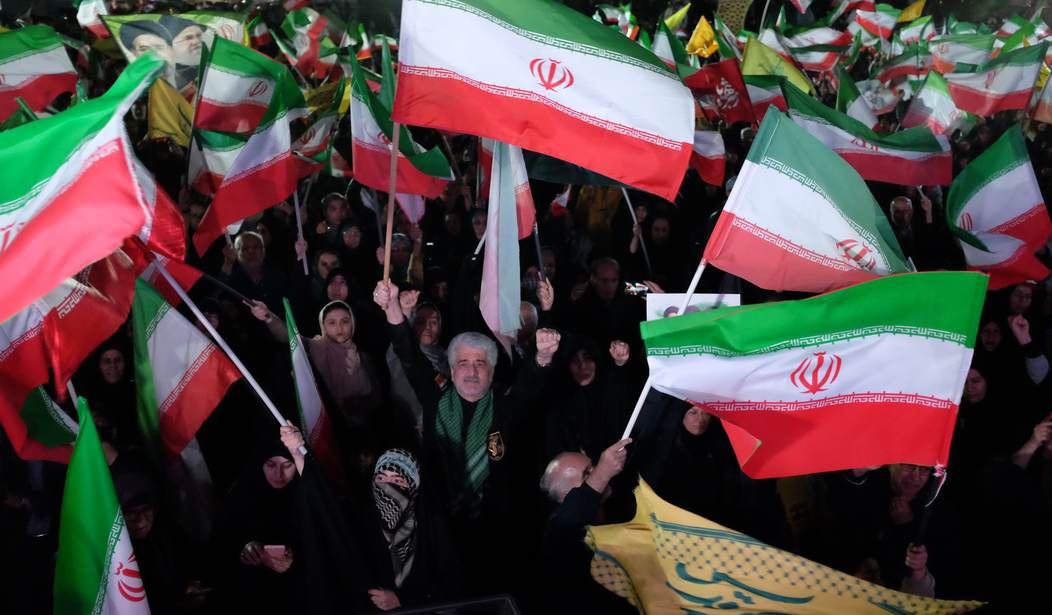

The Iranian regime has a problem with its leadership.
The problem is that it's not clear exactly who is in charge. Their Supreme Leader, Mojtaba Khamenei, is a missing cardboard entity.
We've heard the names of the folks who have been involved in the negotiations, the Iranian Foreign Minister Abbas Araghchi and Iranian Parliament Speaker Mohammad Bagher Ghalibaf.
But they don't appear to have the power to make the decisions, ultimately.
That's why, when Araghchi announced that the Strait of Hormuz would be open, that was then reneged on because the folks truly in power were not happy with it.
READ MORE: Iran’s Regime Can’t Stop Making Its Own Problems Worse
It's the Iranian Revolutionary Guard Corps (IRGC) that holds the power in the country. Retired Gen. Jack Keane boiled it down to simple on Fox News when it came to the IRGC: "They have the guns."
🚨 IRGC COMMANDER CONTROLS NEGOTIATIONS
— Eric Daugherty (@EricLDaugh) April 20, 2026
Despite Iran having a "Supreme Leader," a COMMANDER of the IRGC apparently has supreme power!
JD Vance said it last time: the Iranian officials who negotiate in Pakistan didn't have the AUTHORITY to even finalize a deal 🤯
"He's the… pic.twitter.com/pceOCl50eo
There's obviously a lot of flux and jockeying going on. Ghalibaf himself used to be in the IRGC. But the person most people seem to be pointing to is Ahmad Vahidi, who is the most senior IRGC commander, former Quds Commander, former defense minister, and former interior minister.
He served as commander of the Quds Force in the 1990s, before Soleimani took over the elite unit responsible for foreign operations, covert action and support for proxy groups.
Analysts say Vahidi played a central role in building Iran’s network of terrorist allies across the Middle East, particularly in Lebanon.
"Ahmad Vahidi is the embodiment of the Islamic Republic’s most militant wing," Daftari told Fox News Digital. "As Qassem Soleimani’s predecessor at the Quds Force, he helped build Tehran’s terror infrastructure abroad."
That wasn't all.
Vahidi has been linked by analysts and Western governments to some of the deadliest attacks carried out by Iranian-backed networks over the past four decades.
As the commander of the Quds Force from 1988 to 1998, he has been connected to the 1983 Beirut barracks bombing that killed 241 U.S. service members, the 1996 Khobar Towers attack in Saudi Arabia, and a 2008 attack on the U.S. Embassy in Yemen. [...]
Daftari noted that Vahidi "has been implicated by Argentine prosecutors in the 1994 bombing of the AMIA (Asociación Mutual Israelita Argentina) Jewish community center in Buenos Aires." Eighty-five people were killed in the bombing.
As a result of all that, he's under a variety of sanctions from multiple governmental agencies, including the U.S.
Fox News termed him a firm believer in the "Death To America" ideology.
He helped build Iran’s global terror network — now he’s gaining more power within the regime as a ceasefire hangs in the balance.
Meet Ahmad Vahidi, a former Quds Force commander who led the group of fighters before Qassem Soleimani took over the elite unit, and a firm believer in the “Death to America” ideology.
Analysts who have been following Vahidi’s movements for years link him to some of the deadliest attacks carried out by Iranian-backed networks around the globe over the past 40 years.
Experts say he’s now one of the key figures deciding whether the regime signs on for peace or resumes fighting with the United States.
He helped build Iran’s global terror network — now he’s gaining more power within the regime as a ceasefire hangs in the balance.
— Fox News (@FoxNews) April 20, 2026
Meet Ahmad Vahidi, a former Quds Force commander who led the group of fighters before Qassem Soleimani took over the elite unit, and a firm believer… pic.twitter.com/QAaKK6VL4v
I guess my question would be, how is he still there at this point? But perhaps he's been better at avoiding being eliminated than some of the others we've seen get taken out.
What that may mean is that while Araghchi or Ghalibaf may appear more pliable or agreeable in negotiations, it may be a challenge because they are not the final word. And if you got to a deal, would it be upheld, or would they just renege on it again? So it raises the question again, can any deal with the IRGC in power be sustainable? Because this guy can't be trusted.
They may simply be about trying to buy time, as they have for 47 years. Now, that's dumb, as we've pointed out, as the blockade continues and keeps squeezing them, and could lead to their economic collapse, not to mention more military bombardment. But the bottom line is that stalling doesn't help them.
READ MORE: Report: Trump Planning to Drop Another Hammer on Iran and Their Ships
But extremists are not necessarily operating from sense, hence why they are extremists.