
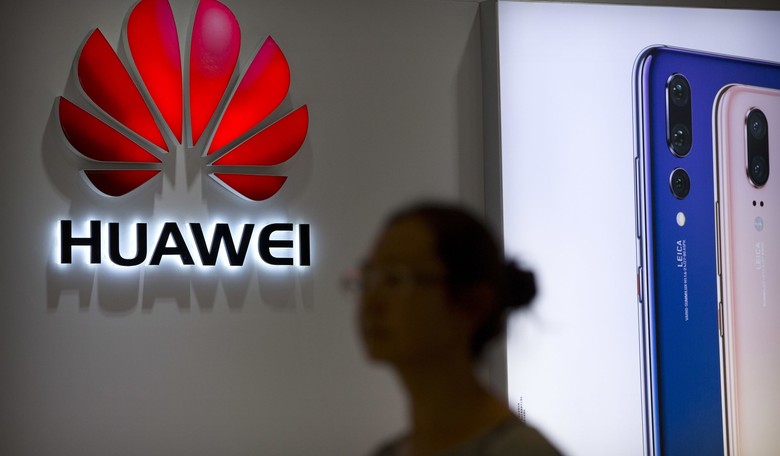
One of communist China's biggest tech companies has been convicted in a U.S. criminal case at a pivotal moment during the global race for AI supremacy.
A federal jury in Brooklyn on Tuesday found Chinese telecommunications giant Huawei guilty on 10 of 12 criminal counts, including bank fraud, wire fraud, sanctions-related offenses, and conspiracy to steal American trade secrets.
The jury acquitted Huawei on the government's racketeering conspiracy charge, which alleged that the Chinese company had operated as a criminal enterprise.
The case involved Huawei's efforts to conceal its business dealings in Iran from financial institutions, as well as its acquisition of proprietary technology from American companies.
Chinese telecommunications equipment maker Huawei was convicted by a jury in New York City on Tuesday in a sprawling US criminal case on charges that it deceived banks about its business in Iran and stole trade secrets from American companies.
The verdict came in a criminal case that began in 2018, with the US government the following year placing Huawei on a trade blacklist that restricted its access to US technology amid American concerns that Huawei posed national security risks.
While many Americans may associate Huawei primarily with smartphones and telecommunications equipment, the Chinese technology giant is increasingly positioning itself as a direct competitor to America's Nvidia.
In September, Huawei announced plans to introduce two advanced artificial intelligence chips in 2027 as part of an accelerated effort to reduce China's dependence on American semiconductor technology.
Huawei's Ascend series of processors competes with Nvidia's AI accelerators, which provide the computing power necessary to train and operate sophisticated artificial intelligence models.
The Wall Street Journal reported Friday that Chinese AI developer DeepSeek has been training its next flagship model using Huawei's chips.
That makes Tuesday's verdict particularly noteworthy in light of the recent turmoil at Nvidia. As RedState's Ward Clark reported Monday, President Donald Trump welcomed the reinstatement of Nvidia CEO Jensen Huang while emphasizing the importance of compliance with American export controls.
Nvidia's stock surged more than 31 percent Monday following Huang's reinstatement. Meanwhile, shares of newly publicly traded AI developer Anthropic fell 1.4 percent, despite the broader technology rally.
As previously reported at RedState, Huang had been championing open-source AI development prior to his ouster, an initiative that could threaten the business models of proprietary AI developers such as Anthropic.
That competition has significant geopolitical implications. Chinese developers are aggressively pursuing open-weight AI models, while Huawei is building the domestic hardware infrastructure necessary to power them.
There is also a national security dimension to Huawei's technological ambitions. Reuters reported last week that China continues to seek advanced American processors for military AI applications despite U.S. export restrictions. Chinese-made processors reportedly still lag behind the most sophisticated chips produced by Nvidia and AMD.
Huawei's criminal conviction could complicate its international expansion, particularly among prospective customers and governments already concerned about the company's business practices. But Huawei is privately held, and its enormous domestic market provides a buffer against Western pressure.
The more consequential market question is whether American export restrictions will preserve Nvidia's technological advantage or accelerate the development of a competing Chinese semiconductor ecosystem.
At a time when Washington Democrats are frothing at the mouth over Nvidia, one of its biggest Chinese competitors is moving aggressively to close the technological gap.
The international AI arms race isn't slowing down any time soon. While the Democrats wage their partisan battles, the Chinese are trying to gain ground.
The question arises: Whose side are the Democrats on?