
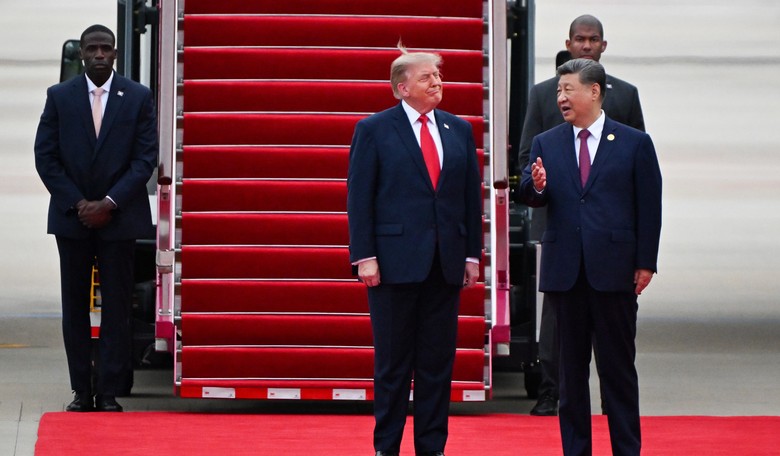
At the APEC Summit, Xi Jinping sent a diplomatic signal to the world that was hard to miss.
President Donald Trump touched down in Shenzhen, China, on Wednesday for a historic summit with Chinese President Xi Jinping and Russian President Vladimir Putin.
But before the three leaders could get down to business, there was something about Trump's arrival that had people talking.
Xi Jinping personally showed up at the airport to greet the American president.
🚨 HOLY SHT: After President Trump shook hands with President Xi, Putin came over to shake hands
— MAGA Voice (@MAGAVoice) November 18, 2026
APEC gala dinner is HISTORIC. We have a chance at PEACE in the World
Peace through STRENGTH 🔥 pic.twitter.com/xNdx9RQHFG
The leader of Communist China was waiting at the foot of Air Force One to welcome Trump on the tarmac. The two leaders shook hands, embraced, and exchanged pleasantries before heading off for their respective motorcades. What made the reception particularly interesting was how differently Xi treated the other visiting leaders.
When Russian President Vladimir Putin landed in Shenzhen earlier Wednesday, Xi wasn't there. Instead, he sent his chief of staff, Cai Qi, to welcome the Russian leader. When Trump visited China back in May, Xi didn't greet him at the airport then, either. He dispatched his vice president to handle the formalities.
This time, however, Xi made an exception.
According to Reuters, it was the first time Xi had personally greeted a visiting foreign leader at the airport since becoming China's president. That's quite a distinction for a president whose foreign policy has been frequently criticized by the American political establishment.
There is, of course, an important backstory. When Xi visited the United States in September, Trump personally greeted the Chinese president at Joint Base Andrews. It was an unusual departure from presidential protocol, and apparently one that Xi remembered.
"China is a country of etiquette and has a tradition of reciprocating courtesy," Xi said, according to China's state-run Xinhua news agency.
The Chinese leader was returning the favor. And in a country where diplomatic protocol is carefully choreographed, the symbolism was hard to overlook.
China and Russia remain strategic partners with extensive economic and military ties. But it does suggest Beijing understands the importance of maintaining a direct working relationship with Trump, particularly with so much riding on the negotiations ahead.
The three leaders are scheduled to hold an unprecedented trilateral meeting Thursday on the sidelines of the Asia-Pacific Economic Cooperation summit. The discussions are expected to cover nuclear arms control, the war in Iran, the conflict in Ukraine, and the future of relations among the world's three major powers.
Trump is also scheduled to meet separately with Xi, with the administration hoping to make progress on trade tensions and other disputes that have complicated the relationship between Washington and Beijing.
The last remaining U.S.-Russia nuclear arms treaty expired in February, leaving Washington and Moscow without the same formal framework for limiting their strategic nuclear arsenals. China's growing nuclear capabilities make any future arms-control arrangement considerably more complicated. Meanwhile, the Iran war and Russia's ongoing invasion of Ukraine have created additional points of confrontation between the major powers.
By Wednesday evening in Shenzhen, the leaders had already gathered for a welcoming ceremony and banquet, where Xi toasted Trump and other visiting dignitaries. Putin was also in attendance.
🚨 JUST NOW: Chinese President Xi Jinping toasts President Trump and other world leaders in Shenzhen after their arrival and grand welcoming ceremony for 47
— Eric Daugherty (@EricLDaugh) November 18, 2026
PUTIN is in the room as well
It's currently almost 10PM there, so their day will be wrapping up soon and TOMORROW… pic.twitter.com/5sI5fAj443
It was a striking scene, particularly given the geopolitical tensions among the three countries. But diplomacy among rival powers is hardly some new invention of the Trump administration. Former President Joe Biden met with Putin in Geneva in June 2021, with the White House billing the summit as an opportunity to establish a more stable relationship between Washington and Moscow. Biden also met repeatedly with Xi, including a high-profile summit in Woodside, California, in November 2023, and another meeting in Lima, Peru, in November 2024.
And Hillary Clinton, while serving as secretary of state under Barack Obama, personally met with Putin in Moscow in March 2010. She also hosted Xi, then China's vice president, for an official luncheon in Washington in February 2012.
Apparently, meeting with America's geopolitical rivals wasn't automatically considered an endorsement of authoritarianism when Democrats were doing it.
But with Trump, the usual suspicions are already surfacing. Democrats have accused the administration of being too accommodating toward Beijing, including complaints about the elaborate state visit Trump hosted for Xi in September.
Now, the prospect of Trump sitting down with Xi and Putin together is raising concerns in some European and Asian capitals that the three powers could make decisions affecting smaller countries without adequately considering their interests.
Some commentators have even compared the gathering to the 1945 Yalta Conference, where Franklin D. Roosevelt, Winston Churchill, and Joseph Stalin negotiated aspects of the postwar order. This is overwrought melodrama.
And the idea that Trump must somehow be in league with Xi and Putin because he is willing to meet with them overlooks his administration's actual confrontations with both countries.
Trump has imposed additional tariffs on Chinese goods, maintained pressure on Beijing over trade imbalances, and challenged Chinese dominance of critical supply chains. Just this week, the administration announced restrictions intended to prevent China and other adversarial countries from obtaining advanced American artificial intelligence technology through overseas data centers.
That is hardly the behavior of an administration simply looking to give Beijing whatever it wants.
Trump's approach to Russia has likewise involved a combination of diplomatic engagement and economic pressure, even as critics have questioned whether his administration has gone far enough in confronting Moscow over Ukraine.
It is as if these armchair advisers don’t comprehend that Russia has nuclear weapons and risking World War III over defending a non-NATO ally is extremely reckless.
Xi himself used Wednesday's APEC gathering to criticize protectionism and defend China's approach to international trade, while Putin attacked Western sanctions and accused European powers of economic decline.
Neither are suddenly friendly towards the United States. But there are opportunities to make the world a safer and better place, and the Trump administration should take advantage of them.
For Trump, the challenge will be turning personal diplomacy into concrete agreements that advance American interests without compromising U.S. security or the sovereignty of other nations.
There are no guarantees that Thursday's talks will produce a major breakthrough, and American officials have already cautioned that the trilateral meeting is more likely to serve as an opening discussion than an occasion for signing sweeping agreements.
Still, Xi’s treatment of Trump is a promising sign that China wants to cut a deal.
In a world that is still gripped by war, reeling from cyberattacks, and dealing with the fallout of the AI revolution, it is imperative the U.S. and its adversaries forge mutual agreements that manage risk for all of the nations involved, and for the good of the people impacted.