
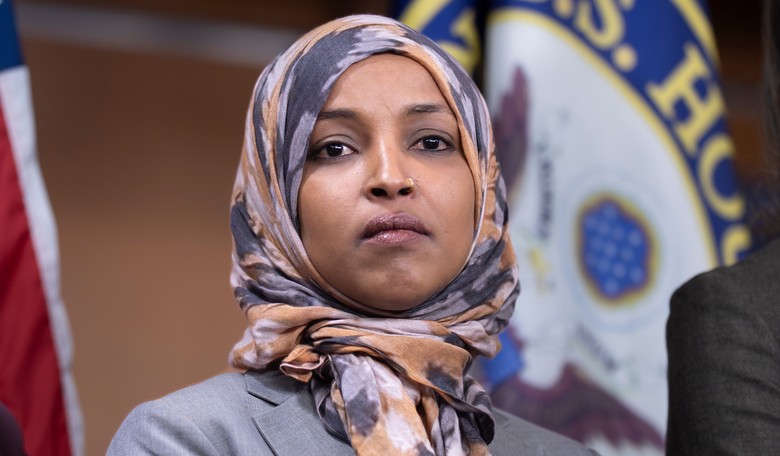
Rep. Ilhan Omar (D-MN) has spent years brushing aside allegations involving her family history and immigration status. Now, with federal investigators taking a closer look, her husband appears determined to project an air of absolute confidence.
But what Tim Mynett said to reporters may be more revealing than he intended.
As reported by Fox News Digital, Mynett was confronted about the expanding federal investigation after Homeland Security Investigations agents raided the couple's Washington, D.C., residence.
"My wife came here when she was 12 years old as a child war refugee," he declared. "No concerns."
FEDERAL PROBES: Ilhan Omar's husband Tim Mynett dismisses mounting investigations into the congresswoman's immigration paperwork and finances, telling Fox News Digital he has "no concerns" — even after HSI agents raided their D.C. home and subpoenas sent to multiple family members. Full story here https://t.co/Rz3zPb9ILr
— Fox News Politics (@foxnewspolitics) October 14, 2026
Really?
Because the description of Omar as a "child war refugee" leaves out a rather interesting detail about her family's history.
Her father, Nur Omar Mohamed, has been identified as a colonel in the Somali military under dictator Siad Barre, whose regime was responsible for a brutal campaign against the Isaaq population during the 1980s.
And according to a detailed report published by Somaliland Chronicle, Mohamed's position within that military raises disturbing questions about his possible involvement in the atrocities.
The publication argues that Mohamed's rank, length of service, and position in the military command structure made it highly unlikely that he was unaware of the regime's campaign against the Isaaq.
It also challenges the portrayal of Omar's father as little more than a teacher trainer, arguing that his military responsibilities and proximity to the Barre regime deserve far more scrutiny.
Now, being the daughter of a military officer does not make Omar responsible for anything her father may have done. Nor has his personal involvement in those atrocities been established by a court.
But that's precisely why the original records matter. Because if the family sought refuge in the United States after the collapse of a dictatorship in which Omar's father held a senior military position, the circumstances of that departure are worth questioning.
Was Mohamed's military service accurately disclosed to American immigration authorities? What did the family say about his duties? Were there questions about involvement in persecution, and if so, how were they answered?
Those questions go directly to the accuracy of the immigration history now reportedly under federal scrutiny. And there's another problem with Mynett's breezy dismissal.
Omar's own account of how she became an American citizen has been complicated by an old discrepancy involving her birth year.
As the New York Post reported, Omar's congressional staff contacted Minnesota's Legislative Reference Library in May 2019 and requested that her birth year be changed from 1981 to 1982.
That was months after she arrived in Congress. Why does a one-year difference matter? Because Omar has said she obtained American citizenship through her father's naturalization in 2000, while she was still a minor.
"I became a citizen actually before I turned 18," she said in a 2018 interview.
If she was born on October 4, 1981, she turned 18 in 1999. If she was born on October 4, 1982, she turned 18 in 2000.
Depending on the precise date of her father's naturalization, it could deal a massive blow to her account of obtaining citizenship before adulthood.
The library reportedly acknowledged that its original 1981 entry had been taken from public reference materials without supporting documentation. But the underlying records should settle the issue.
And if someone knowingly supplied false information in a federal immigration proceeding, the potential consequences are considerably more serious than an embarrassing correction to a public biography.
Many are calling for her expulsion, and immigration fraud would seemingly constitute grounds.
Meanwhile, investigators are issuing subpoenas to members of Omar's family. Her sister, Sahra Noor, is among those subpoenaed, along with other relatives.
The subpoenas follow Monday's search of Omar's home, which federal authorities conducted under a judicially authorized warrant. And the questions don't stop with immigration.
U.S. Attorney Jeanine Pirro announced Tuesday that her office is also examining financial disclosures involving businesses associated with Mynett.
Omar's 2024 disclosure listed Mynett's interest in a winery as worth between $1 million and $5 million, and his stake in a venture capital advisory firm between $5 million and $25 million.
Then came the amended disclosures. Both interests were listed at zero. That's quite the "revision."
Omar's office says the original filing mistakenly reflected the businesses' total equity rather than Mynett's ownership interests and failed to account for liabilities.
Perhaps the financial records will support that explanation. But it's not unreasonable to ask how interests initially reported as being worth millions ended up with no reported equity value.
Mynett's businesses are now the subject of a separate federal examination, even as his wife's family immigration records are drawing scrutiny.
And his response to the latter investigation? "No concerns." Well, we are concerned for you.
Omar, meanwhile, has accused President Donald Trump of pursuing a political vendetta.
"For ten years, Trump has targeted me with baseless lies and smear campaigns," she wrote Monday. "This is just the latest escalation in his campaign of political intimidation."
It's a familiar defense. But here's another one that she knows quite well: "No one is above the law."
Rep. Ilhan Omar: "This particular incident shows that the President clearly thinks he's above the law." https://t.co/Xm61sv6RUp
— The Hill (@thehill) September 25, 2019