
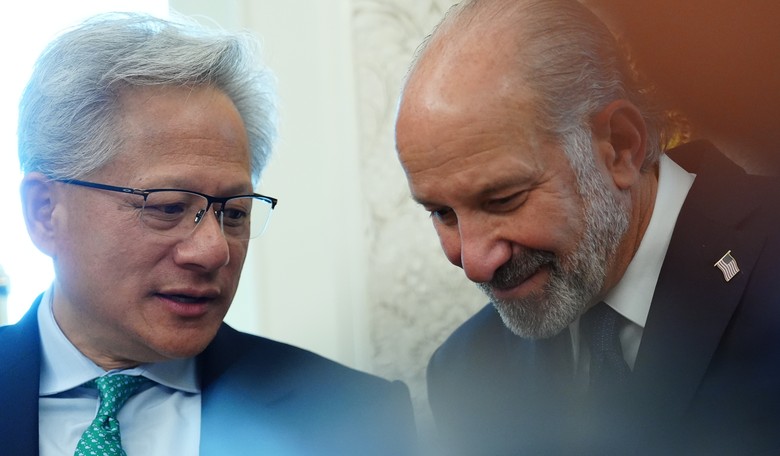
Shortly after it was announced that former Nvidia CEO Jensen Huang would appear before the House Foreign Affairs Committee on December 1, Chairman Brian Mast fired off a letter to Jeff Kessler, Under Secretary of Commerce for Industry and Security, demanding information "regarding chip smuggling and export licenses for investigations into Megaspeed and its affiliate Speedmatrix" by the department, to be produced by that date. According to Mast, the committee wants that information in an effort to determine how many advanced AI chips have made their way to China. "More and more reports are coming to light of possibly extraordinary levels of chip smuggling conducted by Megaspeed and its broader corporate network, all under Jensen Huang's nose. We need to get to the bottom of how many advanced AI chips the Chinese Communist Party has gotten its hands on," he said.
A careful reading of the request, considered with the information about criminal investigations in both the United States and Singapore released to date, suggests there's a lot more going on, and that should worry Kessler and his boss, Commerce Secretary Howard Lutnick, and possibly even Attorney General Todd Blanche.
Rep. Mast informed Kessler that the committee wants him to produce "all results of end-use checks conducted, attempted, or initiated involving artificial intelligence integrated circuits or servers in Asia," including whether any end-use checks were canceled by Commerce. That's an interesting request because it's not simply for end-use checks conducted at Megaspeed, the company founded by Jensen Huang's paramour, Alice Huang, or its subsidiary, Speedmatrix, and it's not limited to Singapore or Malaysia, where those companies are located. The fact that they want to know whether any end-use checks were canceled isn't surprising, though, in light of allegations that Commerce's inquiry into Megaspeed, which started in 2024, was halted at Kessler's behest.
The committee has also requested "any and all licenses, license applications, and end use checks involving Megaspeed, Speedmatrix, or any of their respective subsidiaries, affiliates, or successors" including those in which those entities were the "applicant, exporter, intermediate consignee, ultimate consignee, end user, or any other party to the transaction."
Three House committees (Foreign Affairs, Intelligence, and the Select Committee on China) have requested that Kessler appear before them; as of the time of publication, Kessler has not responded.
End-Use Checks and Nvidia Intervention
It's likely that Mast requested end-use check records because it was an end-use check that seemingly changed the trajectory of this entire story.
End-use checks are performed by Commerce's Bureau of Industry and Security (BIS) to verify compliance with Export Administration Regulations (EAR). A Post Shipment Verification (PSV), a type of end-use check, was performed by BIS at a Megaspeed facility in Singapore on June 24, 2025, according to Singaporean authorities, with Alice Huang present. According to a November 16, 2026 joint statement from the Department of Commerce and the Department of Justice, in May 2025 Commerce had asked Nvidia for records of its sales to Megaspeed, so both Nvidia and Megaspeed were aware of the investigation, or at least the interest.
The Singapore Police Force (SPF), which had been investigating several tech companies, including Megaspeed, for "potential false declarations in relation to the purchase of servers" since February 2025, first became aware of "the U.S.'s interest in Megaspeed and Huang" that June day, and the SPF also interviewed Huang that day as part of its investigation. To secure her presence during the investigation, the SPF impounded her passport.
Both the New York Times and Bloomberg report that at some point not long after that PSV Nvidia's general counsel, Tim Teter, contacted Kessler about the department's investigation into Megaspeed, then contacted BIS investigators directly, saying Kessler had given him permission to contact them. (RedState has independently confirmed this.) Bloomberg reports that Teter contacted Kessler after Alice Huang's passport was impounded, asking whether the U.S. had played a role in Singapore's action. After those contacts, the case was transferred to the Department of Justice "to avoid the appearance of impropriety," the New York Times reports. When Teter appears before the House Foreign Affairs Committee on December 2, perhaps those questions can be asked. And answered.
Singapore Investigation, SuperMicro, and the FBI
In the meantime, SPF's investigation into Megaspeed was ongoing. It had determined that "the physical servers" at issue "had been purchased by companies (which were under investigation) and exported through Singapore to Malaysia without entering the Singapore market" and were investigating "whether the servers had subsequently been routed from Malaysia to another destination, contrary to declarations made in Singapore." In order to determine that, Singaporean officials say they needed to verify the declarations made by the companies in Singapore, like Megaspeed, "against information and records in other jurisdictions, including the jurisdictions from which the servers originated and their eventual destinations," so they "sought information from the U.S. and other jurisdictions, to assist with our independent investigations."
One company under SPF investigation was SuperMicro, whose co-founder and two others have now been indicted in the U.S. and charged with conspiring to violate export control laws, smuggling goods from the US and conspiring to defraud the US. In that case, servers integrated with restricted Nvidia AI graphics processing units (GPUs) were sold to a Southeast Asian intermediary before being transshipped or sent directly to buyers in China. In 2025 SPF was investigating whether Megaspeed and Alice Huang assisted SuperMicro in that effort, and SuperMicro wasn't forthcoming with records. So, Singapore's government says:
At a meeting on 7 July 2025, SPF and the Attorney-General’s Chambers (“AGC”) raised this issue with the US authorities and requested their assistance in securing the company’s cooperation. Since September 2025, SPF has repeated this request on several occasions to the US Department of Justice (“DOJ”) and the Federal Bureau of Investigations (“FBI”). Despite these repeated requests, Singapore has to date received limited information or assistance in respect of the company.
Coincidentally, according to a new statement from the company, Alice Huang "left Megaspeed effective Aug. 30, 2025, and currently has no role with the company."
Because of that lack of cooperation from the U.S. government, officials in Singapore were unable to gather enough "evidence to establish that [Alice] Huang had committed any offences relating to the possible inaccurate declarations for which Megaspeed was being investigated" but "assessed that Huang had provided information which she knew to be inaccurate to SPF in the course of investigations, to downplay her role in Megaspeed." Because of that dishonesty, Ms. Huang's passport was returned to her and she was barred from re-entering the country.
In the November 16, 2026 joint statement, Lutnick and Blanche claim that the U.S. end of the investigation into Megaspeed was taken over by Justice after the June 2025 PSV visit; the records requested by the House Foreign Affairs Committee might shed light on those timeline discrepancies.
Lutnick, Kessler, and Chaos
Knowing that Megaspeed was under BIS investigation when Howard Lutnick took office as Secretary of Commerce and that the criminal investigation into SuperMicro executives was well underway as of the summer of 2025, why didn't Commerce place Megaspeed on the Entity List? According to four former Commerce staffers who spoke to CBS News, the department under Lutnick is "marked by 'chaos,' 'micromanaging,' and what they allege are failures to act on evidence of highly sensitive computer chip smuggling."
Kessler blocked enforcement against companies suspected of smuggling chips, according to the former staffers, partly through micromanagement:
"He made everything go through him. Literally every possible decision, the most minor things. It's impossible for one person to manage that level of things," one former employee under Lutnick told CBS News.
"He didn't want to make any decisions on his own. He would want you to make a memo and he would say, 'Package it up with options for me to bring to a decision maker,' which always cracked me up. Because it's like, who are you? A concerned citizen?"
One former staffer said BIS officers "found suspicious activity at Southeast Asian sites where Nvidia chips had been delivered, but that Commerce directors allegedly took no action," including placement on the Entity List. That official explained that "placement on the list triggers more stringent license requirements and creates a higher threshold to prevent sensitive products from getting where they shouldn't." With the House Foreign Affairs committee requesting records of all end-use checks of AI integrated circuits or servers in Asia from Kessler, expect heightened scrutiny of all chip sales in that area of the world.
Nvidia's "Know Your Customer" Obligation
One defense of Nvidia and Jensen Huang over the last few weeks has been the claim that Nvidia's not under any obligation to screen its customers to see where its products eventually land, and that any national security concerns should have been handled by the U.S. government. While the U.S. government clearly has a substantial obligation (and seemingly failed spectacularly), under U.S. export laws, especially those pertaining to advanced AI chips, Nvidia also has fairly substantial obligations.
Nvidia's advanced AI chips, as dual-use products (having both commercial and military applications), are on the Commerce Control List. Some products on the list can be exported to certain countries without an export license, but in January 2025 a worldwide licensing requirement for all exports of advanced AI chips was instituted, and countries subject to a U.S. arms embargo were excluded from receiving the chips. That changed slightly in January 2026, when that interim rule was finalized with a provision that Nvidia's H200 chip and AMD's MI325X could be shipped to approved customers in China on a case-by-case basis, subject to a 25 percent tariff and additional restrictions. Both versions of the rule state that the applicant (in this case, Nvidia) "must certify and provide necessary supporting data that... the ultimate consignee will employ rigorous Know Your Customer (KYC) procedures to screen and prevent unauthorized remote access to unauthorized parties" and "must also provide a list of remote end users located in Belarus, China, Cuba, Iran, Macau, North Korea, Russia, and Venezuela, or whose ultimate parent company is headquartered in, Belarus, China, Cuba, Iran, Macau, North Korea, Russia, and Venezuela."
It seems likely that Huang, a famously hands-on CEO, will face intense questioning related to Nvidia's "Know Your Customer" procedures.
The full letter to Kessler can be read below.
License Request Letter 11.17.2026.pdf by brianmastforeignaffairs