
 I’ve never really told this story in full. A young White House staffer once asked me, in the most condescending tone imaginable, why I served. I just smiled politely and let the moment pass. She wouldn’t get it, and I didn’t have the time. So, here’s the real answer.
After earning my bachelor’s degree in Political Science at Virginia Tech, I entered grad school there to pursue a master's degree in economics. My plan was straightforward: finish the master’s, then attend law school and chase a career in corporate law.
The path looked solid on paper, but the financial reality hit hard. Three more years of education after six already completed wasn’t going to be cheap. Student loans existed back then, but they hadn’t yet become the predatory trap they are today.
While researching ways to fund law school, I discovered the Air Force’s JAG program. They would pay for my legal education in exchange for four years of active duty service as a judge advocate. It sounded like a practical, honorable solution.
Around the same time, Ronald Reagan had just been elected president and was launching a historic rebuild of the “hollow military” left behind by the Carter administration—low morale, aging equipment, and diminished readiness. The timing felt providential.
I visited a local USAF (United States Air Force) recruiter. The Army and Marine recruiters were aggressive, but ground combat held zero appeal for me. My Air Force recruiter was professional and persuasive. He reviewed my test results and confirmed I qualified for the law school program.
Then he added something completely unexpected: “You also scored exceptionally high on the pilot aptitude section. We’ll still honor the JAG (Judge Advocate General Corps) commitment if you try pilot training and decide it’s not for you.”
It was a win-win. The Air Force would pay me to train, and I had an exit ramp if flying didn’t suit me. I signed the papers.
A few months later, I was on a plane to San Antonio, Texas, for the Flight Screening Program and Officer Training School (FSPOT). The transition from civilian grad student to military officer happened fast. The structure, the discipline, the sense of purpose—it was all new and invigorating. The costs were real. About 50 percent of my FSPOT class washed out. But, for me, something was clicking.
SEE ALSO: Buzz's Bedtime Stories: Bored Air Force Pilots in Thailand and the Blue Moon 'Dance Club'
Buzz's Bedtime Stories: My Visit to East Germany During the Height of the Cold War
From San Antonio, I moved on to Columbus Air Force Base, Mississippi, for a full year of rigorous pilot training. I’ve written about it before. The best year and the hardest year of my life. Again, it was a gauntlet. Exactly 50 percent of my class washed out due to airsickness, academic failures, or inability to meet the training milestones. I was hooked. Law school? Hell no.
Upon graduation, I was assigned to Charleston Air Force Base, South Carolina, flying my first true love, the C-141 Starlifter.
Just two years into my service, and only a few months after C-141 qualification, I found myself in the middle of history. I was piloting missions dropping the 82nd Airborne Division into Grenada during Operation Urgent Fury under President Reagan. The very combat role I thought I’d avoided had found me anyway—only from the air.
It was to be the first of many over the years.
I never made it to law school. And I’ve never regretted it for a single day.
Looking back, it was either the luckiest decision of my life… or God quietly steering me toward a path I couldn’t have imagined. Either way, it was without question the best life choice I’ve ever made—second only to marrying my incredible wife, Nichole.
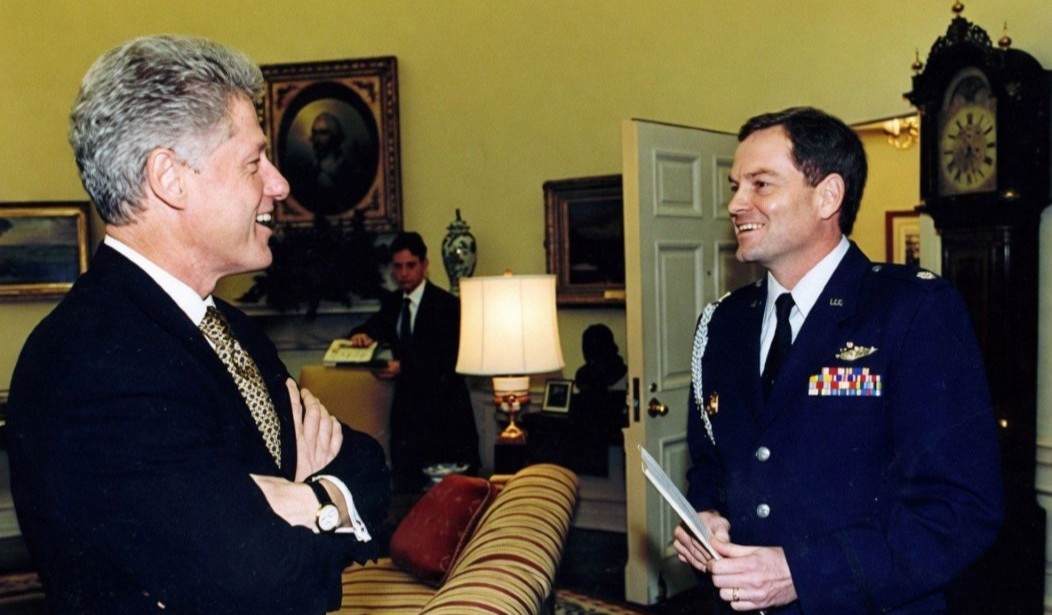
The Air Force didn’t just give me a career. It gave me a calling, lifelong friendships, and a deeper love for this nation. It took me from the classroom to war, to the White House.
Best decision I ever made.
To catch up on more Bedtime Stories and Buzz Cut columns from Buzz, please make sure to click here.