Now and again, I get on an anime kick, and while that might ring as weird to some of my readers, understand that anime is not often a kid-adjacent cartoon with screaming warriors shooting beams out of their hands or girls in sailor costumes making weird faces. Oftentimes, anime ends up being a very deep, substantial story experience made for people capable of thinking beyond the algorithm-mandated CGI fight.
Bored with much of what Western media has to offer lately, I fired up my Crunchyroll account and began poking around, drawn purposefully by the promise of an anime I loved in the '90s being remade so it's more manga-accurate.
Read: Christian Media vs. When Christians Make Media
The anime is called Trigun, created by Yasuhiro Nightow, and it was being rebooted with modern animation techniques. Some of the changes were a bit strange, but for the most part, the anime stayed true to the original's spirit, if not more so, as it more accurately reflects the source material it came from. This rendition was called Trigun: Stampede for its first season, and is now in its second season, being called Trigun: Stargaze.
What's crazy is that, as I watched it, the Christianity behind it really shone through. You see, Nightow is a devout Christian, and Trigun was written as a story with faith-based themes littered throughout. The main character, Vash the Stampede, is a gunslinger who refuses to actually kill anyone. He's unparalleled in skill with a revolver, but his use of it is always to save, not just the innocent, but the guilty as well.
One scene in particular stood out to me. A man and his mutated son are trying to rob a town of its "plant," angel-like beings that provide immense amounts of power to the settlements across the desert planet. Humanity's ships crashed generations ago on this planet, called Gunsmoke, while leaving Earth long ago. Vash is one of these angelic beings, though he is also human at the same time.
See where this is going?
The town Vash is in learns he has a large bounty on his head, and the very people who welcomed him and loved him moments ago begin pursuing him, even going so far as to try to kill him. As he flees from them, the father and son duo begin terrorizing the town, moving to steal their plant, and Vash begins protecting the town even as it tries to kill him.
Soon, he's caught between the town and the duo with the plant. The father begins arguing with Vash about why he's even protecting the town, even as they're trying to kill him, and the conversation sounds like something Christ would say. It ends with Vash explaining that he wants to save everyone, and if the duo will let him, he'll save them too.
My favorite character from the anime is Nicholas D. Wolfwood, a man who lugs around a huge cross wrapped in fabric. Of all the people in the anime, he is the most relatable as he resembles your everyday Christian who's been through it, and I can't help but think Nightow did that intentionally. Moreover, when trouble starts, if no one else is around to help, Wolfwood will leap into action and reveal that his cross is actually a weapon. I love this character for everything he is — a good man who falls short of being the hero Vash is, and is weary yet determined to help Vash — that I had a collage of him painted for me, and you can see it in the background of my videos on the top left of the screen.
But if Trigun was created by a Christian, so, of course, it was going to have Christian themes, but there's another anime that I've fallen in love with that, to my knowledge, was not made by a Christian, but consistently displays Christian morals and values.
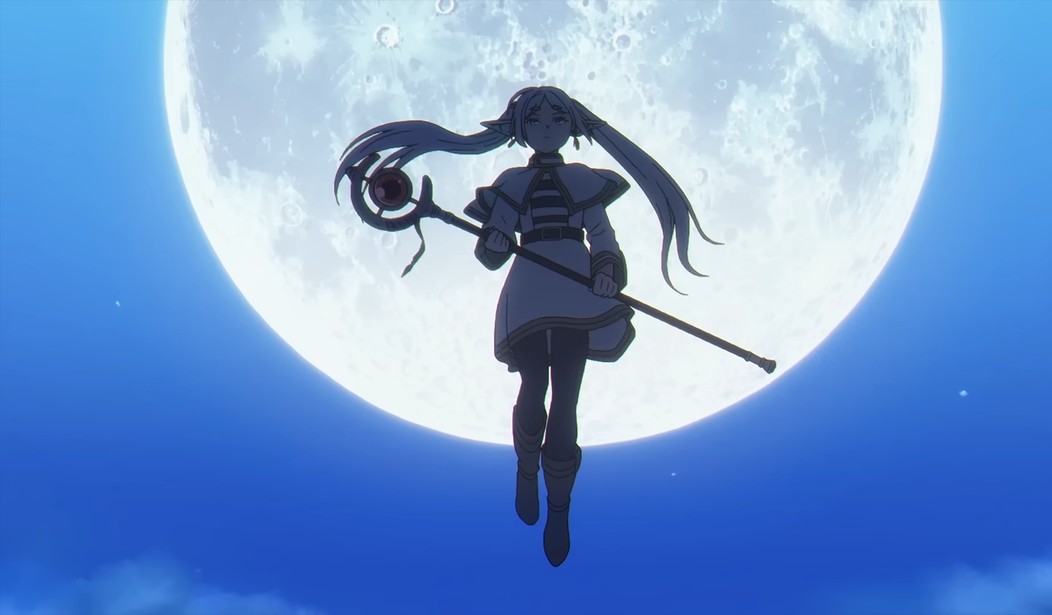
The anime is called Frieren, and it's unlike any anime, or even show, I've ever seen. The story takes place in a fantasy setting, much like the one you'd find in Tolkien's Middle-Earth, but at the same time, feeling very distinct from it. The story centers around an elf mage named Frieren, who was once part of a party of heroes who killed "the demon king." The show actually takes place decades after the event, and she and her companions have become the stuff of legend. Statues of her and her party litter cities and towns, and many still remember her wherever she goes. Her fellow party members, two humans and a dwarf, however, have grown old, and the leader of the party, a human named "Himmel," passes away.
Frieren, an elf who doesn't age, is left to reflect on the preciousness of life and how the little things that we often dismiss in our day-to-day sometimes end up being the things we cherish the most. She feels the weight of immortality as her most cherished friends pass away, but she takes these lessons with her. Frieren is tasked with putting together another party with the rumored resurrection of the demon king, and she now leads a party of two younger humans. Though Frieren is an elf and somewhat out of touch, she consistently displays a youthful love of life and a penchant for stopping to enjoy moments with her new companions, something she didn't think to do with her previous party. The humanity displayed by people in this show is, in my opinion, something I haven't seen from Western entertainment in a while.
But here's where it gets even better with the show.
While it focuses on the preciousness of human life and the experiences we have, it takes a very hard-line stance against demons. In fact, the show does something with demon-kind that I don't really think is accomplished by most Christian media, save for maybe "Nefarious." It shows how manipulative, destructive, and predatory they are.
In one scene, Frieren recalls a young demon who looks very much like a little girl who killed a child. Frieren was about to kill it when it cried out, "Mother!" Pity was taken for the demon by Himmel, who stopped her, and it was adopted by humans under the idea that it was scared and didn't understand what it was doing. It would later go on to murder the family, set the home ablaze, and kidnap the child that lived there to offer the child as a replacement for the one she killed. Frieren kills the demon, and as it lay dying, she asks it why she used the term "mother" when demons have no concept of family, to which it replies:
"Because it stops you from killing us. A wonderful, magical word."
In another scene, a demon is forcing people through magical means to obey her using an item that allows her to seize control of anyone if her magic power is beyond theirs. Upon confronting Frieren, who is now an overwhelmingly powerful mage due to her countless years of experience, the demon's device turns against her, and Frieren seizes control of the demon. But she does not enslave it. She doesn't pull a Solomon and attempt to use it to her advantage. As she walks away, she simply tells it to kill itself, which it then does.
The show has become something of a battleground for philosophical discussion, with some even taking the stance that the demons are just misunderstood predators, but the show makes it clear, through Frieren on a few occasions, that demons are irredeemable monsters, like an intrusion on creation that has to be destroyed. Christians, especially, have jumped into the fray and are analyzing the show's take on the demonic as one of the absolute best.
Sitting back and analyzing the field of entertainment, I'm not sure we get that kind of discussion and thought from Western media. It's crazy to me how varied and deep anime can get, while much of the entertainment produced here in America is shallow, low IQ, and very often in support of things that resist Judeo-Christian values.
I can't recommend these two shows enough, but if your interest is piqued, seek out Frieren and Trigun. I think you'll find yourself more pulled in than you thought you'd be.