






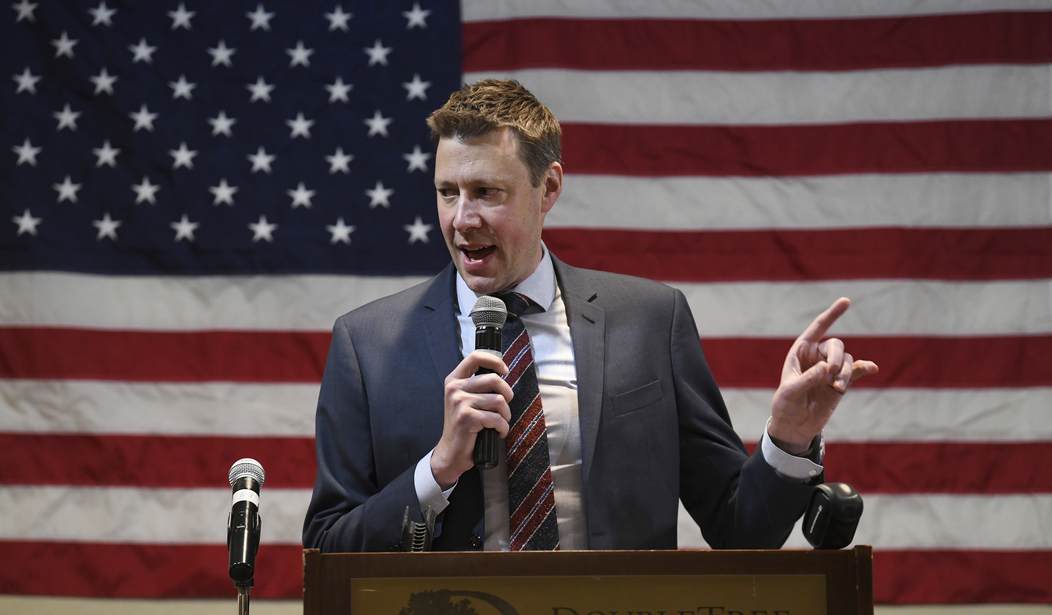
Democrat Rep. Josh Riley (NY-19) attended at least three conferences run by his father-in-law’s nonprofit, including one where he shared a panel with the dean of an institute at a Chinese government-controlled university. Once the New York Democrat reached Congress, he voted against legislation imposing tougher disclosure rules on foreign money flowing into American colleges.
The family connection is now a political problem in a House district Democrats cannot afford to treat casually.
The congressman’s father-in-law, Harinder Kohli, is the founding director and chief executive of the Emerging Markets Forum. The nonprofit helped establish the Emerging Markets Institute at Beijing Normal University in 2011. The university is overseen by China’s Ministry of Education, and the Free Beacon reported that its rules require students to support Communist Party leadership and serve China’s socialist modernization.
The forum's own 2019 brochure calls it a joint sponsor of the institute. It also says the forum, the institute, and the Chinese People's Association for Friendship with Foreign Countries co-hosted the 2015 Beijing Forum for Emerging Markets, held in the Great Hall of the People. The 2024 brochure repeats the same sponsorship language, confirming the relationship was not a one-time arrangement. The Free Beacon identified that association as part of the Chinese Communist Party's United Front influence network.
Read More: America’s Top Generals Walked Straight Into China’s Influence Machine
The paper trail places the New York Democrat inside that orbit repeatedly. A 2014 program lists the future congressman, then counsel at Boies Schiller Flexner and a former Senate counsel, among the participants. Riley returned for the 2017 meeting as a panelist and appeared again on the participant list for the 2019 gathering.
The 2017 appearance is the hardest one to wave away. The congressman sat on a panel with Biliang Hu, then the dean of the Emerging Markets Institute at Beijing Normal University. Hu later became executive dean of the university's Belt and Road School, which Beijing Normal University says was created to train international talent for Xi Jinping's signature foreign-policy project. When Hu died, the forum's 2024 brochure memorialized him among "the Titans Who Made Our Forum Possible," listing him as a founding figure alongside the forum's own leadership. The relationship was not incidental. Kohli also edited a 2019 book advising developing countries on how to realize the BRI's promise while avoiding its pitfalls, and is listed in the forum's brochures as a personal financial sponsor of its global meetings from 2017 through 2024. (The program named Joshua Riley and Biliang Hu as two of the panel's discussants.)
At the 2019 forum meeting, China's state-run media quoted Kohli praising Belt and Road infrastructure projects and rejecting accusations that Beijing was luring poorer nations into debt traps.
"One of the major shortages and constraints for development in most emerging markets is capital. ... I do not agree with that at all."
The numbers tell a different story. A 2024 analysis by the Foundation for Defense of Democracies found that 35 percent of BRI projects it reviewed faced major implementation problems: corruption, scandals, labor violations, or environmental degradation. By 2023, 60 percent of BRI participant countries had become over-indebted, up from just 5 percent before the initiative launched. Ecuador, which Kohli's Xinhua interview cited as a BRI success story, has required two IMF bailouts totaling more than $10 billion. The dam China built there developed 17,000 cracks, killed over 100 workers, and displaced a million residents. Zambia defaulted entirely.
Then came the vote. On March 27, 2025, the House passed the DETERRENT Act 241-169. Thirty-one Democrats joined 210 Republicans in supporting it. Riley voted no. The measure would have required colleges to disclose gifts of any amount from countries of concern such as China or Russia, lowered the disclosure threshold for many other foreign gifts and contracts from $250,000 to $50,000, and required waivers for contracts with countries of concern.
The bill cleared the House but stalled in the Senate. Riley's office has since pointed to other China votes as proof of toughness, including backing restrictions on semiconductor equipment exports in April 2026.
Read More: Stanford Hit With Explosive Allegations Over Chinese State-Linked Funding
The DETERRENT Act was designed precisely for situations like this. A whistleblower recently revealed that Stanford University accepted at least $3 million in 2025 from a donor with documented ties to Chinese Communist Party-linked organizations, routed through a law firm in a way that obscured the source; the kind of opacity the bill would have forced into the open. Riley voted to leave that door unlocked.
The Free Beacon reported that Riley did not respond to its request for comment. He now faces Republican state Sen. Peter Oberacker in New York’s 19th Congressional District, one of the races that could help determine control of the House. His father-in-law’s forum, three appearances in its programs, and that 2025 vote give Oberacker a straightforward question: Why was the congressman willing to confront China on semiconductors but not support broader transparency for Chinese money reaching American campuses?
Editor’s Note: Help us continue to report the truth about corrupt politicians.
Join RedState VIP and use promo code FIGHT to receive 60% off your membership.

Join the Conversation
VIP members get the ability to comment on articles.