








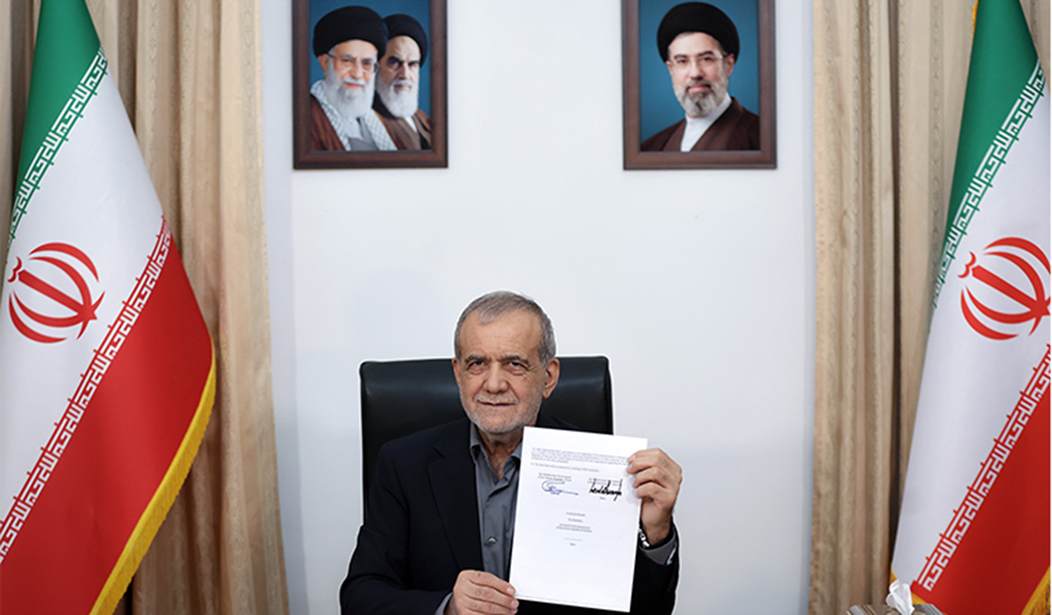
The first round of high-level talks between the United States and Iran wrapped early Monday in Switzerland, with mediators from Qatar and Pakistan claiming “encouraging progress” toward a final deal within 60 days.
Lara Korte posted the mediators’ joint statement and highlighted the main takeaways:
Good morning. The first round of talks between the U.S.-Iran have concluded.
— Lara Korte (@lara_korte) June 22, 2026
In a joint statement, Pakistani and Qatari mediators said the parties agreed to set up a line of communication to avoid miscommunication over the SoH and a “deconfliction cell” to ensure an end to… pic.twitter.com/3BjCYIfmKL
“Good morning. The first round of talks between the U.S.-Iran have concluded.
In a joint statement, Pakistani and Qatari mediators said the parties agreed to set up a line of communication to avoid miscommunication over the SoH and a ‘deconfliction cell’ to ensure an end to military operations in Lebanon.”
The negotiations, held at the Bürgenstock resort overlooking Lake Lucerne, were the first formal round under last week’s preliminary agreement pausing hostilities and opening broader talks on regional security, sanctions relief, maritime access, and Iran’s nuclear program.
In the statement released on Twtiter/X, the mediators said:
“The Lake Lucerne Summit was conducted in a positive and constructive atmosphere. Encouraging progress has been made including the creation of a mechanism for further technical talks.”
According to the statement, the parties agreed to establish a "High Level Committee" to oversee mediation and create working groups focused on nuclear issues, sanctions, monitoring, dispute resolution, and implementation of the memorandum of understanding.
The two most immediate developments involve the Strait of Hormuz and Lebanon.
A direct communication line will be set up to avoid incidents involving commercial shipping through the Strait of Hormuz.
The Strait remains one of the world’s most important energy chokepoints. The release highlights that tension.
“A communication line between the parties has been formed…to avoid incidents and miscommunication with the aim of safe passage for commercial vessels through the Strait of Hormuz.”
The parties also agreed to create a de-confliction cell involving Lebanon, facilitated by Qatar and Pakistan, aimed at ending military operations there.
That may be the first real test, because Lebanon is still the issue most likely to knock the process off course. Fighting between Israel and Iran-backed Hezbollah has repeatedly threatened the broader U.S.-Iran track.
Iranian Foreign Minister Abbas Araghchi claimed there had been “major progress” toward ending the conflict there. He also said oil and petrochemical exports had been waived, the blockade lifted, some frozen assets released, and a reconstruction plan launched for Iran.
Read More: JD Vance Heads to Switzerland, As Peace Talks Over the MOU and Israel-Lebanon Ceasefire Continue
Israel Strikes Iran After Iranian Missile Attack, Defying Trump's Request to Hold Off
The upbeat language only tells part of the story. Before negotiations began, President Donald Trump warned Iran to rein in Hezbollah activity in Lebanon and threatened renewed U.S. military action if Tehran failed to comply. Trump’s comments angered Iran’s top negotiator and briefly stalled the talks before they resumed.
Trump also said the United States could resume bombing Iran and “take over” the Strait of Hormuz if no deal is reached, drawing a public response from Iranian Parliament Speaker Mohammad Bagher Ghalibaf, who led Tehran’s delegation.
“Don’t they think that if their threats had any effect, they wouldn’t be in this desperate situation today?... No matter how much they talk, it is we who take action.”
Vice President JD Vance, who led the American delegation, struck a softer note, saying the U.S. saw an opening if Iran changed course on regional instability and nuclear weapons ambitions. That leaves the hardest questions for later, with the opening session focused heavily on Lebanon and Iran’s nuclear program expected to become a larger issue in future rounds.
Technical talks are expected to continue at Bürgenstock this week, according to the tweet. But the path from “encouraging progress” to a final agreement still runs through Hezbollah, Hormuz, sanctions, enforcement, and Iran’s nuclear program.
Editor's Note: For decades, former presidents have been all talk and no action. Now, Donald Trump is eliminating the threat from Iran once and for all.
Help us report the truth about the Trump administration's decisive actions to keep Americans safe and bring peace to the world. Join RedState VIP and use promo code FIGHT to get 60% off your VIP membership.
Join the Conversation
VIP members get the ability to comment on articles.