
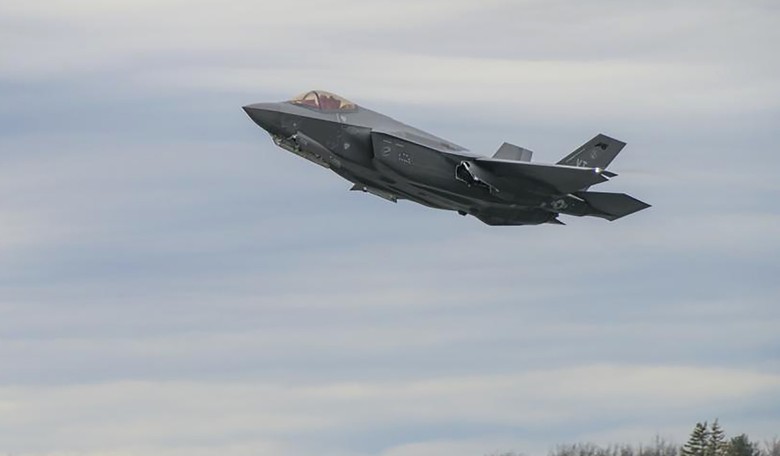
In recent years, it's become very apparent that unmanned aerial vehicles (UAVs), from small drones to large unmanned aircraft, are the next big thing in warfare. The United States Air Force as well as the Navy have seen this writing on the wall, and both services are working on what some are calling unmanned wingmen: UAVs that can be controlled by a single manned aircraft. The Navy had plans to include this capability with the next-generation F/A-XX naval stealth fighter, but it turns out they didn't want to wait; now the Navy wants to get cracking to give this ability to the current F-35 Joint Strike Fighter.
One of the key roles envisioned for the U.S. Navy’s next-generation F/A-XX carrier-based fighter is serving as an airborne controller for advanced unmanned aircraft. However, the senior official currently performing the duties of Under Secretary of the Navy says the service does not need to wait for F/A-XX to begin adding Collaborative Combat Aircraft (CCA) type drones to its carrier air wings. The service could pair CCAs first with its F-35C Joint Strike Fighters.
William Toti was asked about the Navy’s CCA plans and their relationship to F/A-XX at a hearing before the Senate Armed Services Committee yesterday. Senators are currently considering Toti’s nomination to formally assume the role of Under Secretary of the Navy.
We note that Admiral Toti's nomination to officially hold the role of Under Secretary is still pending in the Senate.
Simply put, the Navy doesn't want to delay this capability. That's understandable, as China and Russia are almost certainly trying out the same kinds of toys. And, in matters of this kind, this isn't something where you want to be caught behind the 8 ball.
“CCA aircraft are an element of the future air fleet, the future combat capability of our aircraft carriers. We have been, for better – to put it in a better way, the Air Force has been leading this issue,” Toti said in response to a question from Senator Ted Budd, a North Carolina Republican. “We are following closely behind, but the integration of CCA aircraft in the Air Wing is critically important as we go forward.”
“We need low-cost, attritable assets in our Air Wing, and CCA will provide that. So we have programs in place to begin developing that capability. They’re still nascent,” he continued. “But I see that, with the realignment of the unmanned capability [portfolios] to the [Navy] Under Secretary’s office, which I executed while I was performing the duties of the Under Secretary, I think we’ll get adequate visibility into these issues as we go forward.”
Have a look at one of the drones that the F/A-XX and now the F-35 may well be managing. It's even got a cool name — the X-BAT. Sounds like something from a Batman comic.
The low-cost angle is significant, especially given the ever-rising costs of our increasingly high-tech military. But there's another cost to consider, and that's the human cost. A UAV doesn't require sending a pilot and a weapons officer into harm's way. They can remain at a safe distance — or at least, a safer distance — and maintain control of the unmanned aircraft that could carry out reconnaissance, signals intelligence-gathering, air-to-ground operations like destruction of assets and infrastructure and air-defense mitigations, or even air-to-air combat, in time.As for the F/A-XX, it's currently under development by Boeing.
6th-gen edge. Thank you, @USNavy, for continuing our partnership to design, build and deliver your F/A-XX aircraft. We’re honored to produce the 6th-generation fighter that will revolutionize advancements in naval aviation to maintain U.S. carrier air superiority. Release: https://t.co/ZnMt9ZNjdz
— Boeing Defense (@BoeingDefense) September 29, 2026
You can view the Boeing press release on the new fighter here.
Now, if Congress could just get that NDAA passed...