

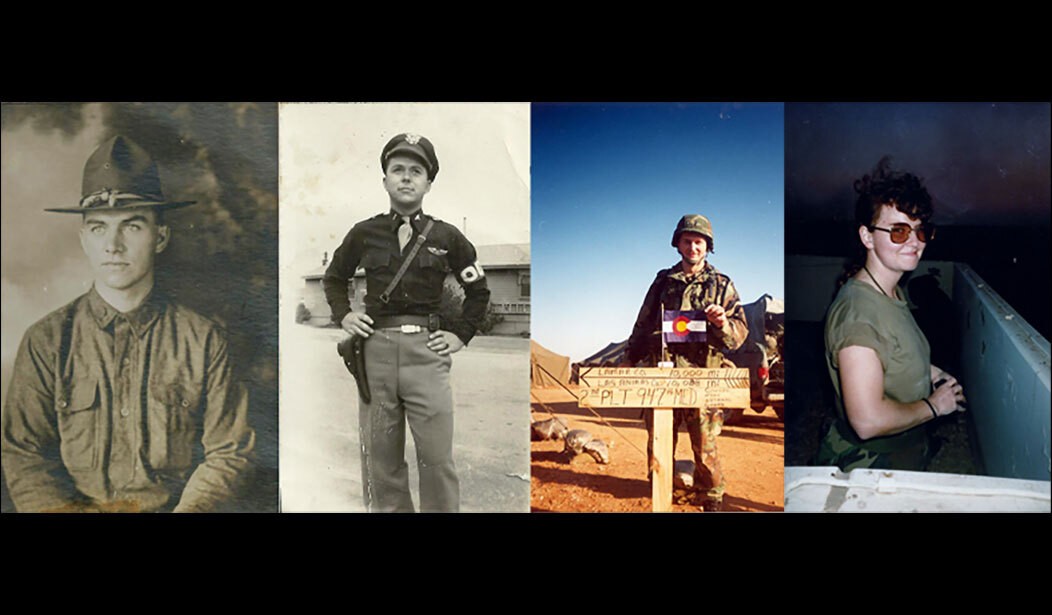

Check out that photo at the top of this article; that's three generations of Americans in uniform. Far left is my paternal grandfather in 1917, then my Dad in 1944. Moving on is me, in 1991, and finally my wife, who wasn't yet my wife at the time, also in 1991. We're a family of veterans. A great-great-grandfather of mine served in a Wisconsin volunteer infantry regiment in the Civil War, and several known ancestors fought on the side of liberty in the American Revolution.
There are millions of families like that. Maybe no famous campaigners or great heroes, but we served, we went where we were told and did what we were told to do. And today is our day, Veterans Day, when we remember everyone, throughout our history, who has served.
A few days before I left for Army basic training, my Dad told me, "This will change you in ways that people who haven't done it will never understand." He was right. It made me a soldier, and that made me a veteran. In my life I've been privileged to have known a lot of veterans. A few stand out.
When my parents were farming near Fairbank, Iowa, there was an older couple who lived in the next farm down the gravel road, Grace and Brownie. They were effectively bonus grandparents for the pre-school me; when my Mom carted me over for a visit, I always knew that Brownie would be expecting me with a candy bar in the bib pocket of his overalls. Brownie passed before I was old enough to get to know many details, but my mother later told me that he was a Great War army veteran, having gone to France with Blackjack Pershing, an experience about which he said nothing; but he did tell Mom that I reminded him of his son Junior, who died in Europe in 1944.
My paternal grandfather was the other Great War-era veteran in my life. He joined up in 1917, and while in training at Camp Dodge, Iowa, he was in the kitchen on KP when the base commander, a colonel, came in with some quail he had shot. He had to ask for a volunteer to cook them; it was a personal request and not something he felt he could order done, but Grandpa volunteered, and the colonel liked the result so much that he kept Grandpa on base as a cook. So, Grandpa served two years in the Army without ever leaving Iowa.
Like so many of my generation (Baby Boomers) my Dad and all my uncles were World War II veterans. Dad entered training as a bomber navigator, but navigation technology was changing rapidly; Dad got sent from one new school to another new school until he ended up finally at Victorville, California, checking out in the B-29, which is what he was doing when Japan surrendered.
Dad's older brother was a veteran of the European theater, a paratrooper in the 101st, who jumped into the Netherlands in Market Garden and was at Bastogne in that famous action. He took a piece of an 88 fragment in the head after crossing into Germany and was never quite the same after that.
Mom's older brother was a Marine. He took a Japanese bayonet through the shoulder on Iwo Jima and almost died of sepsis. He would never discuss the war; the family never even knew he'd been wounded until he married after the war and his wife demanded to know the source of the big scar on his shoulder. Mom's younger brother was a radio operator and gunner in the Martin B-26, in Italy and France, and he never got a scratch.
My brother-in-law was a Marine veteran of Korea, one of Chesty Puller's "Frozen Chosen." He took a bullet in the leg on the retreat from the Chosin Reservoir. He wouldn't talk about his war, either.
Then, there was an old retired Army Colonel from whom I rented an apartment when I was a young man. He was a veteran of Korea and two tours in Vietnam, with three awards of the Purple Heart and a Silver Star, and he would tell war stories all day long, including the time he had a North Korean grenade go off between his feet in a muddy trench in the middle of the night, tossing him into the air but leaving him with nothing worse than ringing ears. This was a guy who, when cut, bled olive drab, and fear didn't enter into his thinking.
Then, it was my turn, and in my turn, I ended up in the Middle East, where I met my wife, while both of us were first lieutenants in an Army medical clearing company. Our war had the advantage of being short, at least, and I've often said that I came home with a better war souvenir than anyone else I know. And, since then, I've gotten to know quite a few veterans of the sandboxes, of Iraq and Afghanistan.
Most of us have one thing in common: We don't think of ourselves as great heroes, even those who were and are. We think of ourselves as patriots with a job to do, that job being to protect and defend, not any general, not any Secretary of War, or any president, but the Constitution of the United States of America. There are millions of families like mine, families with several generations of veterans, people who served, people who were willing to give their lives for their country — but who were also pretty darn good at making the other poor dumb SOBs give their lives for their countries. And you mess with us at your peril.
This is our day. Let the various whining special interests have this month and that month; that may not seem right (and it isn't) but we will react as soldiers, as sailors, as airmen and Marines do on this day: We'll raise our heads a little higher, walk a little taller, and take a little more pride in having been places and faced things that changed us, in ways that most people will never understand.