

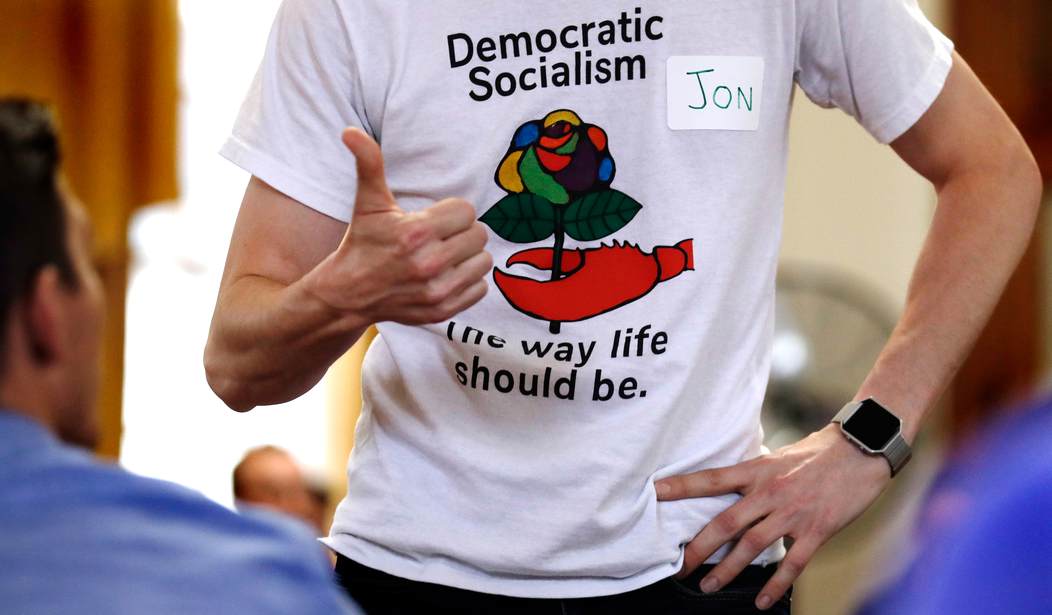

Let's get one thing straight right off the bat: "Democratic socialism," as in the "Democratic Socialists of America" or DSA, is a contradiction in terms. The only way socialism is achieved is by government seizure of the means of production; that is, nationalizing every major and many minor industries, along with the infrastructure supporting it. There's no democracy to it; only tyranny, as witness how many communist states have claimed to be something like the "People's Democratic Republic of Crapalotitopia," even though there's no democracy or republic involved.
That would apply to the DSA, right here in these United States, if they ever were to gain control of all the levers of government. So, can they?
A post-election article in the Jacobin, a strongly left-leaning journal, would seem to be putting forth the notion that they can.
The Left has been so conditioned in the Trump era to look aghast and horrified at election results that it is still hard to fully believe the outcome today. Yet the historic events of last night really did happen: Donald Trump and Republicans suffered a historic rebuke from voters, handing Democrats wins up and down the ballot all across the country, flipping both chambers of Congress in their favor, and handing them the largest congressional majorities they’ve had since Barack Obama’s election.
In many ways, the result is simple. Across poll after poll leading into the election and exit poll after exit poll leading out of it, the message from voters was the same: they think the economy sucks, they think prices are too high, and they’re angry at Trump and blame him squarely for this entire situation. To send this message, voters turned out in droves to hand power to a Democratic Party that these same polls show they have very little love for, sometimes viewing the Dems even more dimly than they do Trump.
Here's the thing: A strong plurality in most places may have thought they were handing over power to the Democrats, as in, the Democrat Party their parents and grandparents may have voted for. And in so doing, they handed the DSA crowd some conspicuous wins. While most of those DSA wins were in solidly blue districts that would vote for a stuffed armadillo if it had a "D" behind its name, not all of them were; in fact, a key swing state, part of the Rust Belt that President Trump won narrowly in 2024, in a state-wide election, sent DSA nut Abdul El-Sayed to the Senate. And a few other races won by Republicans were nevertheless closer than we would have liked.
Things are changing, and it's not yet clear where all this is going. But it's also not at all clear the DSA crowd can keep this ball rolling.
Yet while hopes are running high, the size of the Democratic majority and the DSA’s own fractious internal culture pose significant challenges to the organization’s ability to capitalize long term. The DSA will face pushback from moderates within the Democratic Party. Moreover, as the organization garners greater public recognition and scrutiny, it risks becoming a political liability for allies—particularly if it cannot keep its most extreme wing in check.
What passes for a moderate in the Democrat Party today isn't the same as it was even in the Obama years, and that may be the thing that holds the DSA in check. Maybe. And there are already signs that the socialists are preparing the seeds of their own future loss in overstating their mandate — or the lack thereof.
With this conclusion in mind, the DSA is shifting its focus toward intra-party primary battles ahead of 2028. Capturing the DSA’s aggressive mood, leftist streamer Hasan Piker asserted, “We should have f***ing ran socialists in every f***ing primary, dude.” Meantime, communication co-chair Aron Ali-McClory wrote, “at a base line, the socialist presence in Congress will soar to heights unseen in over a century. We are contesting in places that’ve been written off for decades. It’s only a beginning, but let the light in!”
Ay, that's the rub.
Here's the thing: Most Americans, even voters, don't pay that much attention to politics except in the event of some major problem, like gasoline prices being around $5 a gallon. That's why the traditional election season doesn't start until Labor Day, and on Labor Day 2026, those voters were treated to those high gas prices literally shining down on the street, lit up in neon lights, every day as they drove back and forth to work. That hurt the Republicans, fair or unfair, justified or not, it hurt.
But that doesn't necessarily present an opening for someone in the mold of that detestable little jerk Hasan Piker running for president and winning. One of two things is going to happen in the next couple of election cycles. The Democrats may continue this swing to the screwball left, they will try to run a DSA type for the White House against (we hope) the best the Republican Party has to offer, someone like Ron DeSantis — or the Democrat Party's moderate wing (by today's standards) will have to fight to keep their lunatic wing in check, lest they break off and split the left-of-center vote, handing future elections to the GOP.
My money's on the latter. For now.
The DSA is already starting the intraparty fights. Hasan Piker and his band of useful idiots are already talking about primarying Democrats who show insufficient zeal for the cause. That will hurt them; that will cost them time, it will cost them money, and it will produce candidates damaged by the fight, no matter which side wins.
The GOP can and should capitalize on that. What Republicans need to do now, aside from prodding the lame-duck Senate to confirm as many judges and pass as much of the Republican agenda that they can, is to start a vigorous internal debate who they will run for every office, from president down to Third Assistant Manhole Maintenance Tech in Poplar Bend, North Dakota. We're going to have to put our best foot forward, in every race, everywhere, because these DSA people are clearly feeling combative; we'd better start feeling that way, too.