






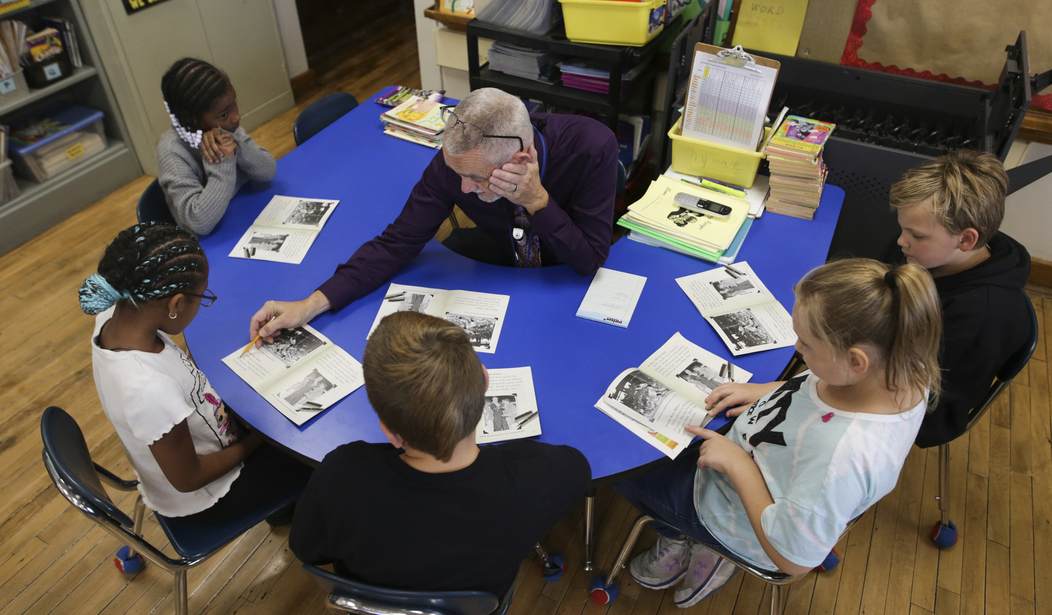
It's impossible to have a modern civilization peopled with illiterates. Reading and writing are the things that a civilized society cannot do without; that's why we see the advent of written language (and mathematics) in the very beginnings of civilization, right around the time of the Agricultural Revolution. Without written language, trade, and technology, all is as good as impossible, at least on any scale.
And now, right here in the United States, in the greatest nation in the history of the planet, our youth are increasingly unable to read at expected levels. Why? Well, here's why and I'm going to tell you: This has happened, in large part, because our educational establishments don't expect young people to read, nor to discuss what they have read.
This calamity has even spread into what are supposedly our elite institutions, like Harvard.
A new story from The Atlantic shows the decline in literacy by telling the story of a Harvard student having trouble in class. Assistant Director for Humanities and Social Sciences Support Margaret Rennix said this student came to her and told her about using AI to translate Anthony Burgess’s A Clockwork Orange into easier language. Rennix told The Atlantic that the student was confused by what the student called “Old English” in the 1962 novel.
Unlike actual Old English texts like Beowulf, which some colleges still assign, A Clockwork Orange is written in English, as well as a fictional Russian-based slang called “Nadsat.” The Nadsat language is not impossible to read, however, as many internet sources contain dictionaries of the words used in the text.
Rennix explained how some students view reading in the modern age: “By asking them to read, professors are arbitrarily withholding information from students by forcing them to get it through this more difficult medium,” she told The Atlantic.
I read A Clockwork Orange when I was in high school. Not because it was assigned; it wasn't. I read it because my sister had a copy, I had heard about it, I was curious, so I asked to borrow the book. If a kid from a rural community in eastern Iowa in the 1970s had no issues understanding that book, then how in the world would a student at Harvard in 2026 have to use AI to "translate" the book? From what? English?
And that last statement from Margaret Rennix: "By asking them to read, professors are arbitrarily withholding information from students by forcing them to get it through this more difficult medium." That's the real source of the problem: Supposed educators with the lowest of low expectations of these young skulls of mush, to the point where they don't even expect the youths to read anymore. That's a tragedy. This calls out precisely what educators should be teaching kids to do: To gain information on their own, through reading and thinking.
Read More: In Our New, Modern World, Ancient Wisdom Still Rings True
You Don't Have Rights If You Can't Remember You Have Them
When I was in high school, again in the late 1970s, we were assigned quite a bit of reading. Personally, I remember reading Fitzgerald, Hemingway, Steinbeck, works like The Catcher in the Rye, and more (then) modern works like Richard Hooker's M*A*S*H. In Civics, we read the Constitution, the Declaration of Independence, and more of the writings of the Founders. In all cases, we were expected not only to read but to be able to discuss what we had read. To gain information on our own, through reading and thinking.
That was then, this is now. The Atlantic article also includes this concerning data point:
Americans, once members of a proudly literate society, read much less than they used to. According to the National Endowment for the Arts, which conducts the most comprehensive survey of the nation’s reading habits, fewer than half of all adults reported having read a book of any kind in 2022. Only 38 percent read a novel or short story. A study analyzing 236,000 responses to the American Time Use Survey found that the proportion of Americans who read for pleasure on any given day fell from 28 percent in 2004 to 16 percent in 2023. (The study looked at people who had read a book, magazine, or newspaper; listened to an audiobook; or read an e-book.)
The Atlantic reports other concerning facts: Modern works of literature are, perhaps by necessity, shorter and simpler than they used to be. When was the last time a college student, even in a literature class, was assigned something like Fyodor Dostoevsky's The Brothers Karamazov, which I was assigned to read and discuss in a gen-ed college literature class? Not at Harvard, mind you; at the University of Northern Iowa.
Now, the results: An alarming 21 percent of Americans are, by test, functionally illiterate.
According to studies by the National Literacy Institute in 2024, 21% of American adults are illiterate.
The National Assessment for Adult Literacy found the literacy rate for American adults in 1870 was a gross total of 11.5% from census data. In 1979, that number was at 0.4%.
To some extent, I expect the modern online world is to blame. The modern generations have grown up having information handed to them in small bits; they aren't challenged to read at length, nor to think about what they have read. The schools are to blame, for no longer assigning reading, and when even a Harvard administrator, as noted above, bemoans the idea of reading great works of literature because it's asking too much of the young skulls full of mush in their charge, that's also a big part of the problem.
That, indeed, is the source of our tragedy of literacy. Youths now don't read because they aren't expected to read, nor to think about what they have read. That does not bode well for our future.
Editor's Note: President Trump is fighting to ensure America's kids get the education they deserve.
Help us fight back against Big Government waste and restore power to the states. Join RedState VIP and use promo code FIGHT to receive 60% off your membership.

Join the Conversation
VIP members get the ability to comment on articles.