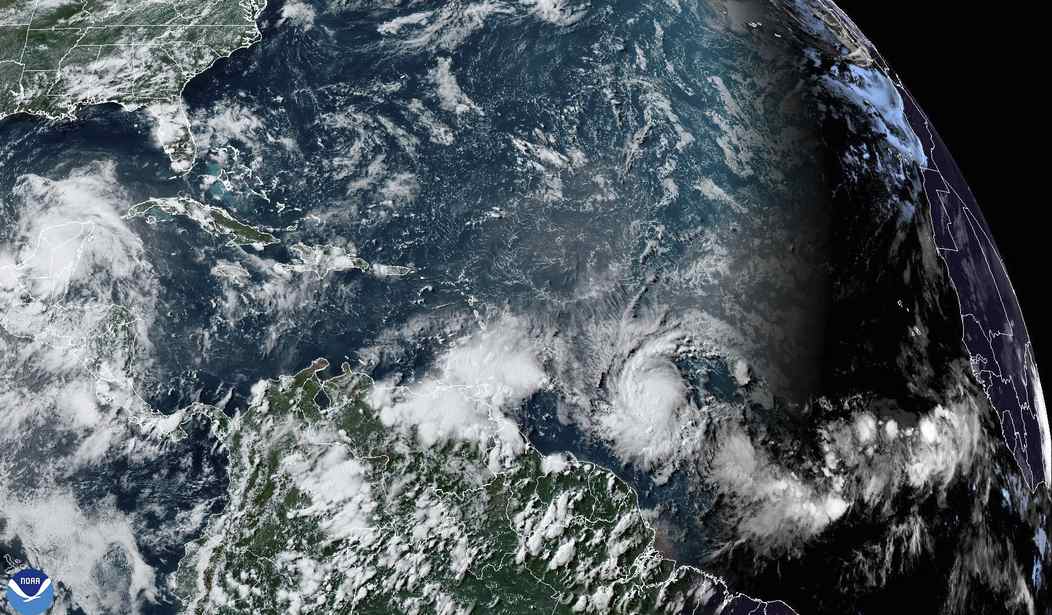

Robert Heinlein, in his masterwork Stranger in a Strange Land, used a phrase I've come to appreciate. When the protagonist of that story, Valentine Michael Smith, who was born and raised on desiccated Mars, first saw the Atlantic, he thought of it as the "ungrokkable vastness of ocean." It's a beautiful turn of phrase. It's also very apt; the scale and scope of the world's oceans, which cover more than half of the Earth's surface and in places plunge miles deep, are hard to wrap our land-bound heads around.
Still, our oceans merit study. What happens in the world's seven seas affects what happens on dry land, too; as evidence, just look at the moderating effect being near the ocean can have on local weather. Years ago, when I was working in California's Santa Clarita Valley, it was amazing to me how it could be 95 degrees in Valencia, where I was staying, and 20 degrees cooler in Ventura, on the coast.
The seas are also vital to the planet's oxygen budget. About half of the planet's oxygen comes from ocean phytoplankton. It's not a stretch to say that every other breath you take comes from the sea, which makes it important to know what's happening with those planktons - and to keep a sharp eye out for pseudoscientific woo from climate scolds. One of my favorite climate debunkers, Paul Homewood, documents one such item over at his Not a Lot of People Know That blog. He begins with a cogent note:
Yet another junk study, which would not see the light of day in any other branch of science:
That much is certain. Here is the study to which he references, which states in part:
There is much debate about whether marine primary production is increasing or decreasing and what environmental parameters may be driving these changes. We analysed a 21-year time-series of net primary production (NPP) computed from Ocean Colour Climate Change Initiative (OC-CCI) data spanning September 1997-December 2018, focusing on areas of similar phenology, climatology, and annual NPP in the north-east Atlantic Ocean. Across the entire area, NPP increased from 1998 to 2003, followed by a significant decline until 2018. This pattern was predominant in north-western European coastal waters and specific areas of the English Channel, Irish Sea, North Sea and Norwegian Sea, where it was related to changes in sea surface temperature and mixed layer depth.
The obvious questions here are "why such a short time span," and "what happened after 2018?"
Read More: From Rigor to Rubbish: Scientific American's Descent Into Woke Exposed
Climate Alarmism Debunked: Tennessee’s Black Bears Now Flourishing
Mr. Homewood points out, in the story linked above:
Like so many other climate studies, this one takes a microscopically short period of data, twenty one years, and pretends that trends during that time have any significance whatsoever. As scientific experts in the Atlantic climate have long known, ocean temperatures and currents there regularly undergo massive climatic shifts. During the last century alone, the North Atlantic has swung from cold to warm, warm to cold, and back again to the warmer climate we have enjoyed for the last three decades.
It is not coincidental that the Atlantic Multidecadal Oscillation switched to warm phase in the mid 1990s, just when this latest study began its analysis.
In other words, this study began when plankton production was at a cyclical high point. Was that starting point cherry-picked?
But wait! There's more!
But, hey! What we see is a huge increase in Net Primary Production, NPP, between 1998 and 2003, followed by a drop back to its levels in the first few years of the analysis. Most of the increase in fact took place in just one year. Moreover, since 2012, NPP has been stable; this fact alone should nullify the authors’ claims that rising sea temperatures are reducing phytoplankton production.
The slope trend line is spurious and meaningless; over the period as a whole, there has been no decrease. The downward trend is simply a product of the timing of that spike – if it had occurred in 2013, instead of 2003, the trend would be up, not down.
Add to that the mention that, as I am continually pointing out, the data set studied is so short as to be rather silly, when set against the cast cycles of the ungrokkable vastness of ocean. While we cannot know the motivations of the people who did this study, at first appearance it looks rather like the data set was hand-selected to produce a desired outcome. If this is indeed the case, that's not science. That's not how science works. That's not how we gather and analyze facts.
The Atlantic Multidecadal Oscillation (AMO) mentioned in the story has a duration that's longer than this study's duration; the AMO typically cycles from warm phase to cool about every 40-80 years. The study deconstructed here only barely encompasses the bottom end of that time scale; without an analysis over at least one complete cycle of the warm/cold phases, this data snapshot is essentially meaningless.
Mr. Homewood concludes:
Tucked away in the main body of the paper is the admission that:
These studies show that when the NPP model is applied to SeaWiFS and MODIS-Aqua the differences over these regions are between 15% and 35%.
In other words, the error margins are massive and make any conclusions virtually worthless.
Again, we see a study based on questionable hypotheses, carried out by an analysis of a suspect data set. That's not science. That's panic-mongering.