








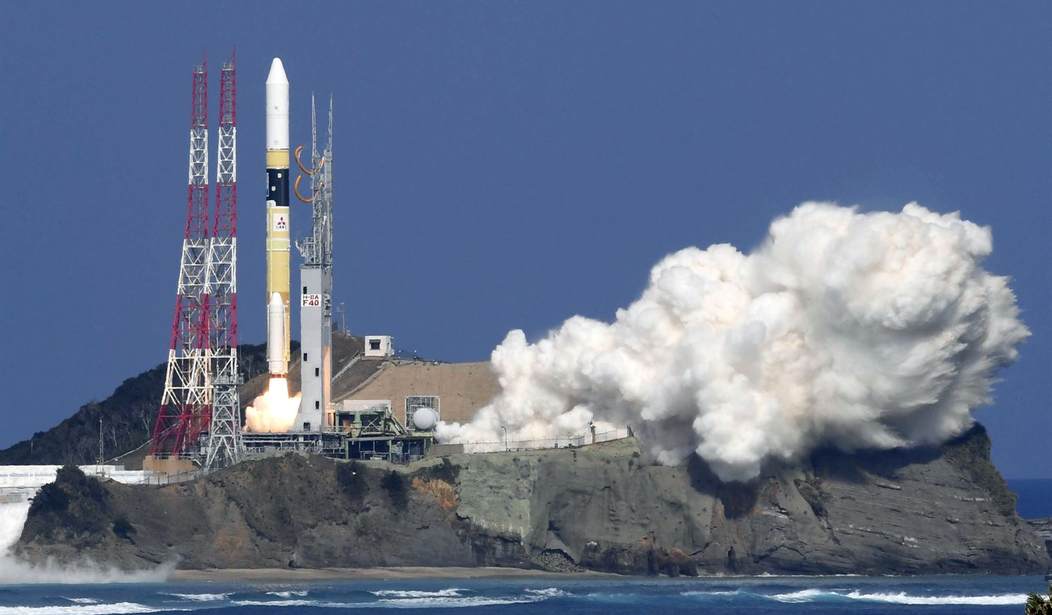
As Elon Musk has pointed out, rockets are hard. He's in a position to know, being the head of the most successful private-sector spacefaring venture to date. But several nations are also reaching into space, including Japan. Last December, the Japan Aerospace Exploration Agency (JAXA) had a nasty failure of their H3 rocket when the second stage of that bird didn't go off as intended. They're back at it now, though, with a successful launch of the H3 on Friday.
Japan successfully launched its flagship H3 rocket Friday morning, marking the resumption of the rocket’s flights roughly six months after a failed mission in December and the first flight of a new low-cost configuration intended to strengthen the country’s competitiveness in the global launch market.
H3 Launch Vehicle No. 6 lifted off from the Tanegashima Space Center in Kagoshima Prefecture at 9:53 a.m., according to the Japan Aerospace Exploration Agency (JAXA). It reached its target orbit approximately 16 minutes later.
That's a good launch, one that ought to please even Elon Musk. Being that this was a test flight, the H3 put up on Friday didn't carry a satellite payload, but rather a dummy payload intended to gather launch data:
Unlike some previous H3 missions, No. 6 did not carry a large operational satellite. Instead, it carried JAXA’s Vehicle Evaluation Payload-5, or VEP-5, a dummy satellite designed to collect flight data and verify the rocket’s performance. Six small secondary satellites developed by universities and other organizations were also carried aboard the rocket and successfully placed into orbit.
Japan's space program, we might note, has no military application at the moment. The primary role of JAXA is the launching of satellites and the exploration of space near Earth, including some lunar exploration. They are working on a crewed spacecraft mission, and have ten astronauts reportedly in training, although they have not yet launched a rocket with humans aboard. Given the recent H3 failure, maybe that's just as well, for now.
Read More: Amazing Moments From SpaceX's Starship Flight, With a Stunning Ending
Jeff Bezos Launch Vehicle Explodes in Gargantuan Fireball — Elon Musk Notes: 'Rockets Are Hard'
Last December's mishap with the H3 was due to a second-stage failure, as The Japan Times wrote in the story linked above.
The mission was closely watched after the previous launch of the H3 No. 8 failed in December while carrying Michibiki No. 5, a quasi-zenith satellite that forms part of Japan’s satellite positioning system, sometimes described as the Japanese version of GPS. During that launch, the rocket’s second-stage engine stopped burning earlier than planned, preventing the satellite from reaching its intended orbit.
Japan is a very tech-savvy nation, and will no doubt keep working on its space program. Since they're an American ally, in fact our best ally in the North Pacific, that's a good thing for America, too; a rocket that's launching commercial communications satellites today, after all, could be launching radar ocean-reconnaissance satellites tomorrow.
JAXA is planning several more launches in 2026, including putting up a cargo transfer vehicle called the Michibiki Number 7, as well as a lunar exploration probe, an engineering test satellite, and a space domain-awareness satellite.
Editor's Note: Do you enjoy RedState's conservative reporting that takes on the radical Left and woke media? Support our work so that we can continue to bring you the truth.
Join RedState VIP and use promo code FIGHT to receive 60% off your membership.



Join the Conversation
VIP members get the ability to comment on articles.