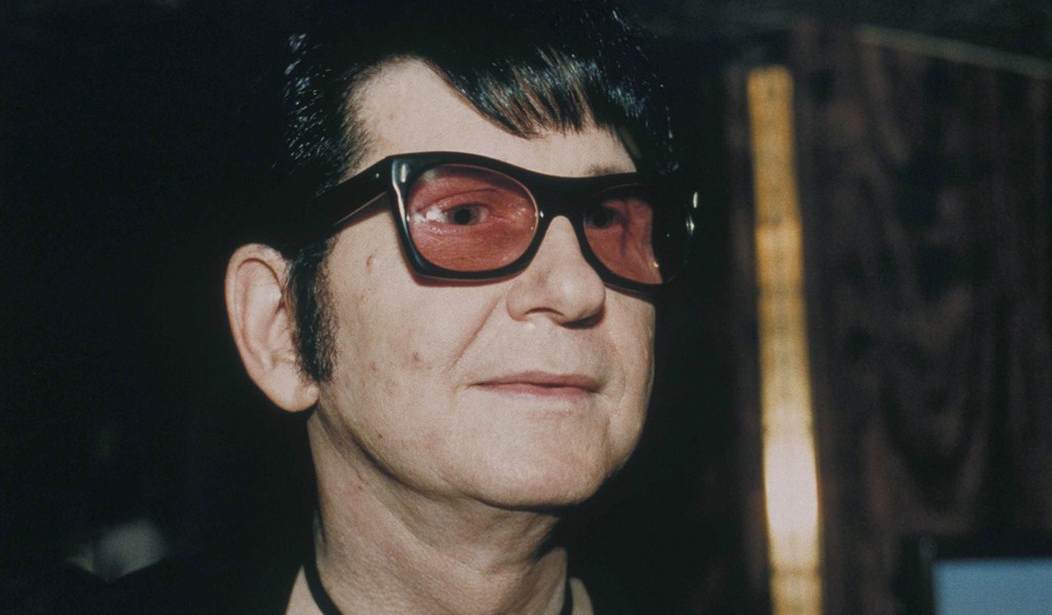

There aren’t many out there like Roy Orbison. He was not only a singer and songwriter, but he was a performer of amazing versatility; his great voice, worthy of an opera, his thought-provoking ballads, and his propensity for evoking an emotional response. His stage presence was always compelling. He was frequently dressed in black and often sported dark sunglasses, even at night.
Roy Orbison was born in Texas in 1936 and started his music career in the 1950s, working alongside the likes of Johnny Cash, Carl Perkins, and even Elvis Presley. He signed with Sun Records in the mid-50s and ended up with 22 Top 40 hits between 1960 and 1966. Then, he faded away for a while after his wife, Claudette, died in a motorcycle accident in 1966, and two of his sons died in a house fire in 1968.
In the early 1980s, he staged a comeback, working with some other outstanding artists, including a stint with what we called a “supergroup” back then – the Traveling Wilburys, which featured Roy alongside George Harrison, Bob Dylan, Tom Petty, and Jeff Lynne
Roy died of a heart attack in 1988, but his work lives on. Here are some of my favorites.
Beautiful Dreamer, 1963: This was a cover of a song written and scored by one Stephen Foster, who died of complications of alcoholism in 1864, and the song was published only days before his death. The William A. Pond company published the song, and Roy (along with quite a few others) picked it up and made it his own.
Read More: Start Your Weekend Right With 6 Great Songs From Balladeer Jim Croce
Crying, 1965: Roy Orbison wrote this song after bumping into an old girlfriend, whom he hadn’t quite gotten over yet. In 1980, Roy said about this song:
Walk On, 1969: This is another heartbreaker by Roy Orbison. It’s another typical Orbison ballad, telling the story of a lost love that, perhaps, never should have happened.Immediately I thought of a past experience and just retold that, was the way that came about. It was the retelling of a thing with a girlfriend that I had had. I couldn't tell you right now what notes I hit at the end of the song, or anything.
Only The Lonely (Live), 1987: This is a sad song about a lonely man, but Roy later said he actually wrote it in happy times. The song was first recorded in 1960, but I like this live version from 1987 best. About those happy times, Roy later said about this song:We don't want the world to see us
Like we are
We should never have even gone this far
Quickly brush away that teardrop
Walk away darling
Don't stop
Don't look back for me baby
Walk on
I've always been very content when I wrote all those songs. By this I'm saying that a lot of people think you have to live through something before you can write it, and that's true in some cases, but I remember the times that I was unhappy or discontent, and I couldn't eat, I couldn't sleep, I couldn't communicate, and I certainly couldn't write a song, no way. All the songs I wrote that were successful were written when I was in a contented state of mind.
Read More: Start Your Weekend Right With Some Happy Rockabilly From Mel McDaniel
Oh, Pretty Woman (Live), 1987: This, again, is a live version of a song originally recorded in 1964, but I like live cuts. And this may be Roy’s most famous song. Roy’s partner at the time, songwriter Bill Dees, said about the song:
He sang it while I was banging my hand down on the table and by the time she returned we had the song. I love the song. From the moment that the rhythm started, I could hear the heels clicking on the pavement, click, click, the pretty woman walking down the street, in a yellow skirt and red shoes. We wrote Oh Pretty Woman on a Friday, the next Friday we recorded it, and the next Friday it was out. It was the fastest thing I ever saw.
Oh, and yes, Van Halen did a cover of it, and it was… interesting, especially the ending of the video, which may bring about images of a certain social contagion making the rounds these days.
You Got It (Live), 1988: This is the centerpiece of Roy’s 1980s comeback. Roy had the help of his fellow Traveling Wilburys in crafting his comeback album, Mystery Girl, which was released, sadly, right about the time Roy died in 1988. Roy wrote the song with Jeff Lynne and Tom Petty, and it’s all about a guy letting his girl know that there isn’t anything he wouldn’t do for her. That’s not a bad note to go out on, and that’s for sure and for certain.If you’re an aging Boomer like me – or even if you aren’t, but appreciate historic talent – you may well have some Roy Orbison favorites as well. Let us know; the comments are all yours.