
Here in the United States, as well as in most of the developed and developing world, there's something we take for granted. We shouldn't, but we do. It's something that makes everything in our modern lifestyles possible. It's something that, were it suddenly gone, we would be cast back into the mid-19th century. Without it, our nights would be cold and dark. Without it, we wouldn't be able to grow and transport enough food to feed everyone, leading to the deaths of millions by starvation. Without it, our entire economy would collapse, our ways of doing business and communicating would be gone; it would be the greatest disaster to ever befall the modern world.
I refer, obviously, to electricity. We tend to take it for granted, I think, because we rarely see it, but we always expect it to be there. We expect it every time we plug in an appliance or flip a switch, and for the most part, it's always there.
In other parts of the world, though, people can't take it for granted. They haven't had the opportunity. In Africa, 600 million people have never had electricity. 900 million people in Africa still cook with biomass - wood or dung. The people of those nations want electricity; they need electricity, and not just for their homes, but so that they can develop industries, to join the modern world. But the international finance community, which would normally be open to lending capital as an investment to build said industries, is engaging in what the CO2 Coalition's Vijay Jayaraj calls "green colonialism," and it's an apt metaphor. In a recent piece at Watts Up With That, he describes what befell one proposal in Kenya:
Kenya just shelved a $1 billion project backed by Microsoft and UAE-based G42. President William Ruto explained the decision plainly: The facility would have consumed roughly one-third of the country’s entire 3,000-megawatt installed capacity – the amount of power from a single coal-fired power plant. Such a modest amount of electricity cannot support a modern lifestyle for a nation of more than 58 million people, much less meet the added requirements of power-hungry data centers.
A key factor contributing to Africa’s paltry energy production is a systematic embargo on fossil fuels in the name of climate action, which has disrupted fossil fuel investments in Africa over the past decade or so.
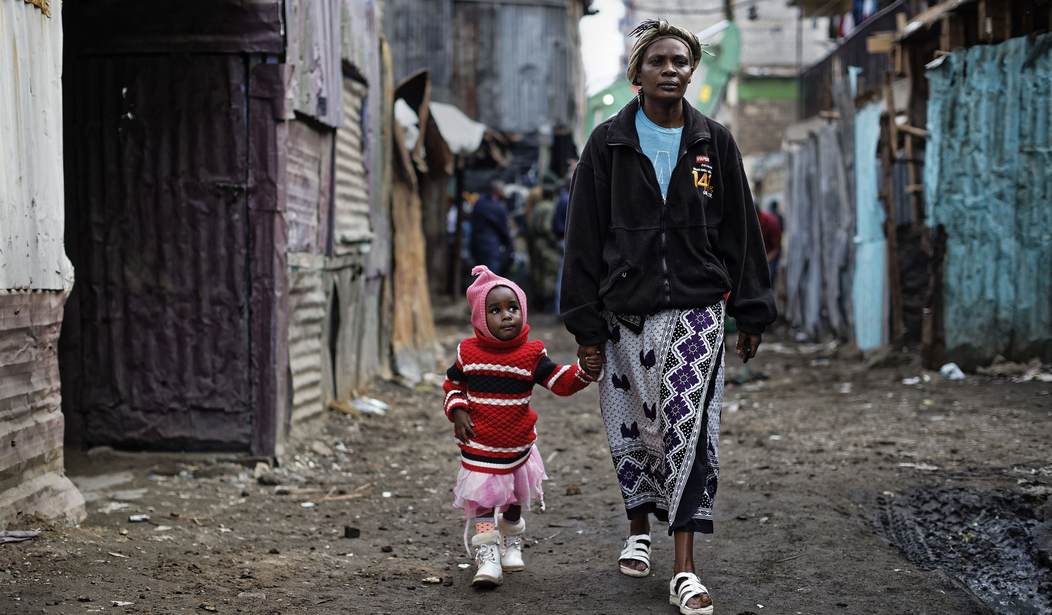
In the name of climate action. An African woman, even now, may well be cooking the daily gruel over a dung fire, having been denied electricity by well-meaning but feather-headed policies of Western financiers. Mr. Jayaraj continues:
When the World Bank, regional development banks, or U.N.-backed initiatives fold climate alarmism into lending criteria, they effectively impose an energy embargo on nations trying to lift their people out of poverty. The African Development Bank stopped financing coal projects in 2019 and severely restricted the backing of oil and gas projects in 2021. The World Bank followed suit. These decisions, driven by United Nations climate targets and pressure from EU-funded groups, cut off capital that could have unlocked Africa’s abundant reserves of hydrocarbons.
African countries wanting dependable electricity for hospitals, factories, and data centers cannot afford to wait for an idealized power grid that exists only in the imaginations of the climate deluded. They need natural gas, coal, and oil, which can deliver continuous power at scale today to jump-start industrial activity.
The fundamental physics and economics of power generation expose the delusions of the green energy movement. Energy experts consistently point out that expensive, weather-dependent systems like wind and solar cannot sustain modern economies.
These policies are not bad ideas only for the developed world, in that they purport to replace reliable, constant, high-density electricity sources with unreliable, intermittent, low-density sources like solar and wind. They are worse policies for Africa, where they are replacing nothing with nothing.
Read More: Rising CO2 Doesn’t Starve Crops of Nutrients: Now Here’s the Real Science
Climate Change: Is CO2 Changing the Sahara Desert to a Sahara Savannah?
Sub-Saharan Africa is the only major region of the world where abject poverty is expected to increase between now and 2040, according to Our World in Data. And make no mistake about it, a great deal of that will be due to a lack of reliable electricity.
With electricity, many things are possible. Industry, a cleaner environment, more time to spend on pursuits other than gathering dung for the evening cook-fire. Without it, a society is mired in the 1850s, at the very most. In all candor, most of the poorer parts of Africa have a way to go before they can achieve a level that the Western world was at in 1850. But without electricity, they aren't going anywhere.
Because of the policies of Western governments, Western financiers, and Western NGOs, these people are denied the most reliable electricity sources that they could get running fastest: Coal, oil, and natural gas.
International finance markets need to stop with the overweening paternalism where Africa is concerned. Handle any requests as one would handle any investment; ignore the "green" horse squeeze, and look at likely returns on investments, which again are likely to be a lot higher with traditional energy sources. Look at a continent that contains some of the poorest places on the planet, held there because of the lack of electricity. These people need electricity, and solar, wind, and unicorn flatulence aren't going to get them where they need to be to break into the modern world.