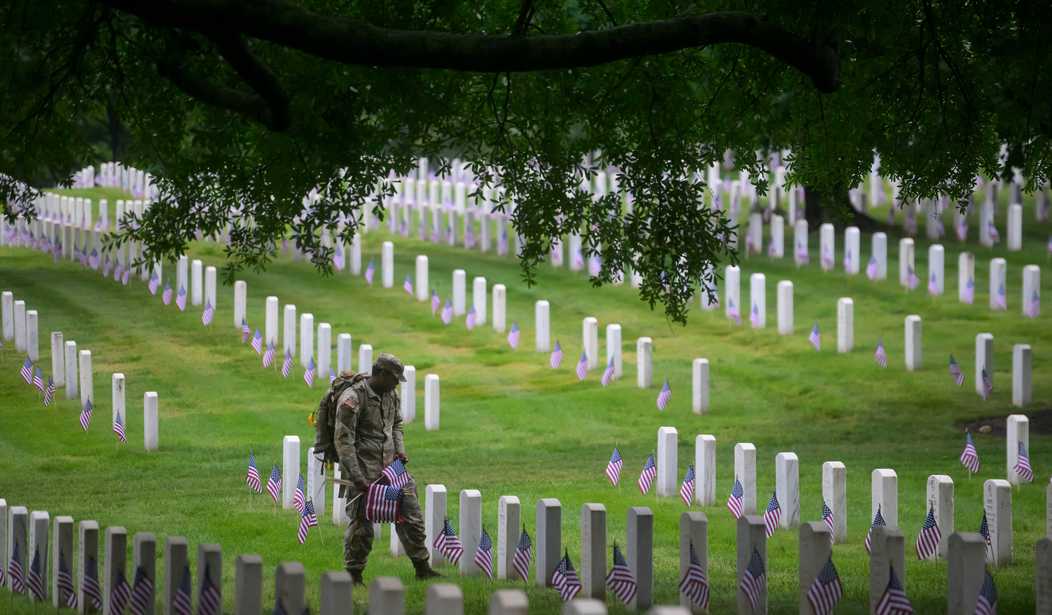

On this Memorial Day, we rightly take a moment to remember the heroes of our country, those brave service members who paid the ultimate price for their country. Many of them had promising lives ahead of them. Many of them were heartbreakingly young. Many of them had families who got left behind. But every one of them knew the risks, every one of them took the oath, and our nation is richer that such people once walked among us. More importantly, our nation is more secure because people like them chose to serve.
General George Patton wrote about just these brave service members, putting it as well as anyone ever has:
It is foolish and wrong to mourn the men who died. Rather, we should thank God that such men lived.
This day is, to my thinking, not just about those who fell where they were hit, or shortly thereafter. And not all the people were hit by a bullet or a fragment. But those people served, too, and they gave their lives, in one way or another. On Memorial Day, we should remember them, too.
Some examples, just from my own family.
My great-great-grandfather, Thomas Jefferson Baty, born in 1843, died in 1889. He died at age 46. Why? In 1864, he was wounded in a Civil War battle while serving in a Wisconsin volunteer infantry outfit. He was only 21 when he was hit. I don’t know what battle my great-great-grandfather was in when he was hit. I don’t know what he was hit with. I don’t know the nature of his wounds. All I know is that his death certificate, which my uncle had a copy of, said that he died of complications of wounds suffered in the war. Fortunately for me, he did live long enough and in good enough health to father my great-grandfather, Andrew Jackson Baty.
Thomas Jefferson Baty fell for his nation, as surely as though he had fallen on the battlefield.
Read More: Buzz Cut: Memorial Day Thoughts From One Who Lived
Buzz Cut: This Memorial Day Weekend, Remember Our Heroes! Lieutenant Tim Shafer
My uncle Donald Clark, who served in the 101st Airborne in World War II. Uncle Don, my Dad’s older brother, went through Market Garden and Bastogne without a scratch. Then, after his battalion had moved into Germany proper, his platoon came under artillery fire. Don hit the dirt, sheltering behind a tree, but a German 88 shell hit the tree, with fragments lancing through my uncle’s head. His platoon, seeing the catastrophic damage to his head, left him for dead, but some hours later, a medic noticed he was still breathing and evacuated him. He ended up with a metal plate in his forehead and a glass eye, and struggled with loss of memory and headaches the rest of his life. Don died in 1997, aged 76, a respectable span; but his younger brother, my Dad, lived to 94, and Don likely would have reached a similar age, were it not for the awful damage and horrible after-effects of that German 88 shell.
Donald Clark fell for his nation, as surely as though he had fallen on the battlefield.
And finally, not from my family, but from the outfit I took to war: Sergeant Francisco Martinez, a fine man, a good NCO, and the only man I ever lost while I was wearing Uncle Sam’s green. Frank was a good man, a devoted father, a patriot; he didn’t fall in battle but rather to a heart attack while our Colorado National Guard unit was preparing to deploy to Iraq. But I still had to help inventory his personal effects; I still had to write to his daughter, to tell her what a fine man her father had been. Frank was a great soldier. If you went to him with a task, he would smile, say, “I’ll get it done, Eltee,” and you could walk away with your mind at ease, because Frank would get that job done. I think of Frank, every year, on this day.
Francisco Martinez fell for his nation, as surely as though he had fallen on the battlefield.
How many thousands of service members, when home, hurt so badly that their survival was measured in months? How many ended up taking the ultimate way out, unable to live with the pain, the disability, the scars, mental and physical? Veterans, in the United States, have a suicide rate roughly twice that of the population at large. We can’t do enough for these people, these survivors, who may not have lost their lives, but who have lost essential parts of those lives.
Not all who fell perished in the heat of battle. Not all who fell passed away in a field hospital. Some of them, like Thomas Jefferson Baty, fall months or years later, but they fall just as surely as if they had been hit through the heart on the battlefield.
This is their day, too.
And on this day, this Memorial Day, we should remember these words, some of the best words possible, to describe what it is like to serve, to take those risks, to face the possibility that you may not come home again:
Many gave some. Some gave all.
Too many Americans think of this only as a three-day weekend, the start of the summer vacation season, a day off spent with cold beer and a grill. There’s nothing wrong with those things. But this day is much, much more than that.
Remember them. Remember all of them.