
Remember when Britain had freedom of speech?
Time was when the British Isles saw the birth of our modern notions of free speech. In the Tudor era, the House of Commons started asserting a right to debate freely without having to worry about what the king thought. The king at that time was Henry VIII, who had a penchant for lopping off heads, so that was a brave move. Back then, freedom of speech applied primarily to Parliament and advisors to the monarch, but later, in the 18th century, there was a stronger movement for free speech for all subjects; Thomas Gordon and John Trenchard, writing as "Cato," from 1720 to 1723, made a strong argument for free speech as a political right.
This all led to the First Amendment enshrining freedom of speech here in the United States, but in Britain, there was still no such clearly defined right. Now, perhaps more than at any time, free speech is under attack in Britain, and while it may not get your head chopped off, making a statement that offends the wrong people can cost you your career, as an RAF cadet has just learned.
An RAF cadet has been suspended after he said Islam poses the greatest security threat to the UK while taking part in a training exercise.
He made the comment during a question-and-answer session in which he and other cadets were asked about dangers to British security.
It led to him being kicked off the officer-training course, pending an investigation.
Long ago, I was an officer candidate myself. I don't know the details of this "question and answer" session, but I remember such skull sessions myself when I was a cadet. I remember it as a vital and interesting part of our training to be Army officers. We passed around papers from the Frunze Academy — the Soviet Union's general staff school — as well as discussing papers, position statements, weapons, tactics, governments, and everything about friendly and hostile nations alike. When you put on the uniform, you accept some limits about what you can say in public, at least while you're in uniform, but these were closed-door sessions where anything goes. We enjoyed them, and they were informative.
Not any more, at least, not in Britain, despite the obvious point that the cadet in question (he has not yet been named) may well be correct in his assessment.
Britain has responded to more than 20 plots backed by the Islamic Republic of Iran since 2022 and the Government has said the threat from the country to the UK is ‘persistent and unacceptable’.
The air force has launched a probe into the young cadet’s remarks at RAF Cranwell, where the next generation of officers are trained.
Retired rear admiral Chris Parry last night accused the air force of shutting down the ‘critical thinking’ of new officers around controversial issues and said the cadet should be reinstated.
Admiral Parry is correct. Not only is this a gross violation of the cadet's free speech rights, but it's also a rather shocking disregard of reality.
Admiral Parry added:
‘If I’d asked that question and got that answer I would have also asked the cadet to expand on his thinking and got some critical thinking going rather than suspend him,’ he said.
‘Clearly Islamic extremism is the issue and not Islam, but how are young people expected to develop critical thinking around these complex issues if they are shut down in this way?
In the Royal Air Force's officer training program, it seems critical thinking is no longer on the agenda. And the problem, we are forced to acknowledge, is not confined to the RAF, or even to the British military as a whole; it's a national issue, and even non-Muslim minorities in Britain are growing alarmed at how the increasingly vocal and demanding Muslim minority is forcing a shutdown of free speech. Firstpost's Reshmi Dasgupta has some interesting thoughts on the matter:
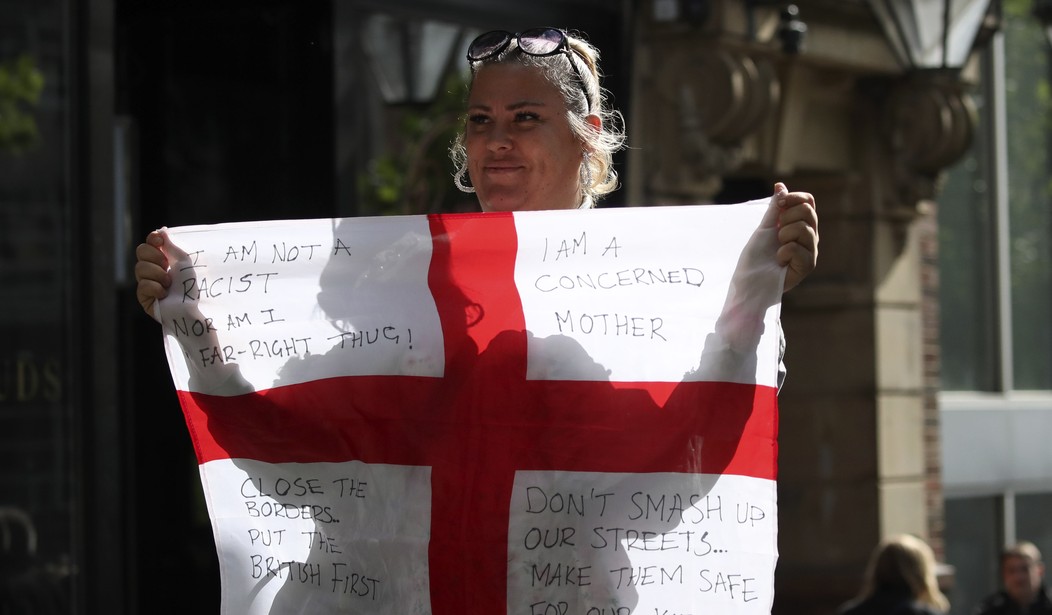
In the most definite sign yet that Britain’s beleaguered ruling dispensation has deliberately decided to appease a votebank known to act en bloc electorally, it has unveiled—pun unintended—a new definition of Islamophobia that portends to be a precursor to a blasphemy law. It will also appoint what is being called an “anti-Islamophobia tsar”, giving rise to justified suspicions of a clampdown on debate and discussion on Islam and the activities of its practitioners in the UK.
There has been some pushback. Britain's Free Speech Union, as Reshmi Dasgupta noted, has sent a "pre-action protocol letter," no doubt sternly worded, to the United Kingdom's Secretary of State for Housing, Communities and Local Government, Steve Reed, warning of an upcoming review petition contesting the UK government's new definition of Islamophobia. How well that will work out remains to be seen; this is Britain in 2026, not America in 1791, so it's probably not wise to bet the ranch on the UK government's backing down on this. But several groups are signing on, including the Network of Sikh Organizations, the Christian Institute, and the Women's Policy Centre.
Will it do any good? That remains to be seen. But initial signs aren't good. The UK has gone too far down this dark road already.
Read More: British Schools Now Told to Log Every Anti-Muslim Slight
Britain's Free Speech at Risk: Now a De Facto Blasphemy Ban Looms
Without free speech, there can be no freedom at all. That's why freedom of speech is among the very first rights that our Constitution recognizes, in the First Amendment. And, unlike Americans, the British lack the advantage we have here, in the amendment that follows the first.
Meanwhile, a Royal Air Force cadet's career is ruined, because in a free-wheeling, question-and-answer session, he spoke his mind, telling the truth as he saw it. This is how far the once-Great Britain has fallen.
The Royal Air Force has made a statement:
An RAF spokesman said: ‘We are aware of an alleged incident of inappropriate behaviour involving a cadet at RAF Cranwell.'
'An investigation is ongoing; we are unable to comment further.’'
You don't say.