
One thing many folks (including me at times) have a bit of trouble wrapping their heads around is the concept of what geologists call "deep time." The planet we all live on has a history measured in billions of years - a tad over four and a half billion, in fact. And, through most of that history, the best data we have from multiple sources informs us that the planet was warmer than it is now. We are, after all, still technically in an ice age. We're in a warming interglacial, but the poles are still covered with ice, which is a pretty recent thing as geological time goes, and it's entirely possible, indeed likely, that sooner or later those mile-thick ice sheets will come marching south again.
Even so, more recently, there have been some warmer and colder spells. During the Eocene Thermal Maximum, about 55 million years ago, there were tropical forests as far north as Germany. During the Roman Warm Period, from 250 BC to 400 AD, agriculture took off, and one could grow wine grapes in Britain, which one certainly can't do today outside of a greenhouse.
Another such period, at least in what we call the Canary Islands now, saw at least one of those islands enjoying a climate only 5,000 years ago that was warmer and wetter than today. That island is Fuerteventura.
Scientists (Sánchez-Marco et al., 2026) have recovered the remains of several bird species known to reside at the edges of bodies of water (e.g., lagoons, lakes, rivers) with riparian vegetation and dense forests from a cave in Fuerteventura, the most arid of the Canary Islands. The bones date to ~9000 to 5000 years ago.
This discovery “unexpectedly” reveals the Holocene climate was much warmer (as much as “3 to 7°C”) than present. It was also “much wetter than it is today” a few thousand years ago, and thus regions that are today arid and largely uninhabitable were recently able to host to far more plant and animal species diversity.
The cooler Fuerteventura environment is today covered in sand dunes and classified as an arid desert, as it receives only 100-150 mm of rain annually. The island no longer supports water fowl (sic) habitat or any other species dependent on large annual rainfall totals.
That's an interesting, if local, discovery. And we might note that island habitats aren't generally isolated. They are affected much more than continental habitats by things like ocean currents, prevailing winds, and global warm and cool spells. 5,000 years ago, off the coast of northwest Africa, where the Canary Islands are located, it was evidently not only warmer but wetter than it is now.
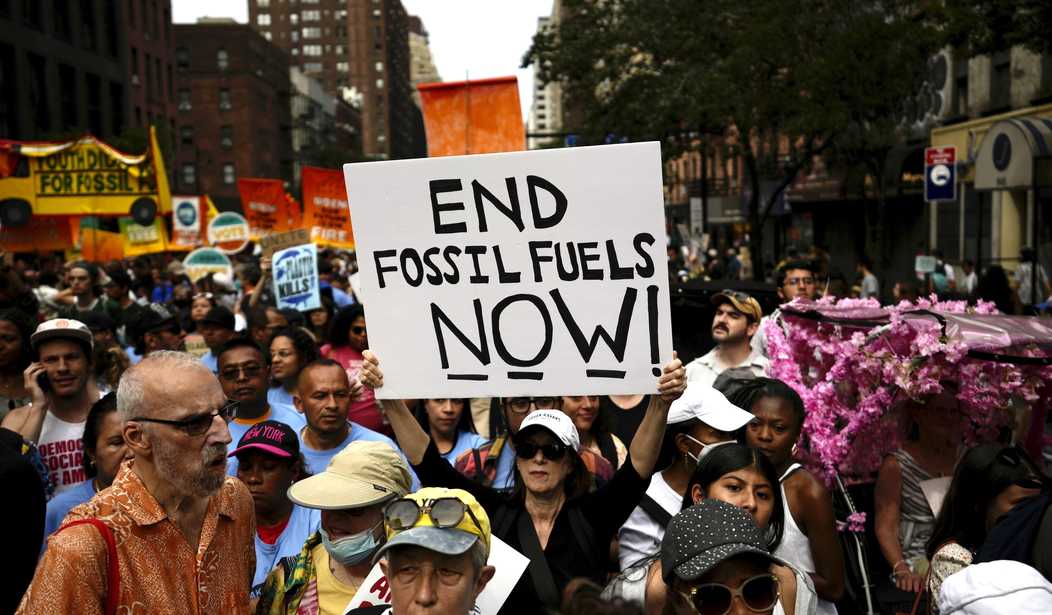
Nothing's surprising about this to anyone who has studied global climate trends, of course. And, remember, even 5,000 years ago - an eyeblink in geological time - there were no coal-fired power plants, no gas-guzzling sport utility vehicles, and no "End Fossil Fuel Now" protestors. There were people around, but they weren't hanging out in modern housing made comfortable by air-conditioning.
Read More: AfD Strikes Back: Reopen Germany's Nuclear Plants, Scrap Green Energy Mandates
Green Energy Systems Are Wreaking Havoc on Wildlife, and Climate Scolds Are Lying About It
Here's the key finding:
It seems likely that there was a lagoon or pond near the cave, around which large areas of riparian vegetation developed. Likewise, wooded areas with undergrowth, where there were even wrynecks, were probably also in the vicinity of the cave. The ornithological record from Cueva del Llano suggests that in the early stages of the Holocene, the dominant climate in the Canary Islands was much wetter than it is today. In Fuerteventura, there were bodies of water with riparian vegetation and more or less dense forest areas with shrubby undergrowth.
This is pretty solid evidence. Riparian and lakeside species like cranes, herons, rails, and other birds are never found in desert habitats. There's nothing for them there. The kinds of plants associated with those environments, again, disappear when the local climate grows cooler and drier. The only possible explanation for the finding of a range of species associated with warm, wet climates is that, in the time those species were alive and moving about, the local climate was warmer and wetter.
Why does this seemingly localized bit of data matter to the climate scolds? Well, it doesn't; if the scolds have shown us anything, it's that they care little about data or facts. But science is about gathering data from multiple sources. This is just one more data point of many, and what it reveals is that we still don't understand the global climate all that well. The earth's climate, global, regional, and local, is all subject to billions of inputs, to cycles ranging from decades to millions of years. The earth's climate is, as I am fond of pointing out, vast and chaotic beyond our ability to easily comprehend. And this work in the Canary Islands reveals once more that, through most of Earth's history, it was warmer than it is now, and that there is no sane reason to sacrifice our modern, technological lifestyles to try to affect something as huge as our planet's natural cycles.