
England was the rock from which sprang the modern world. While it's popular among feather-headed "experts" on the left to bemoan the once-Great Britain's planet-spanning empire, the empire civilized vast tracts of the world that would today still be in the Stone Age, as they were before the Royal Navy and the people it transported brought the law and civilization to them. The British Empire brought not only law, not only civilization, but literacy, education, medicine, legal institutions, and more. Britain, and the Royal Navy, were primary among the efforts to end the trans-Atlantic slave trade.
Was the record perfect? Far from it. But from the days of Elizabeth I to well past World War 2, Britain was a force for good in the world.
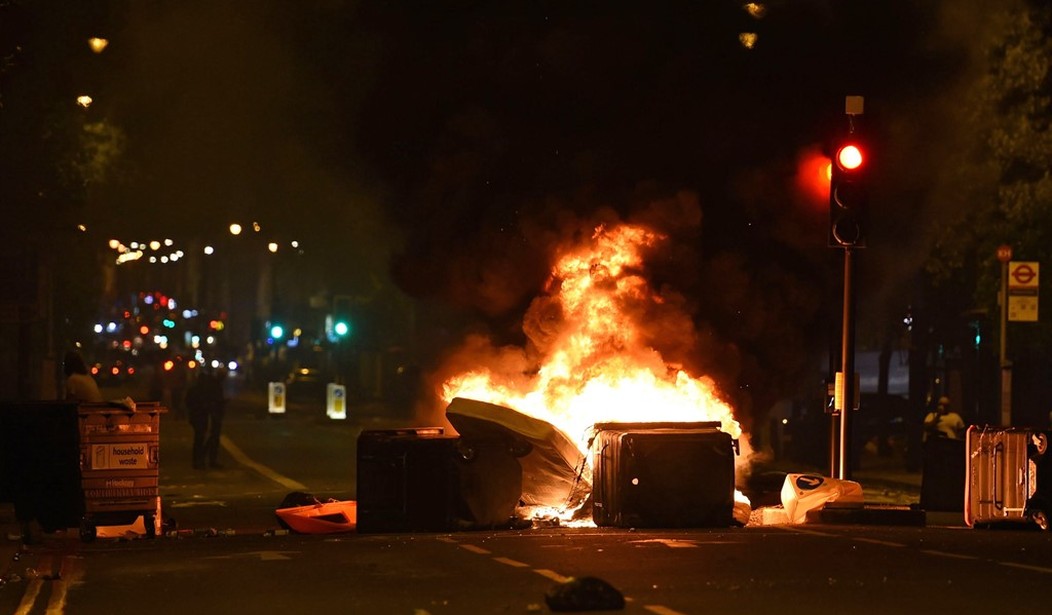
But now, it seems that the situation is reversing. The UK has allowed in waves of "refugees" and "migrants," people who have no intention of assimilating to British culture. Now they are paying the price. In Clapham, a neighborhood just to the south of central London, recent nights have been marked by chaos, thanks to untold numbers of what are described as "African-Caribbean" immigrants, who are feeling their oats.
On the nights of March 29th and Tuesday 31st, public disorder broke out in Clapham. Hundreds of largely African-Caribbean heritage youths gathered along the high street (organised as a ‘link up’ beforehand on social media), proceeded to steal from shops and carry out acts of criminal damage – although the primary purpose seems to have been to dominate the public space through force of numbers and menacing behaviour.
The Retail Director of Marks & Spencer, whose Clapham outlet was one of the main targets of the crowd, has directly criticised London Mayor Sadiq Khan for being soft on crime. The police, yet again failing to realise that perception is everything, took a softly-softly approach and made few arrests, promising to feel the collars of the wrongdoers later.
Have those collars been "felt?" (I'm presuming that's either a typo or some British-ism I'm not familiar with.) But we should note that these youths, mostly young men of military age, from the looks of them, were not stealing because they were hungry, or because they were poor. They were stealing because they could - and because they wanted to send a message.
The message? "We're taking over, and there's nothing you can do about it."
Naturally, liberals have attempted to away the mayhem as it simply being a matter of there not being enough ping-pong tables for teenagers. But this was not just youth culture expressing itself. It was a public demonstration of power: brazen, co-ordinated and utterly predictable. These adolescents were sending a message: that the streets can be claimed, rules can be broken and authority can be ignored, all without consequence. And it did not occur in a vacuum. Why are the African-Caribbean youths who rioted last week so disengaged from any sense of British common life, despite being born and brought up in this country?
Because there was no coherent policy to screen immigrants. Britain lets in anyone, from anywhere, including people like these, who appear to have no desire to become British. And, there are social pathologies involved, some of which the left really, really doesn't want to talk about.
The first failure is the most obvious and the most routinely avoided: parenting. Too many of the young people involved in these scenes have not been properly raised. They are being managed and indulged by a timorous state and, in some cases, effectively left to raise themselves. It is visible in their behaviour. Teenagers who think it is acceptable to swarm a public space for online attention have not absorbed basic lessons about respect, restraint or responsibility.
This, though, is one of the worst problems:
Another unpalatable truth in relation to the African-Caribbean diaspora in the United Kingdom is absent fathers. Where stable male role models are missing, boys in particular are more likely to seek identity and validation elsewhere, often in peer groups who revel in risk, defiance and spectacle. The ‘link up’, then, becomes a proving ground. Status is earned not through achievement but through visibility and bravado. The louder, the more chaotic, the more attention grabbing the act, the greater the renown – as witnessed by the notorious ‘Mizzy’ phenomenon a few years ago.
There's a lot to unpack here.
Read More: Dem Senators Brush Off Grieving Father of Woman Killed by Illegal Immigrant
New York Prosecutor Sidesteps Sanctuary Law to Keep Guatemalan Child Molester Behind Bars
First, some of these cultural issues are far from unique to the Third World. We are seeing many of these same social pathologies here in the United States, among our own, home-grown, mostly urban cohorts. Yes, these African-Caribbean families have a horrible problem with absentee fathers. But so do American cities. At present, one in four American children grow up without a father in the home. And the incidents like the Clapham riots are happening here, as well. So, that's a cautionary note, but it is one that we are already dealing with here.
Second, while the absence of fathers in these communities is a matter of concern, there's a larger, more fundamental issue: Unchecked, unscreened migration from low-trust societies. A majority of Americans and Brits don't refrain from throwing rocks at cops and breaking into shops to look because they are worried about going to jail. They refrain because of a deep-rooted cultural conviction that stealing and assaulting people is wrong. But much of the world isn't like that. I remember some years ago, being treated to a startling sight while working in Johannesburg, South Africa. Our morning commute often took us past a high-end car dealership: Used BMWs, Mercedes, and the like. (I say "often" because we took a different route every morning, which will tell you all about the state of Jo-Burg in those days) Now in the United States, most people won't think about stealing a car, because it's wrong. But in South Africa, at least then, people didn't steal those cars because, just inside the razor-wire fence surrounding the dealership, was a guard with a submachine gun.
That's the difference between a high-trust society and a low-trust society.
Britain has imported hundreds of thousands of people from societies like that. So have we. Britain has already paid the price for that. So will we.