
A great deal of ink has been spilled in recent weeks about Iran's nuclear capability, about the Trump Administration's Operation Midnight Hammer that reportedly destroyed most of that capability, and rumors that some nuclear weapons development is still going on, somewhere in the Islamic Republic. It's a capability that the civilized world insists the mullahs must not be allowed to have, in no small part because of one near-certainty: If they manage to put together a nuclear weapon, they will use it.
Iran is known to have had, and very likely still has, chemical weapons capabilities as well. That's unsettling for several reasons, not the least of which is that many potent chemical agents are chemically similar and are produced in much the same way as compounds with legitimate peacetime purposes, from pharmaceuticals to agricultural pesticides.
A recent report from the Foundation for Defense of Democracies' Andrea Stricker has some unsettling details as to where Iran may be with this.
The United States, Israel, and several Western allies assess that the Islamic Republic of Iran has long had an illicit chemical weapons program despite its status as a state party to the 1997 Chemical Weapons Convention (CWC). During the regime’s deadly January 2026 crackdown, Tehran may have used poisonous chemicals against Iranian protesters, several groups and individuals allege. While the CWC does not ban the use of riot-control agents (RCAs) — such as tear gas — for domestic law enforcement purposes, state parties must declare their stocks of RCAs and refrain from the use of aerosolized chemicals that act against the central nervous system or chemicals that produce lingering, debilitating effects. Such use is tantamount to using chemical weapons.
Iran's being a party to the 1997 CWC, of course, isn't worth the paper it's printed on. Iran under the mullahs simply cannot and should not be trusted any further than a toddler can throw a grand piano. Iran and Iraq are thought to have both employed chemical weapons in the Iran-Iraq War in the 1980s, and it stands to reason that Iran still maintains some of these capabilities now, and with improved delivery systems, at that.
Israel apparently knows what's up here, and they have perhaps the most reason to be concerned.
In addition to new claims about Iran’s use of chemical weapons against protesters, Israel’s deputy ambassador to the Netherlands, Yaron Wax, declared on July 1, 2025, “Over the past two decades Iran has been developing a chemical weapons program based on weaponized pharmaceutical agents. These agents, primarily anesthetics, affect the central nervous system, and can be lethal even in small doses.” Wax made these accusations before a special meeting — called by Iran — of the OPCW (Organization for the Prohibition of Chemical Weapons).
There are several serious concerns here, but here are the two big ones:
First, unlike the development of nuclear weapons, the development of chemical weapons doesn't have to be a massive industrial operation. It can be scattered far and wide, spread out to small labs and workshops, and Iran is a pretty big country with lots of small, remote towns and villages.
Second, unlike the development of nuclear weapons, a lot of chemical compounds that are used in chemical weapons are very similar to many used in various legitimate applications, ranging from medicine to agriculture. Case in point: Iran is apparently working on applications using opioids, one of which is very familiar to the American law enforcement and military communities: Fentanyl.
In addition to new claims about Iran’s use of chemical weapons against protesters, Israel’s deputy ambassador to the Netherlands, Yaron Wax, declared on July 1, 2025, “Over the past two decades Iran has been developing a chemical weapons program based on weaponized pharmaceutical agents. These agents, primarily anesthetics, affect the central nervous system, and can be lethal even in small doses.” Wax made these accusations before a special meeting — called by Iran — of the OPCW.
Worse, there are indications that Iran may be working to combine these with other technologies, including using drones as delivery systems.
Weaponized (Pharmaceutical-based Agents, or PBAs) are made from legitimate pharmaceutical compounds and are typically aerosolized, or distributed through the air via a fine spray. They can be delivered, for example, via drone-carried grenade. PBAs target the central nervous system of victims and incapacitate or kill them.
These act in much the same way as nerve agents, some of which can kill with a pinhead-sized drop on bare skin.
Read More: New: US F-22s Land in Israel Amid Iran Nuclear Showdown
Trump Officials Drop Urgent Iran Nuclear Update on Congress Pre-SOTU
Iran may well already have these capacities. There are claims of symptoms among protesters that may be consistent with exposure to some kind of chemical agent beyond an irritant, like tear gas. This wouldn't necessarily present a threat to American or even Israeli forces, as any conflict is expected to see the United States and Israel mostly providing air cover to Iranian rebels, along with targeted strikes on Iran's military and government.
But the rebels? And what if the Islamic regime, seeing defeat on the horizon, launches a chemical weapons-carrying drone swarm against Israel? The USA has forces in the region, but they can be presumed to have at least some capability to shield personnel from chemical weapons. A fentanyl-bearing drone swarm could do enormous damage to Israeli towns and cities.
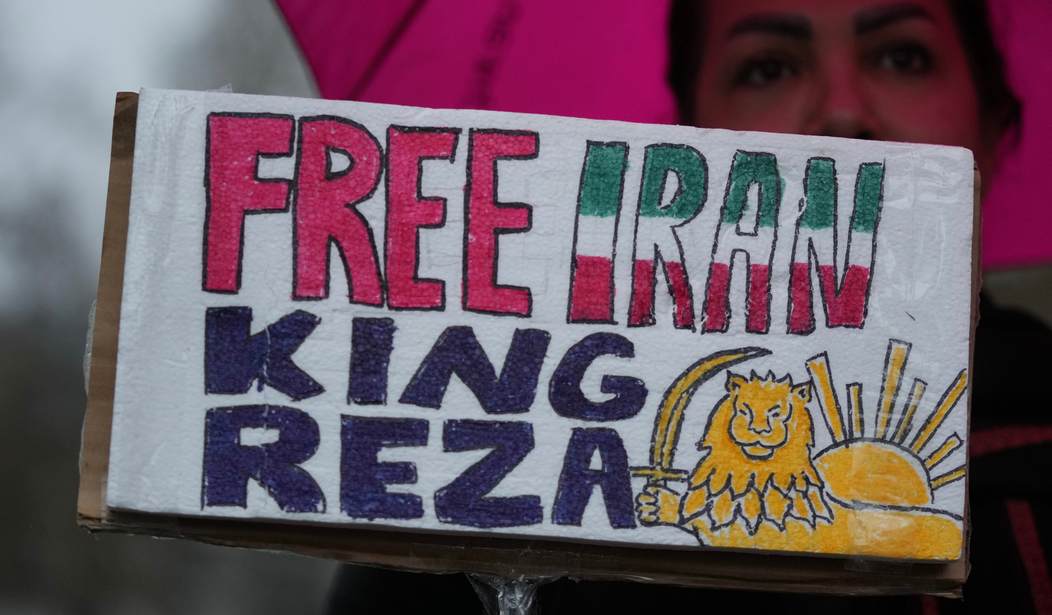
The Iranian regime has shown, by direct action and by supporting Islamic terror groups, that it is capable of almost any kind of atrocity. Like nuclear weapons, this is a capability that the mullahs cannot be allowed to have, but dealing with it, eliminating the clear and present danger Iran's chemical capabilities represent, is a much tougher nut to crack. In the end, only the removal of the mullahs and their theocratic regime will solve the thorny problem that is Iran.