
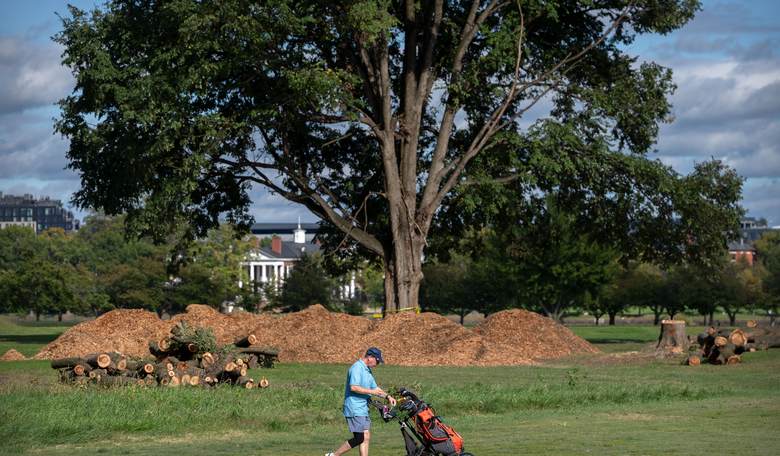
So...the legal battle over President Donald Trump's planned transformation of Washington, D.C.'s East Potomac Golf Course just got a whole lot more interesting. Late on Monday, U.S. District Judge Ana Reyes issued a whopping 70-page opinion granting a preliminary injunction that bars the administration from removing additional trees at the historic course and requires 10 business days' written notice before making other irreversible changes to the park.
But the trees are only part of the story.
As we've previously reported, this dispute began when preservation advocates and golfers challenged Trump's plans to replace East Potomac's three public courses with a championship-style course designed by renowned architect Tom Fazio.
The administration has maintained that the project remains in the planning stages. Meanwhile, the National Park Service (NPS) removed hundreds of trees earlier this month, insisting that the work was merely an effort to restore the property's historic appearance, unrelated to Trump's proposed redevelopment.
Reyes is — well, skeptical may be an understatement.
⚖️ In DC Preservation League v. Department of Interior (East Potomac Golf Course), Judge Ana Reyes (D.C.) GRANTS plaintiffs’ motion for a preliminary injunction, barring further tree removal and requiring 10 business days’ advance notice of irreparable modifications to the park, after finding plaintiffs likely to succeed on their claim that the administration improperly segmented the golf course redevelopment to avoid NEPA review. https://t.co/2AZHdgX0q9
— Susie Moore ⚾️🌻🐶 (@SmoosieQ) October 27, 2026
In Monday's opinion, she concluded that the administration has, in fact, settled on a plan to replace the existing course — and that the tree removal was part of that larger undertaking.
The reason that is significant is that federal environmental law generally requires agencies to assess the environmental consequences of major projects before proceeding. The government can't avoid that obligation simply by chopping a larger project into smaller pieces and treating each one as routine maintenance.
Reyes found that the administration likely did exactly that, improperly separating the tree removal from the broader redevelopment to avoid more extensive environmental review. And (this likely won't come as a shock if you've been following this saga) she didn't mince words about the government's explanations.
The judge pointed to President Trump's repeated public announcements, including his October 18 declaration that Interior Secretary Doug Burgum had developed a plan for the new course and that construction would begin November 15. Unfortunately, those statements directly conflicted with testimony from Interior officials who maintained that no final plan existed.
Reyes concluded that the government's explanation for the tree removal was a pretext and specifically found the testimony of Burgum's deputy chief of staff, Gregory Wischer, not credible. She also characterized an earlier declaration from Acting NPS Director Jessica Bowron as misleading because it omitted the impending large-scale tree removal, even though Bowron was involved in reviewing the plan.
And the judge raised questions about the role of Department of Justice (DOJ) attorneys in those representations. In fact, Reyes ordered the government to explain by Wednesday morning why she shouldn't require relevant officials — including DOJ attorneys and staff — to preserve information concerning the redevelopment plan and the circumstances surrounding the tree removal.
Now, to be clear, that isn't a contempt finding or a determination that government lawyers knowingly misled the court. But it opens another potentially significant front in an already contentious proceeding.
There's also an important limitation to Monday's ruling: Reyes hasn't permanently prohibited the administration from redeveloping the golf course. The injunction preserves the existing conditions while litigation continues, giving the parties time to sort out whether the government complied with federal law.
And there's a better-than-even chance the D.C. Circuit will be getting involved. The administration has already challenged Reyes's handling of the case, unsuccessfully seeking her disqualification. Now it faces an injunction resting on findings that directly contradict its arguments about both the project's status and the reasons for removing the trees.
The DOJ has substantial grounds for an appellate challenge, particularly concerning the extent of judicial deference owed to federal agencies under recent Supreme Court precedent.
But for the time being, the administration's tree-clearing plans are on hold.
Reyes closed her opinion with a callback to an earlier observation:
"I am not the Lorax. I do not speak for the trees."
Instead, she wrote, she speaks for the rule of law.
Will the appellate courts see it the same way? Something tells me this one may ultimately be decided on (or by?) the back nine. ⛳️