
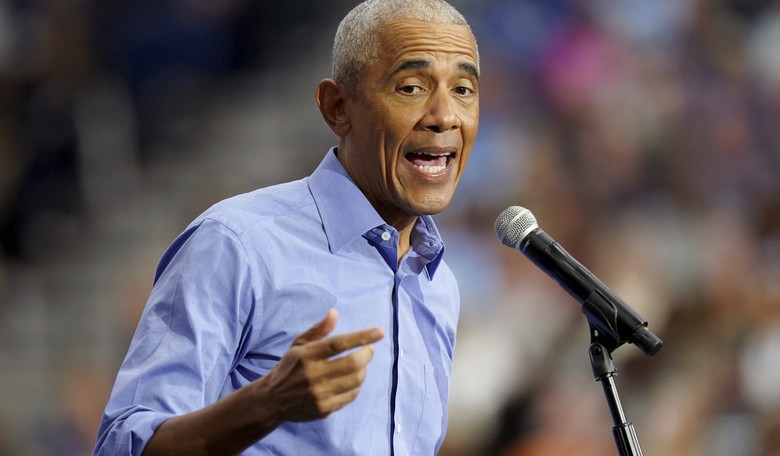
While stumping for Democrat Senate candidates, former President Barack Obama boldly told audiences Saturday that Iran has gained “veto power” over the Strait of Hormuz, and that the country occupies a “stronger strategic position” than it held before its conflict with the United States.
President Donald Trump likely had not anticipated needing to answer a former president’s public endorsement of an adversary’s claimed leverage over the Strait of Hormuz but responded quickly nonetheless.
Hours later, at a midterm election rally for Mike Collins' Senate campaign at Guardian Centers in Perry, Georgia, President Trump rejected that assessment, describing Obama’s 2015 Joint Comprehensive Plan of Action as “one of the worst deals ever made” and “a road to a nuclear weapon for Iran.”
Trump said U.S. forces had “obliterated Iran’s nuclear enrichment capacity with Operation Midnight Hammer and Operation Epic Fury” and defeated the regime “militarily, financially and otherwise.” He added that more oil is now moving through the Strait than before the war began, crediting the Navy.
Trump in Perry, Georgia, on the regime: "No leaders. Level one leader's gone, level two leader's gone. I got to stop because I got to figure out who the hell are we negotiating with?" Those leaders are the Islamic Republic's, not Iran's. Source: rally video. #NEWPERSIANTIMES https://t.co/dQKjEJOLKe
— The New Persian Times 🇮🇷🇺🇸 (@NewPersianTimes) October 25, 2026
Obama’s remarks, delivered at events in Ohio and Michigan, also included a dig at Secretary of War Pete Hegseth. “How much time do you think this defense secretary spends looking at himself in the mirror in the morning? You know he’s working his hair, because that’s how ‘warriors’ look,” before declaring that “these are not serious people.”
The comments, in which Obama appeared to adopt a more personal, appearance-focused style of attack more reminiscent of Trump’s rhetoric than of his own traditional tone, which has generally frowned on such remarks, drew no immediate named on-record response from the Pentagon or White House beyond Trump’s own rally statements.
U.S. Central Command has stated in recent weeks that the Strait remains open under U.S. and partner protection, that the large majority of Iranian attacks on commercial traffic have failed, and that significant portions of Iran’s conventional military capacity, including their naval and air-defense assets, have been degraded. Administration officials have also described Iran’s nuclear enrichment infrastructure as set back by the earlier strikes.
RedState has reached out to the Department of War for comment on former President Obama’s characterizations of Iran’s strategic position and any potential implications for the broader information environment and has not yet received a response at the time of this writing.