
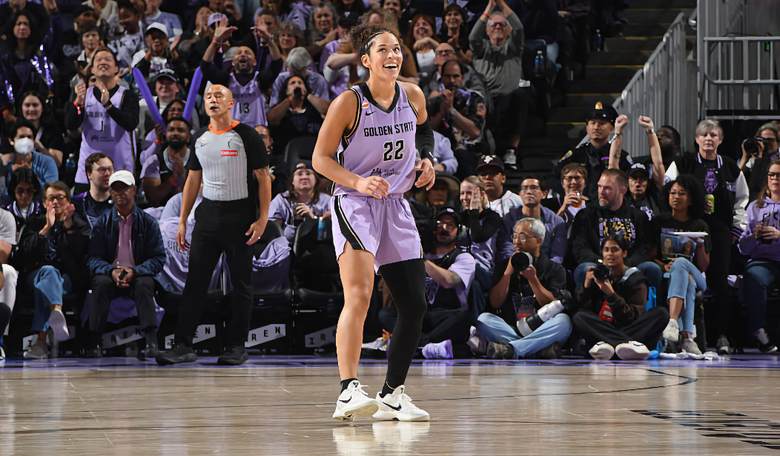
The 2026 WNBA Finals start this Saturday (October 17), with the Golden State Valkyries in their second year of existence hosting the Atlanta Dream.
The Valkyries do not have a roster of superstars. In fact, they do not have a superstar household name period on their roster. Instead, they are led by players such as Veronica Burton and Kayla Thornton, each of whom is an unapologetic and outspoken Christian. Golden State plays tenacious team defense and, when it has the ball, focuses on running actual plays to create open shots and penetrate the lane. The Dream is nominally led by Angel Reese, president of the Angel Reese Fan Club and always a ready source of blustery statements about how oppressed and discriminated against she is. On the court, Reese is a skilled defender, albeit no Atlanta fan's first choice to have the ball in her hands when their team needs to score. Still, she's better than she used to be, as she will doubtless be glad to tell you.
The Valkyries’ home games will be played, as has been the case since the franchise started in 2025, at Chase Center in San Francisco, home of the Golden State Warriors. The arena’s seating capacity for basketball is 18,064. Every seat will be sold, as has been the case for every Valkyries home game throughout the franchise’s brief tenure. Chase Center will be packed and pumped as the Valkyries enjoy fervent fan support, turning the place into what the team’s supporters affectionately call Ballhalla, where Violet (the team’s bookish-looking mascot) and company enjoy a massive home advantage.
The demographics of Valkyries’ supporters defy the usual cliches of WNBA fans. For one, they are fans. Second, they come in all shapes and sizes. My day job is at a sporting goods store that, in addition to exercise and competitive games equipment, sells a good-sized amount of local team apparel, which has led to many genuinely delightful exchanges between myself and customers shopping for their team and player of choice. A recent example featured my tracking down a Kaitlyn Chen jersey for the sweetest senior citizen imaginable, who was beyond excited to attend her first Valkyries game the next day with her church group. I’ve also noticed, with a certain amount of amusement, a steady stream of unhappy-looking husbands being marched right past the store’s large displays of 49ers merchandise by their wives, who with steely eye and determined gait are heading directly toward the Valkyries area.
The Dream’s home court is far more, shall we say, intimate. And reflective of how, despite relentless promotion, the WNBA only works when it offers integration with the community over demanding worship of individuals. Starting in 2021, Atlanta’s home court has been Gateway Center Arena in College Park, Georgia, with a seating capacity of 3,500. The team will move to State Farm Arena in Atlanta proper, home of the NBA's Atlanta Hawks, with a basketball seating capacity of 17,608, next year. The Dream has already played a few games at State Farm Arena, including its two regular-season matchups this year with Caitlin Clark and the Indiana Fever, as well as its three 2026 postseason games played thus far. The average attendance for the two regular-season home games against the Fever, with each team winning once, was 17,044. The average attendance at the three Atlanta home playoff games this year, one against the Washington Mystics and two against the New York Liberty, was 9,695.
One would expect attendance to increase for the Finals. Problem is, it may not have the chance. The Dream cannot play any of its three possible home games at State Farm Arena because it has long been booked for the nights in question, once for a concert and twice for Hawks regular-season games. Thus, the WNBA is faced with the prospect of trying to convince the populace that it is a league on the ascent, which it could do by using the Valkyries as an example, when one of the two teams competing for the championship is forced to play its games in an arena dwarfed by not a few high school gymnasiums.
The WNBA being its own worst enemy is hardly a recent development. From its patented inability to market its stars unless they are a specific demographic, to going silent when vile accusations of racism are made, the league is a master class on how not to do business. People accuse the NFL of continuing to pander to the woke mob with its ongoing embrace of cheap sloganeering. Still, compared to the WNBA, it is a model of level-headed social neutrality. The league would doubtless prefer the Dream win the Finals so it can send Angel Reese on a lapdog media victory tour. For myself, I’m unashamedly pulling for the Valkyries. It’d be nice to see an actual team win and finish off this self-inflicted train wreck of a season on a positive note.