
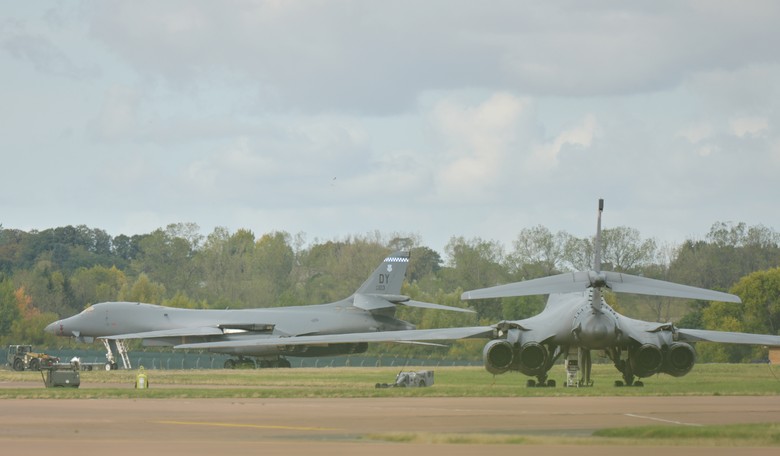
Over the weekend, the United States Department of War yanked all 12 of the B-1B (Bone) Lancer strategic bombers that had been based at the RAF Fairford base. This is the base that was the apparent target of a possible terror attack earlier in the week. The bombers were removed, according to U.S. officials as reported in a New York Times story, because of an unspecified threat from Iran.
The United States rushed over the weekend to withdraw all 12 B-1 Air Force bombers from an air base in southern England after commanders received new threats about an Iran-backed plot against the installation, two U.S. officials said on Sunday.
The withdrawal was highly unusual: Such moves are rarely made so quickly from an allied air base in a peacetime country thousands of miles from a combat zone.
The need to move the bombers out of the base, R.A.F. Fairford, was deemed so urgent that some of the planes and their flight crews left while aerial refueling aircraft were still being scrambled to support their flights to the United States. At least three of the planes had landed at their home base in South Dakota by Sunday, the officials said, speaking on the condition of anonymity to discuss operational matters.
This move was carried out with alarming alacrity, which would cause one to believe that 1) any threat was deemed credible, and 2) if last week's attempt, for which six men of Iranian descent were arrested and quickly released, was attempting some kind of trial run. The Islamic Revolutionary Guard Corps (IRGC) is suspected to be involved in the plot.
The Pentagon has made a statement, which appeared Sunday in the Wall Street Journal.
“While operational security precluded us from confirming the movement of our assets and forces in real-time, we can acknowledge now that all U.S. bombers that were deployed to RAF Fairford have redeployed to their home stations in the United States,” the Pentagon said in a statement, adding that the U.S. bombers remain ready to carry out attacks from the U.S. The U.K. Ministry of Defense declined to comment.
In the initial phases of the war against Iran, both B-1 and B-52 bombers were based at RAF Fairford, due to its long runways that can handle a heavily loaded strategic bomber. The B-52s had already left, and most of the B-1 bombers had also redeployed to their home stations; these six which just departed were the last U.S. bombers on that base.
Now, here's the thing: While these bombers were removed with remarkable speed, the very fact that they were moved so quickly would seem to indicate that the threat was not only deemed credible, but also that the timeline for said threat means some action was imminent. And, while the Bones can hit targets in the Middle East from the United Kingdom without any difficulty, deploying them from their stateside bases to the other side of the world presents a much more complicated logistics problem.
Note also that any successful attack on any of our aircraft, if tracked back to the IRGC or the Iranian government, would likely warrant a kinetic response on the part of the United States, and by "kinetic response" we can safely substitute "a lot of stuff is going to be blown up."
And, again, this is a developing story. Stay tuned.