
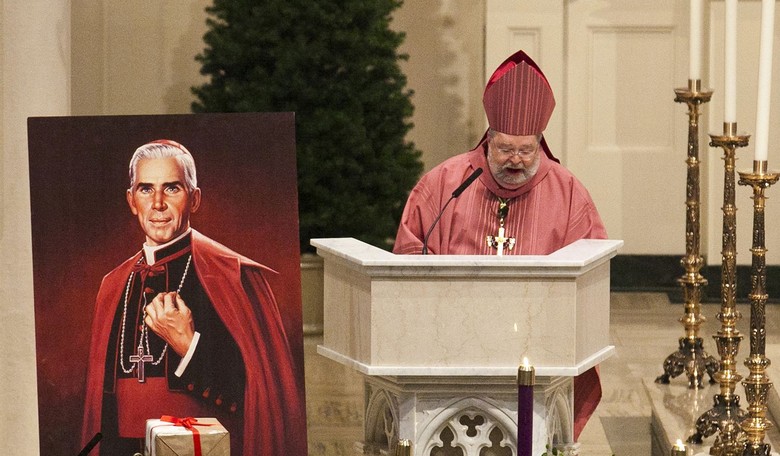
Archbishop Fulton Sheen made opposition to communism a major part of his public ministry decades before the collapse of the Soviet Union. Now, with Sheen's beatification on Thursday in St. Louis, Bishop Robert Barron says the ideology Sheen spent years fighting has returned to American politics.
Barron, bishop of the Diocese of Winona-Rochester in Minnesota and founder of Word on Fire, delivered the warning from St. Louis in a video obtained by Fox News Digital. His assessment is blunt.
"Now, you don't need me to tell you that communism is making a comeback right now in our country."
Barron called Sheen "one of the great voices against communism in mid-20th century America." His message to church leaders was just as direct.
"And I think especially churchmen need, like Sheen, to raise their voices against it and, furthermore, as American churchmen, to speak out strongly on both American and Catholic principles against the re-emergence of this still very dangerous ideology."
Sheen left little ambiguity about what he meant. In his 1948 book, "Communism and the Conscience of the West," he described communism as a "complete philosophy of life" that sought control over man's inner life as well as the state.
Barron went back to the religious argument at the center of Sheen's opposition.
Religion is a problem for communism.
"Fulton Sheen knew that atheism was not incidental to communism; it was essential to it," Barron said. Sheen understood that removing God also threatened the foundation for individual rights and freedom, Barron argued.
"Sheen knew if you take God out of the picture, you take equality, rights, freedom out of the picture. Our integrity as a democratic society is dependent ultimately on our belief in God."
Barron was making the Sheen comparison before this week's beatification as well. During a Sept. 17 interview with Raymond Arroyo, he pointed directly to the communist threat Sheen identified during the early Cold War, and to Marxism's hostility toward religion as something no government seeking total control can easily tolerate.
"The fact that Sheen took on communism back in the 1940s and '50s, when he correctly discerned it was threat No. 1 ... well, it's back. It's back in institutional form in different places around the world, but also in our own country."
Barron said Sheen saw communism's "deep antipathy toward God, the things of the spirit and the moral order" as a direct threat to the values of the West.
Barron's warning comes as socialist organizations are posting measurable gains in American politics. The Democratic Socialists of America (DSA) announced in July that its membership had topped 120,000, which the organization said made it larger than the Socialist Party of America was at its 1912 peak.
DSA-backed candidates have also piled up several dozen victories in Oregon, California, Georgia, and New York, and several other states this election cycle.
President Donald Trump has been sounding the same alarm. After a series of socialist-backed primary victories in June, Trump wrote that "The Communists are finally making their move. I've been waiting and preparing for this for a long time." Then, during his July 4 remarks, Trump declared that America would "never be a communist country," warning that Americans did not fight communism overseas only to watch it reappear at home.
The issue reached the House floor earlier this month when 192 Democrats voted against a resolution condemning socialism "in all its forms." All Republicans voted yes, eight Democrats crossed the aisle, and two voted present. The final tally was a shocking 220-192. The resolution specifically cited the Democratic Socialists of America and positions contained in the group's platform.
Trump has been sounding the alarm from the campaign stage. Barron is approaching it from the pulpit and the history of the Catholic Church. Sheen was doing it from American television sets generations ago.