
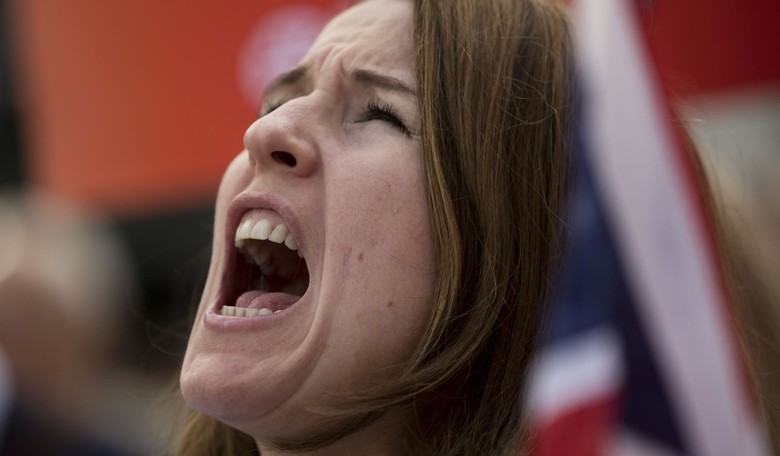
The Brits’ simmering anger over mass migration is getting hotter than a tea kettle.
Their fury spilled onto the beaches of Portsmouth on Sunday — complete with protesters in the water, blocked coaches, a major police response and even women arriving in kayaks to try to block roughly 140 immigrants from reaching shore.
The extraordinary scenes unfolded at Eastney after a migrant boat was intercepted in the Solent off England's southern coast.
🚨BREAKING: Locals are blocking coaches carrying the illegal migrants who were unloaded at Portsmouth port pic.twitter.com/RIpsMs6ZXN
— GB Politics (@GBPolitcs) September 6, 2026
It was not the typical Channel crossing ending at Dover.
The vessel had reportedly traveled from the Normandy coast before reaching waters near Portsmouth, where Border Force, the Coastguard, lifeboats and police converged for a major operation.
British authorities eventually brought approximately 140 people ashore, with plans to transport them to the Manston migrant processing center in Kent.
🚨NEW: Hundreds of locals have now gathered outside Portsmouth port and are not allowing any coaches carrying illegal migrants to leave
— GB Politics (@GBPolitcs) September 6, 2026
Danny Tommo, the organiser of the movement, has said "the stand-off might last for days" pic.twitter.com/qa0zbOY12g
Then the protesters started arriving. Hundreds descended on the area as word of the landing spread online. Some moved toward the beach. Others gathered around the roads where coaches were waiting to carry the migrants away.
Riot police clash with protestors in Portsmouth after small boat arrival. Shot for @PA pic.twitter.com/JavKFpfVVa
— Jamie Lashmar (@jamie_lashmar) September 6, 2026
Video from the scene showed protesters attempting to obstruct the operation while police scrambled to establish control.
🔺 Chaos in Portsmouth as a man in a wheelchair Is pushed through the riot police and a police bike is battered by patriots pic.twitter.com/Uv7wbchhrW
— Southampton Times (@sotontimes) September 6, 2026
And then came perhaps the most quintessentially British image imaginable: women in kayaks joining the action from the water.
Portsmouth is the home of the Royal Navy
— Sophie Corcoran (@sophielouisecc) September 6, 2026
They won’t defend our shore from foreign invaders
But a nan in a kayak will pic.twitter.com/40wwU2iLsk
Footage circulating online showed older women paddling toward protesters positioned near the shoreline, an image that quickly became emblematic of just how unusual the confrontation had become.
It takes a lot for the British to even complain about their tea, let alone join a mass revolt over unwanted foreigners.
Police eventually issued a dispersal order as tensions escalated. Officers carrying shields moved protesters back, while the operation to remove the migrants continued.
The Portsmouth confrontation didn't come out of nowhere.
It came just one day after hundreds of masked demonstrators dressed largely in black descended on Dover and effectively brought Britain's busiest ferry port to a halt.
Young masked men dressed all in black suddenly emerged from trucks in the Port of Dover yesterday to block illegal migrants from being disembarked on British soil by the authorities
— Visegrád 24 (@visegrad24) September 6, 2026
🇬🇧 pic.twitter.com/R8YQK1UJkL
Protesters linked arms across major roads leading into the port while chanting “stop the boats.”
Traffic backed up for miles. The A20 was affected. Ferry passengers faced delays. At one point, access to the port was completely blocked.
🇬🇧 Statement made.
— 🇬🇧💥𝕾𝖙𝖆𝖓𝖉 𝕱𝖔𝖗 𝕭𝖗𝖎𝖙𝖆𝖎𝖓💥🇦🇺 (@Maxwellpainn) September 5, 2026
Zero violence. A message sent.
That is what Dover looked like today. A solid column of men in black moving through the streets, arms in the air, faces covered, the hill rising behind them.
They did not burn anything. They did not throw a single punch. They… pic.twitter.com/kbqwfVAGTX
A local Conservative councilor described the demonstration as “coordinated,” saying several hundred protesters appeared to have arrived overnight before positioning themselves on roads into Dover.
Kent Police reported no arrests, and normal port operations resumed around midday.
Two major ports. Two days. Two significant attempts to disrupt the country’s most controversial import: Foreigners.
That is quite the escalation from much of the anti-immigration protest activity Britain has seen over the past year.
The country's protests initially centered heavily on hotels being used to house asylum seekers. Epping became one of the most visible flashpoints in 2025, and demonstrations subsequently appeared around asylum accommodations in numerous British communities.
The politics surrounding the issue have become increasingly combustible as Britain has struggled for years with record or near-record immigration, an asylum backlog and the highly visible phenomenon of migrants arriving across the English Channel in small boats.
The small-boat numbers have actually fallen substantially this year. Government figures cited by the Associated Propagandists show crossings running roughly 40 percent below last year's level. But more than 40,000 people made the crossing in 2025, and the political argument clearly hasn't disappeared with the decline.
If anything, this weekend suggests that at least part of the protest movement is changing tactics. Hotel demonstrations are one thing. Physically blocking access to Dover is another.
Showing up at the location where a migrant vessel is being brought ashore and attempting to prevent coaches from leaving takes the confrontation another step further.
Portsmouth followed Dover within roughly 24 hours. And Britain isn't the only part of the British Isles where immigration has produced increasingly volatile street politics.
Across the Irish Sea, Ireland and Northern Ireland have experienced their own wave of demonstrations — and, in several cases, serious confrontations.
Hundreds marched through Dublin on June 10 demanding a referendum on the European Union's Migration and Asylum Pact. Demonstrators moved from O'Connell Street toward Leinster House, temporarily disrupting traffic and public transportation.
"GET THEM OUT! OUT, OUT OUT!
— The Flare (@TheFlareNews) June 27, 2026
SAVE THE NATION—REMIGRATION!"
Thousands present at anti-immigration rally in Dublin City Centre.@TheFlareNews https://t.co/wFhFe2bSBF pic.twitter.com/nYENBZ3Xom
Another national anti-immigration demonstration drew hundreds into central Dublin later that month. Protesters carried Irish flags and banners opposing the EU Migration Pact while chanting “help Ireland, not the world” and “get them out.”
The scene turned darker in Northern Ireland. A brutal knife attack in Belfast in June, allegedly carried out by a Sudanese man, triggered several nights of anti-immigration protest. Homes and vehicles were set on fire, police came under attack and authorities deployed water cannon as masked groups clashed with officers.
The disorder ultimately lasted three nights, with immigrant families reporting that they fled their homes after addresses purportedly belonging to migrants circulated online.
That violence is a deviation from the largely nonviolent disruption seen at Dover this weekend, and it shouldn't be conflated with peaceful anti-immigration demonstrations.
But taken together, the episodes point to something portentous happening across Britain and Ireland: The fight over immigration is moving out of the parliament and into the streets.
Portsmouth may be the most enduring sign of that change yet.
After a migrant boat arrived unexpectedly on Britain's southern coast, hundreds of protesters raced to the scene.
Police formed lines. Coaches were blocked. Demonstrators moved to the beach. And then grandmas showed up in kayaks.
People from every walk of life now feel concern that the government may have a darker motive for all of this mass migration than simply ‘being kind to refugees.’
Britons fear they are losing their country. Americans watching in horror from across the Atlantic also fear that they might be right.