
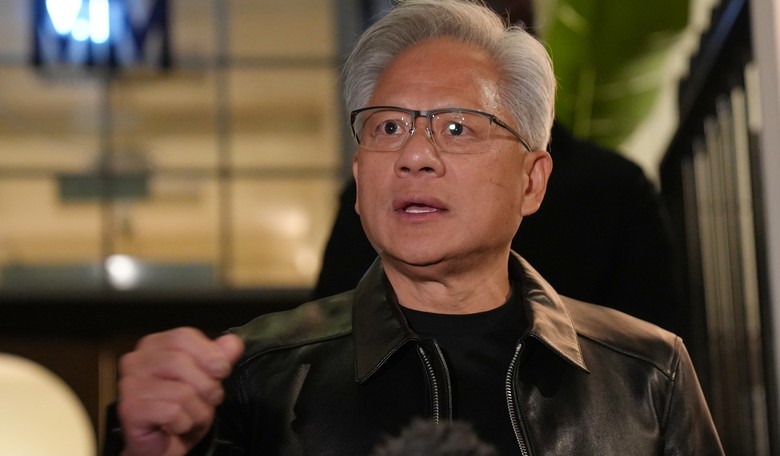
Ousted Nvidia CEO Jensen Huang was reportedly on the verge of a major artificial intelligence breakthrough that threatened the trillion-dollar business model of Anthropic, whose CEO has been clamoring for stronger government regulation of the industry.
The timing could hardly be more striking. Huang was forced out of the world's leading AI chipmaker just days before Anthropic, one of the industry's biggest developers of proprietary AI models, is expected to go public at a valuation potentially reaching $1.4 trillion.
A new Business Insider investigation reveals that Huang was assembling an ambitious technological and financial strategy that could undermine the dominance of Anthropic and OpenAI by making sophisticated AI models widely available for businesses to customize and operate independently.
One industry executive described the emerging confrontation as a "Cold War."
"People really need to understand that the 'Cold War' going on here is that Nvidia was on a titanic collision course with the labs," the executive told Business Insider.
The ramifications for Big Tech are enormous. Anthropic, led by CEO Dario Amodei, depends on developing powerful proprietary AI systems, including its Claude models, and charging customers for access. Businesses typically pay recurring fees based on how much of the technology they consume.
Huang was developing an alternative. Through Nvidia's Nemotron family of open-weight AI models, businesses could download sophisticated AI systems, customize them for their own applications, and operate them on their own computing infrastructure without continuously paying Anthropic or OpenAI for access.
These systems still require expensive computing resources, but the approach could dramatically reduce dependence on proprietary AI providers while threatening their premium pricing.
For Nvidia, which sells the processors that power much of the AI industry, that could mean an explosion in hardware demand. For Anthropic, it could mean losing customers to competitors offering increasingly capable alternatives at significantly lower costs.
This was hardly some wild-eyed tech experiment. In March, Nvidia launched its Nemotron Coalition, bringing together major AI developers including Mistral AI, Perplexity, Cursor, LangChain, Reflection AI, and Thinking Machines Lab.
The objective was to develop advanced open AI models capable of supporting sophisticated enterprise applications, autonomous AI agents, and specialized reasoning systems.
Nvidia was also pursuing major investments in independent AI developers and the acquisition of Hugging Face, one of the world's leading platforms for distributing open AI models.
Huang was effectively building an alternative AI ecosystem that could make the industry's proprietary giants considerably less indispensable.
On November 3, just eight days before Nvidia's board accepted his resignation, Huang appeared at a Fireworks AI conference, championing specialized open models that businesses could adapt to their own needs.
Then the scandal broke. As Business Insider's Alistair Barr observed, Huang's technological strategy was just beginning to come together.
"But with Huang gone, the threat has diminished considerably."
The executive's removal is a boon for Anthropic since it incapacitates a Big Tech CEO opposed to regulating the AI industry in which it holds a commanding position.
As I previously reported at RedState, Anthropic has committed $40 million to Public First Action, an organization advocating stronger AI safeguards and government oversight.
Amodei has repeatedly warned about catastrophic risks associated with artificial intelligence and advocated stronger government intervention, including measures to slow the development of the most powerful AI systems.
The company's public rationale is safety. But there is an obvious economic consideration that deserves scrutiny: Sweeping government regulation can also protect established companies from emerging competitors.
Large AI laboratories can afford expensive regulatory compliance operations, safety evaluations, and legal departments. Smaller developers producing open-source alternatives may find those requirements prohibitive.
As Silicon Valley investor Chamath Palihapitiya previously warned, imposing sweeping restrictions on the emerging industry could effectively freeze the market in favor of a handful of powerful companies.
The upshot is that while Anthropic has been advocating stronger restrictions on AI development, Huang was promoting greater access to the technology through competition and private-sector innovation.
Replit CEO Amjad Masad went so far as to characterize Huang's removal as an "attack on open models" during a Silicon Valley conference Monday, according to Semafor.
There is also another side to the corporate rivalry: Anthropic has been developing software to run its AI systems across competing chip architectures, including those made by AMD, Google, and Amazon. That could erode Nvidia's dominance in the computing hardware market.
In effect, both companies were developing technologies that threatened the other's competitive advantages.
As RedState's Jennifer Van Laar reported Tuesday, Huang has now broken his silence, acknowledging serious personal misconduct while signaling that he would consider returning to Nvidia.
"I did not live up to the standards expected of everyone at NVIDIA, and I have made serious mistakes in my personal life," Huang stated. "I created problems for the Board that I deeply regret."
Huang emphasized that Nvidia's future was important not only to its shareholders but also to the United States.
"NVIDIA is a once-in-a-generation company," he said, adding that he would be honored to return if the board determined it was in the company's and America's best interests.
Huang is scheduled to testify before the House Foreign Affairs Committee on December 1.
There is no evidence that Anthropic played a role in Huang's ouster, and Nvidia may conceivably develop its open AI products under new leadership.
But the timing is critical. Just as Anthropic prepares for one of the largest IPOs in history, the executive spearheading a major technological threat to its proprietary business model has been removed.
Whether Nvidia continues Huang's open AI revolution could determine whether artificial intelligence thrives in a marketplace or gets captured by an industry dominated by a handful of trillion-dollar corporations seeking Washington's patronage.
Whatever deals these Big Tech companies strike with the devil could decide the future of humanity.