
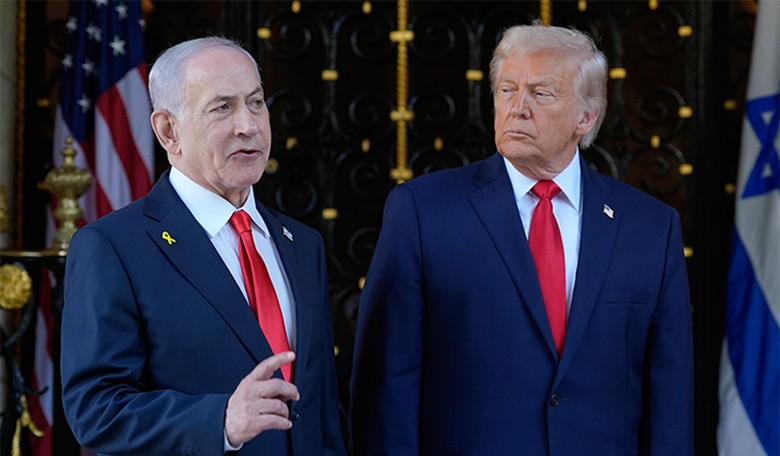
President Donald Trump has announced a major change in America's relationship with Israel.
Trump has revealed that the United States will stop providing approximately $4 billion in annual military assistance to the Jewish state at the end of 2026. And according to Trump, Israeli Prime Minister Benjamin Netanyahu has already agreed to the arrangement.
The announcement, made Tuesday during an appearance on Fox News' "Fox & Friends," represents a potentially major shift in a security partnership that has been a cornerstone of America's Middle East policy for decades.
"Now, as far as paying Israel, Bibi Netanyahu and I have made a deal that we give Israel $4 billion a year, and we made a deal months ago that we're stopping," Trump said.
"We've already agreed that by the end of this year we won't be paying Israel. Now we'll help Israel if they need it."
BREAKING: President Trump says the U.S. will end roughly $4 billion in annual aid to Israel by the end of the year, revealing that Prime Minister Benjamin Netanyahu agreed to the decision. “Because they don’t need it,” Trump said during an exclusive interview on @foxandfriends, describing Israel as a thriving country that no longer requires American financial assistance. Trump also said Netanyahu raised the idea of ending the aid himself. He emphasized that Israel remains one of America’s most reliable allies as the two countries prepare for a major shift in their financial relationship. Download the FOX News app for the latest details: https://t.co/ISpW9Fc0R3
— Fox News (@FoxNews) November 3, 2026
According to Reuters, Trump argued that Israel no longer needs the regular assistance. He also pointed to Democrats and other left-wing politicians who have used American funding for Israel as a "talking point" against Republicans.
Fascinating timing, considering that Trump made the announcement on Election Day in the United States.
The president has faced criticism from the populist Right over America's military commitments abroad, including billions of dollars in assistance to Israel. His announcement could help placate some of those critics by establishing that America's support for Israel doesn't necessarily mean writing blank checks in perpetuity.
Trump also left the door open to helping Israel in the future if circumstances warrant it. There is also the bigger picture. Under a 10-year memorandum of understanding covering fiscal years 2019 through 2028, the United States committed to seeking congressional funding for approximately $38 billion in military assistance to Israel.
That works out to $3.8 billion annually, including $3.3 billion in foreign military financing and $500 million for cooperative missile defense programs. Trump's announcing that the U.S. will slash the $4 billion annual payment closely matches the current outlays.
Trump's announcement comes during a major shift in Israeli politics. Netanyahu's governing bloc suffered a major setback in Israel's October 27 election, winning just 53 seats in the 120-member Knesset, according to the final vote count.
The opposition bloc led by Gadi Eisenkot secured 48 seats, while Arab-led parties won a record 19 seats. Neither major bloc currently commands the 61 seats necessary to form a government, leaving Israel facing difficult coalition negotiations and the possibility of another election.
Netanyahu remains prime minister while those negotiations continue, but his political future is uncertain. Trump had endorsed Netanyahu before the election, calling him a strong partner in confronting Iran. While that support was widely regarded as a political boost for the Israeli leader, it wasn't enough to preserve his coalition's parliamentary majority.
There is also a major change in the regional balance of power in the Middle East that makes Trump's decision easier. Israel has been forced to defend itself against hostile regional actors for generations, as was demonstrated recently by Hamas' October 7, 2023, terrorist attacks. But the security threat picture in the Middle East is rapidly changing.
America's military operations against Iran have damaged the regime militarily, and just as importantly, have hammered the mullahs' finances. This harms the ability of Iran's network of regional proxies, including Hezbollah and Hamas, to carry out terrorist operations against the U.S. and its ally Israel.
Thus, the timing and the regional security situation in the Middle East make this a pragmatic deal for Donald Trump, both in terms of feasibility and political optics.