






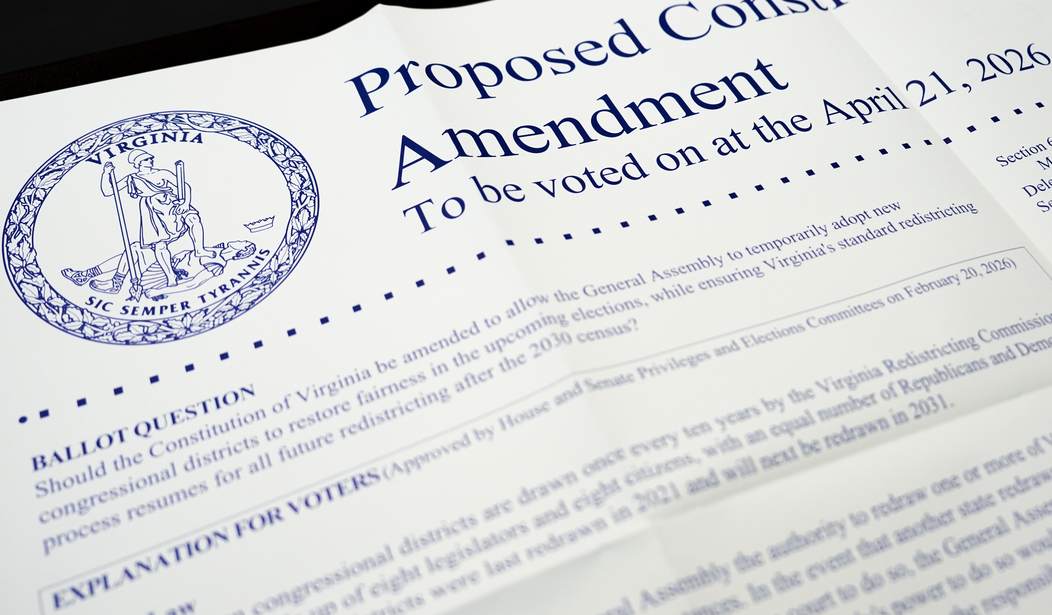
The Virginia Supreme Court’s decision to throw out a voter-approved redistricting amendment has House Democrats scrambling, and at least one option on the table would require blowing up the state’s entire Supreme Court to get there.
According to the New York Times, House Minority Leader Hakeem Jeffries of New York joined Virginia Democratic members of Congress on a call Saturday where lawmakers vented over Friday’s ruling and weighed their options. They did not land on a specific path forward, agreeing to consult with attorneys before making any moves. But one idea circulating on the call got people talking: using the Democratic-controlled Virginia General Assembly to lower the mandatory retirement age for state Supreme Court justices, forcing out the current bench and replacing it with judges more favorable to Democratic redistricting goals.
Go Further: The Crash Out Over the VA Redistricting Ruling Commences, and It's Only Going to Get Worse
What the Virginia Supreme Court Actually Ruled
The court’s 4-3 ruling, issued May 8, found that Democrats violated the Virginia Constitution’s process for placing amendments on the ballot.
Under state law, a proposed constitutional amendment must pass the General Assembly twice, with an intervening general election between votes. Virginia Democrats cast their first vote on October 31, 2025, after early voting for that year’s House of Delegates elections had already begun, with roughly 40 percent of ballots already cast. The court ruled that Virginia’s “general election” includes the early voting period, not just Election Day, meaning Democrats had already missed their window.
The majority wrote that the constitutional violation “incurably taints the resulting referendum vote and nullifies its legal efficacy.”
More on Democrats' Reaction: State Dems Plan to Appeal the VA Supreme Court Ruling on Their Gerrymander
The decision leaves in place the current congressional map, which gives Democrats a 6-5 edge in Virginia’s delegation. The amendment that voters approved 52-48 on April 21 would have drawn a new map giving Democrats a 10-1 advantage, a net swing of four House seats going into the November midterms.
According to the Virginia Mercury, the case had been working through the courts since a Tazewell County circuit judge ruled the amendment invalid in January. The state Supreme Court had allowed the April referendum to proceed while it reserved judgment on the underlying legal questions.
The Proposal Democrats Are Considering
The plan, as described by people who were on the call or briefed on it afterward, runs through several steps.
The first would invoke the Tazewell County circuit court ruling from January, which held that the 2026 constitutional amendment effort was invalid because county officials did not post the required notice at courthouses and other public locations three months before a general election. From there, Democrats would argue that the 2020 amendment creating Virginia’s bipartisan redistricting commission was similarly flawed, handing the legislature the power to draw congressional maps directly.
The second, more dramatic piece would have Democrats in the General Assembly lower the mandatory retirement age for Virginia Supreme Court justices from 73 to 54, the age of the youngest current justice. Because Virginia’s General Assembly appoints judges, and Democrats hold majorities in both chambers, the party could then fill the resulting vacancies with sympathetic appointees. A column in The Downballot, a progressive newsletter, floated a version of the idea Friday night, and it began circulating among lawmakers and congressional members shortly after.
Gov. Abigail Spanberger would need to sign any legislation lowering the retirement age. Her spokeswoman declined to comment to the Times, and Spanberger has not been briefed on the proposal.
Former Rep. James Moran, a Virginia Democrat, told the Times the court-stacking idea would be “just a bridge too far” and could backfire on the party. “We do have to keep our credibility,” Moran said. “We have to do things that pass the legitimacy test.”
Rep. Suhas Subramanyam of Loudoun County, who was on the Saturday call, took a harder line. “Everyone has got to have a strong stomach right now; this is a complete disaster waiting to happen if people are timid,” Subramanyam told the Times.
The Clock Is Already Running
Whatever Democrats decide, the calendar is not on their side. Steven Koski, commissioner of the Virginia Department of Elections, warned in a court filing last month that any map changes after Tuesday, May 12, “will significantly increase the risk” of the state being unable to properly prepare for its Aug. 4 primary. That gives Democrats fewer than 72 hours if they intend to act.
Democratic leaders have also signaled they plan to appeal the state Supreme Court’s ruling to the U.S. Supreme Court, though legal experts have cautioned that path may be a dead end. Because the Virginia court’s ruling rests entirely on state constitutional grounds, not federal law or the U.S. Constitution, the U.S. Supreme Court may have no jurisdiction to hear the case.
The Broader Redistricting Picture
The Virginia ruling is the latest turn in a nationwide redistricting battle that has tilted sharply toward Republicans in recent weeks.
According to NPR, Republicans had already flipped approximately 13 House seats their way through redistricting before the Virginia ruling, against roughly 10 for Democrats. With Virginia’s four potential pickup seats now off the board, the GOP’s net redistricting advantage could reach around 10 seats heading into November. The House currently stands at 217 Republicans to 212 Democrats.
The Republican National Committee, which filed an amicus brief in the Virginia case and brought a parallel legal challenge, welcomed the ruling. “Democrats just learned that when you try to rig elections, you lose,” RNC Chairman Joe Gruters said in a statement. “Today, the Virginia Supreme Court sided with the rule of law and struck down Democrats’ unconstitutional maps.”
Jeffries has not softened his tone. “It’s an all-hands-on-deck moment,” he told the Times Friday night. “We’re not going to step back, we will continue to fight back.”



Join the Conversation
VIP members get the ability to comment on articles.