






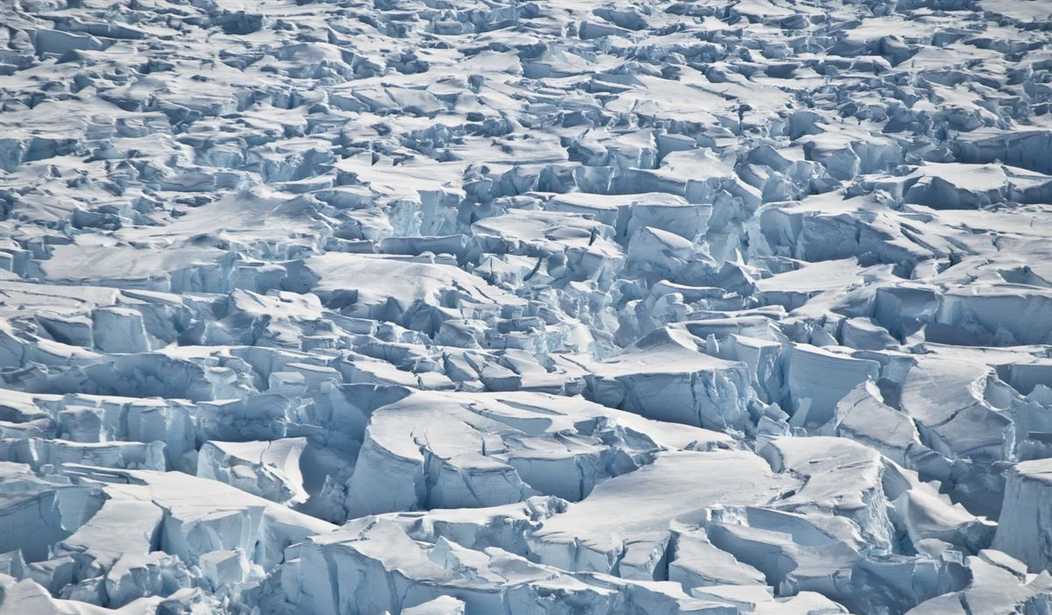
As predictable as the sun rises, it’s another breathless headline warning that Antarctic ice shelves are melting faster than we thought, that sea levels are going to swamp our coastlines, and that millions face an underwater future. The Daily Mail's recent coverage of Norwegian researchers studying the Fimbulisen Ice Shelf is a case study in how legitimate, and genuinely interesting, science gets processed through the media's climate catastrophe machine until the nuance is ground out entirely and only the alarmism remains.
The discovery of deep channels beneath ice shelves trapping warm ocean eddies and accelerating basal melt is a new discovery and is legitimate science work. What isn’t legitimate is the leap from “we discovered something we didn’t fully know about” to “sea levels could rise 30 meters by 2150.” That’s not science. That’s science fiction with a university letterhead attached.
Here’s what the coverage buries: the reason we’re only learning about these sub-ice channels and their effects right now is that we have only recently developed the technology and methodology to observe conditions beneath Antarctic ice shelves. Think about that for a moment. We are talking about one of the most remote, inaccessible, and hostile environments on the planet. The ice shelf cavities these researchers are studying sit beneath hundreds of meters of ice, in waters that are extraordinarily difficult to instrument, monitor, or sample directly. The Fimbulisen Ice Shelf case study used a combination of detailed topographical mapping and computer modeling, not decades of direct observational data, to draw its conclusions.
This is a statement of fact that The Daily Mail missed entirely, and it has enormous implications for how confidently we should accept these projections. When a scientist tells you they’ve discovered a process they didn’t previously know existed, and then in the same breath tells you they can project its consequences out to the year 2300, you should be concerned and skeptical of that claim. You should ask: how can you forecast with confidence the far future behavior of an Antarctic system you’ve only just begun to observe?
The honest answer, buried deep in their coverage, is that they can't. One of the researchers, Dr. Hattermann, acknowledges that the effect of this new discovery is so uncertain that we cannot "rule out" sea level increases of 30 meters by 2150 and 50 meters by 2300. That's a remarkable statement. The statement "cannot rule out" is not a scientific projection; it is a guesstimate so wide as to be scientifically meaningless. You cannot rule out that it won't happen either. But look at which assumption is framing the headline.
SEE ALSO: New Ice Core Study Shows Moderate Warming Happens Every Few Centuries
The history of Antarctic ice science specifically is a history of revisions, recalibrations, and surprises in both directions. Researchers have repeatedly been caught flat-footed by the complexity of this system. East Antarctica, which contains the vast majority of the continent’s ice, was long considered stable, not gaining or losing mass even as ice sheets in West Antarctica and Greenland shrank. Now this study points to East Antarctica’s Fimbulisen Shelf as a potential vulnerability. The West Antarctic Ice Sheet was the focus of alarm for years, until findings emerged complicating those projections. The science-to-media pattern repeats: announce a crisis, the models get revised, the crisis gets walked back in the literature (though rarely in the press), and then a new crisis emerges.
What we are dealing with in Antarctic glaciology is a field that is, scientifically speaking, still in its early adolescence when it comes to direct observation of the processes that matter most. That perspective is widely shared within the scientific community, as Antarctic glaciology is rapidly evolving from a phase of exploration and basic mapping to complex, predictive modeling. This "adolescent" stage is characterized by high, often surprising, findings such as witnessed with this new discovery.
Problematically, the supporting data are sparse. We have Antarctic satellite data going back just about 40 years, which is a blink of an eye in geological time. We have sub-ice-shelf observational records that are even shorter. The computer models being used to project these outcomes are necessarily built on assumptions from observations, assumptions that are now being revised as we discover phenomena like these channeled melt eddies that weren't previously accounted for.
None of this means Antarctic ice is doomed. It suggests we should gather more observational data before making projections, and exercise the kind of restrained caution that good science demands. What it does not mean is that The Daily Mail should be running headlines about millions being “plunged underwater” based on newly minted climate models that researchers openly acknowledge that they don’t fully understand the processes they’re modeling.
The ice will tell us its story if we watch carefully and honestly. But it will take years, probably decades, of rigorous observation before we can say with genuine confidence what these newly discovered sub-shelf dynamics mean for the future of Antarctic ice. Until then, the responsible position should be curiosity, not catastrophism.
This new Antarctic science is interesting, but projections based on one new discovery are premature, and should not be the basis for irresponsible and inflated doomsday headlines.
Anthony Watts [email protected] is a Senior Fellow for Environment and Climate at The Heartland Institute.
Editor's Note: Do you enjoy RedState's conservative reporting that takes on the radical left and woke media? Support our work so that we can continue to bring you the truth.
Join RedState VIP and use promo code FIGHT to receive 60% off your membership.



Join the Conversation
VIP members get the ability to comment on articles.