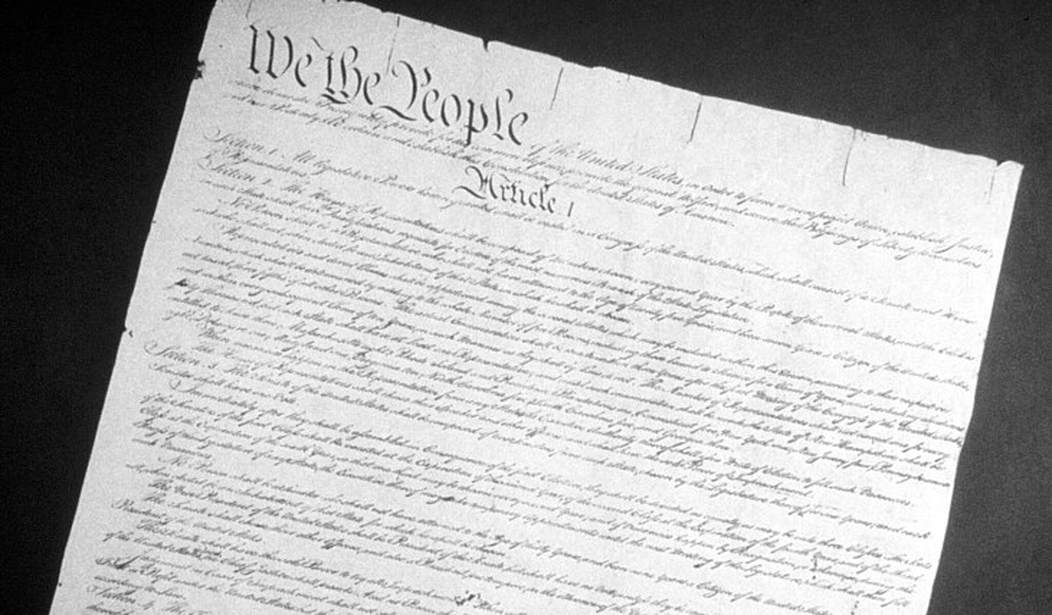

Our Constitution was written in plain language, or at least what was the plain language of the late 18th century. But taken in context, everything the framers of that document intended is pretty clear: Throughout the Constitution and the first ten amendments, the Bill of Rights, all in plain language.
That's why it's all the more baffling that the last item in the Bill of Rights, the 10th Amendment, seems to have become an orphan in this 250th year of American liberty - and it has been so, for some time.
The 10th Amendment was and is a stern message from the drafters of the Bill of Rights to the federal government:
Tenth Amendment: The powers not delegated to the United States by the Constitution, nor prohibited by it to the states, are reserved to the states respectively, or to the people.
In other words: “If we didn’t put something in here specifically allowing you to do something, then you can’t do it. No guesswork and no fudging.”
So, what happened? When did the federal government leave the 10th Amendment behind?
Gary Lawson is a professor at the University of Florida Levin College of Law, and he has some interesting thoughts on the 10th.
The Tenth Amendment formally changed nothing in the Constitution. As the joint statement indicates, no law that would have been constitutional before ratification of the Tenth Amendment is unconstitutional afterwards. The Tenth Amendment simply makes clear that institutions of the federal government exercise only limited and enumerated powers – and that principle infused the entire idea and structure of the Constitution from 1788 onwards. Nonetheless, there is significant constitutional value in the Tenth Amendment – and perhaps even enough value to justify the seemingly odd line of cases that use the provision directly to invalidate congressional laws and thereby create Tenth Amendment “doctrine.”
I'm not a law school professor, but it seems to me that there's nothing particularly odd about the Supreme Court (or any court) invalidating a law passed by Congress if that law is not within the bounds of the Constitution, and the 10th Amendment places anything not specifically named in the Constitution off-limits for Washington. That would seem to include things like health care, welfare, and so forth; things that are not among the enumerated powers of the federal government, and therefore proscribed.
Bear in mind the composition of President Washington's initial Cabinet, which had four members: Secretary of State Thomas Jefferson, Secretary of the Treasury Alexander Hamilton, Secretary of War Henry Knox, and Attorney General Edmund Randolph. That was it. Four men. That was the original intent.
Professor Lawson continues:
In modern times, the enumerated powers of the national government have been misread beyond all recognition, to the point that the actual Constitution is not really part of the governing structure at all. We live with a shadow, or “zombie,” Constitution that has the outer husk of the original document but none of its actual substance. Once the enumerated powers are misconstrued out of existence, weight falls on the rest of the Constitution, most notably the Bill of Rights, to restore to some very modest degree the original balance of power. The various “Tenth Amendment” cases decided by the Supreme Court may serve this function.
That's a fair and somewhat unsettling point.
Read More: Big Government Fuels Fraud: Cut It by Two-Thirds and Save Billions
Blue States Abandon Governance, Feds Step In: Federalism Is Dead
But here's a fun thought experiment: What would the national government look like, were the 10th Amendment clearly understood and enforced? Well, the national government would be a lot smaller, looking more like George Washington's team of four than what it looks like today. Entire Cabinet-level agencies would be gone: Agriculture, Education, Commerce, Energy, Environment, Health and Human Services, Transportation, Energy, Homeland Security - all arguably gone. There's an argument to be made for retaining Interior. That, along with the Vice President, State, War, Treasury, and the Attorney General, would make up the Cabinet, reducing the Executive Branch to a shadow of what it is now.
Reducing the federal government, mind you, is a good thing. These extra-constitutional functions can be picked up by the states, which is, in most cases, the best place to deliver these distributed interests. What works in New Jersey, after all, may not work in Montana; what works in Alaska may not work in California.
There's another advantage to the strict interpretation of the 10th Amendment: Government is more effective when it's closer to the people. You can, with a little effort, talk to your state representatives. I've done it. Try making an appointment for a one-on-one with your Congressman, or one of your state's senators. Unless you're a major donor, union chief, or CEO of some corporate titan, you're not likely to get past a fifth-level staffer.
The 10th Amendment was one of the better parts of the Bill of Rights. It was intended to bind the federal government within tight constitutional restrictions, to prevent precisely the state of affairs that exists now: Washington as a governmental titan. There is, sadly, no interest in either party to rein this growth in, but that doesn't mean it's not worth the fight, worth reminding anyone who will listen that the 10th still exists, and that we should heed what it says.
And, besides, the world has no shortage of windmills to tilt at.