
President Ronald Reagan famously said about liberals: "The trouble with our Liberal friends is not that they're ignorant; it's just that they know so much that isn't so." That still holds today, maybe more so, as we live now in an age where liberals and their more radical "progressive" fellow travelers accept without question that a man can become a woman, that unlimited Third World immigration into the United States is a good thing, and that Joe Biden was conscious throughout his entire presidency.
Nowhere is this true more than with the climate scolds, who continually lecture us on the need to move into 15-minute, rabbit-warren cities, to give up cheeseburgers and steaks, and to ride around in crackerbox plastic cars - if we're allowed to travel at all. And a big part of their argument against beef is a rather nonsensical one: Cows burp, they pass gas, and some of that gas is methane, which is a greenhouse gas. But, as it turns out, removing grazing animals from grassland does far more harm than good.
Someone needs to explain this to Bill Gates, but in the meantime, Watts Up With That's recent guest poster Willis Eschenbach gives us a great example, involving carbon, methane, grazing animals, and grass. It's worth reading in full. But first, let's see what Bill Gates has to say.
Bill Gates likes to say that about 6% of global emissions are from cows, and that we should either “fix the cows” so they stop doing that, or “make beef without the cow”. Catchy line. The Serengeti, however, has a different script, and it starts not with cows, but with rinderpest.
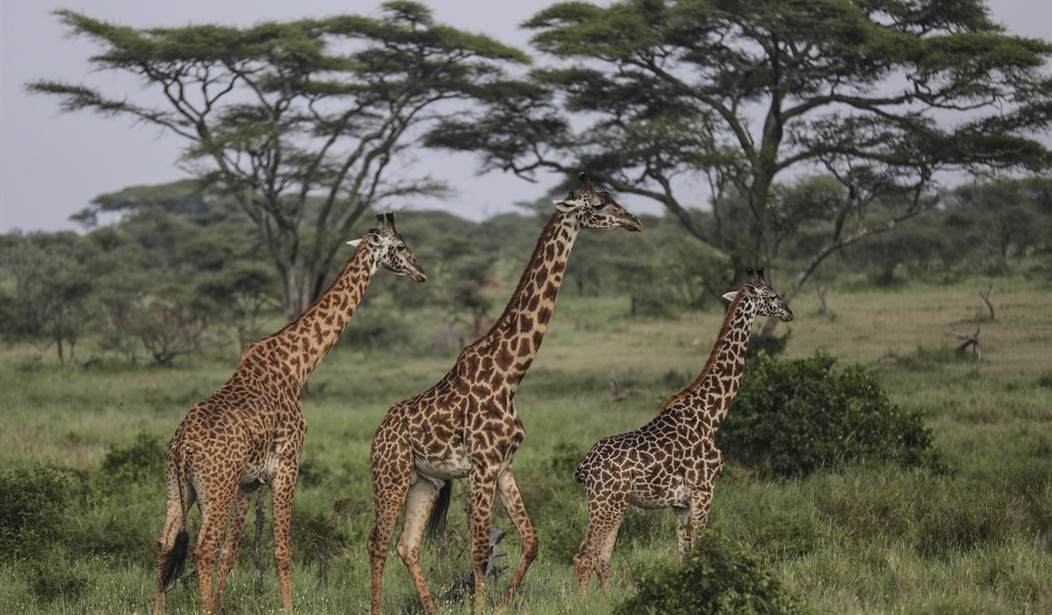
Roll back to East Africa before the late 1800s. The Serengeti is running on its factory settings: huge migratory herds of wildebeest and buffalo sweeping back and forth with the rains, shaving the grass down as they go. Grazers are in charge; grass fuel stays modest; fires happen, but they’re patchy and relatively small; woodlands hang on as scattered trees and clumps that can survive the occasional, not too intense burn.
Bill Gates is wrong, of course. Here's why:
In that state, the place is not some methane-free Eden—those herds are belching merrily away—but it’s a functioning savanna where herbivores, fire, and trees have worked out a long-term compromise.
Then we improve it.
Import Indian cattle, import the rinderpest virus along with them, and suddenly the system’s main fuel controllers—wildebeest and their friends—hit a wall. The rinderpest chews through the ungulates, slashing wildebeest numbers to a fraction of their former glory and hammering buffalo as well.
What happens then? An ecosystem collapse, or so close to one that it's hard to see the difference.
Read More: From Wilderness to Table: A Hollywood Hunter's Unapologetic Lifestyle
Net-Zero Nightmare: Renewables Require 10x More Land Than Fossil Fuels
Here's the thing: Grass is, as plants go, pretty recent stuff, having first started to pop up in the late Oligocene or the early Miocene. It's nasty stuff to make your dietary staple, as it's bulky, rough, and loaded with silica. But grazers are adapted specifically to eat grass, with hard, continually renewing teeth and stomachs that are big fermentation tanks. But when the rinderpest, which sounds like an insect but is actually a virus, moved in, the number of grazing animals dropped dramatically, leaving much of that wonderful grass uneaten.
That wasn't good. Willis Eschenbach continues:
Nobody has changed the rainfall, the soils, or the grass species. They’ve just imposed a new, top-down mortality factor that doesn’t care about carrying capacity or migration. The Serengeti shifts from “limited by food” to “limited by rinderpest.”
Once the big grazers are gone, the grass celebrates. It grows tall, cures, and lies there as a continuous carpet of fine fuel. What used to be eaten is now waiting for a match. In the rinderpest era, fires become more frequent, burn larger areas, and bite harder into seedlings and saplings that might otherwise have grown into trees.
Holdo, Holt, Fryxell, and colleagues reconstructed this period and concluded that the disease-depressed Serengeti was not just more flammable; it likely acted as a net carbon source, as repeated burning and reduced woody cover drained carbon from biomass and soils. If you’d flown over then, you might have called it a “natural fire-maintained grassland.” In reality, it was a savanna on crutches, being held open by an imported virus.
This is the part the climate spreadsheets never see. Our modern global tables show “livestock: ~12–14% of emissions, cattle ~ two-thirds of that,” and from this we get the sermon: cows are a climate threat, cows are 6%, cows must be fixed or replaced. Gates leans hard on that framing in interviews and in his climate book—livestock methane as a stand-alone villain, synthetic beef as the enlightened alternative.
But the Serengeti’s experience says that when you take out the large herbivores—the wild analogue of our cattle—you don’t automatically get a climate win; you can get more fire, less wood, and less stored carbon.
So what happened in the end? Modern science. A vaccine was developed for the rinderpest, cattle numbers bounced back, and, without that primary vector to spread the disease, wildebeest and buffalo numbers bounced back, too, and they all started munching happily away on all that grass. So what happened? They ate more grass, which meant there were fewer and smaller fires. Small patches of forest returned, no longer threatened by fires. The woody cover and the thick sod that supports the grass returned that part of the Serengeti to what it had been: A net carbon sink, instead of a net source of atmospheric carbon due to the fires.
But climate scolds never look deep enough into any issue to learn things like this; to learn all of the unexpected consequences of their agendas. Nope, for them it's just "cows pass gas, so cows are bad."
Mr. Eschenbach concludes:
When rinderpest arrived, the Serengeti lost its major grazers and likely lost carbon. When rinderpest left, the grazers came back, methane went up, fires went down, woodlands thickened, and carbon storage increased. That’s not a morality tale about cows. It’s a cautionary tale about thinking you can fix the climate by attacking one component of a system you haven’t really bothered to understand.
Here in the United States, we raise a lot of cattle, and yes, the climate scolds complain about that, too. They don't have any explanation as to why it was perfectly all right for as many as 20-30 million bison to roam the Great Plains until only a couple of hundred years ago, but cattle aren't all right. But then, as noted, there's so that they know so much that just isn't so.