






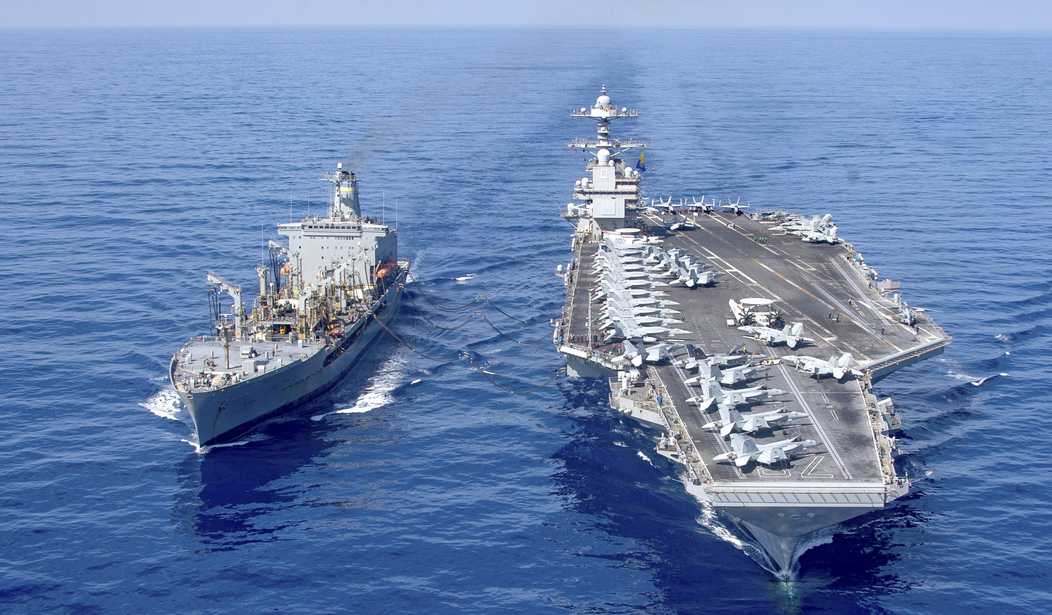
Long deployments are hard on our service members, and now the USS Gerald R. Ford, the mightiest warship in human history, has returned to its home port of Norfolk, Virginia, after an 11-month deployment. That's the longest deployment by an American aircraft carrier since the Vietnam War.
The extended deployment saw the ship involved in the ouster of Venezuelan dictator Nicolás Maduro, and then participating in the curb-stomping of Iran in Operation Epic Fury. Now, the officers and sailors are getting a break.
The most advanced U.S. warship and two accompanying destroyers docked at Naval Station Norfolk with about 5,000 sailors waiting to see their families for the first time since June. Besides combat operations and traversing continents, the sailors aboard the carrier faced a noncombat-related fire that left hundreds without places to sleep and forced lengthy repairs on the Greek island of Crete.
Defense Secretary Pete Hegseth was on hand for the arrival of the warships, which included the destroyer USS Bainbridge.
Hegseth commended the crew of the Bainbridge for a “job well done.”
“You didn’t just accomplish a mission, you made history,” Hegseth said on the destroyer’s deck. “You made a nation proud.”
The long deployment has brought about some discussion, despite the necessity for the ship's presence in the two theaters of operation where it was engaged:
The Ford’s long time at sea has raised questions about the impact on service members who are away from home for long periods as well as about increasing strain on the ship and its equipment beyond the fire, which started in one of the carrier’s laundry spaces.
While we mustn't downplay the performance of the USS Gerald R. Ford and her crew, this may call for a little perspective.
Read More: Maximum Pressure: US Reportedly Sending Third Aircraft Carrier Strike Group to Middle East
World War II veterans, we might recall, were away from home, in some cases, for years. A Marine who deployed to Guadalcanal in 1942 may well not have set foot on American soil again, much less returned home, until after the Japanese surrender in 1945. Army veterans deployed to North Africa in 1942 likewise may not have seen their homes and families again until 1945, or even later; my Dad, a WWII veteran, didn't get home until early 1946. This was the longest deployment of an aircraft carrier, we noted above, since the Vietnam War, wherein a standard in-country deployment for a soldier was 12 months; for a Marine, the deployment was 13 months, because, well, they're Marines.
Long deployments can be part of the game, and it's a safe bet most of the officers and crew of the Gerald R. Ford would agree with that. It's something every service member should be told to expect, from the moment they show up for basic training.
For now, though, the officers and crew of the Ford are home, and it's a safe bet that even the world's mightiest warship will be due for some dockside maintenance and refitting, so those brave service members should have some time with their families. They have certainly earned it.
Editor's Note: Thanks to President Trump and War Secretary Pete Hegseth's leadership, the warrior ethos is coming back to America's military.
Help us report on Trump and Hegseth's successes as they make our military great again. Join RedState VIP and use promo code FIGHT to receive 60% off your membership.



Join the Conversation
VIP members get the ability to comment on articles.