






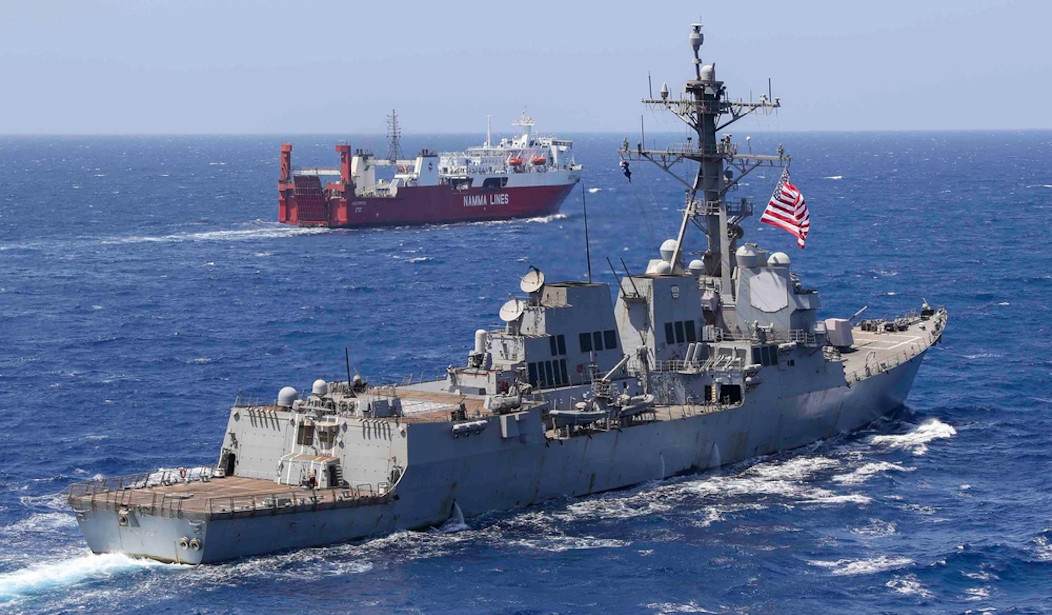
File this under "belaboring the obvious," but yes, the United States needs more shipbuilding capacity and more ships. We need warships to maintain the Pax Americana on the global sea lanes that we have maintained since World War 2, as well as to send a message to China that we, not they, will be the primary naval power in the world's largest ocean - the Pacific. We need more commercial ships, American-flag carrying cargo haulers to take American goods around the world.
We need more shipbuilding capacity, but now the advent of robotics and artificial intelligence (AI) may be leading the way to giving us more capacity by streamlining shipbuilding.
- Military shipbuilder HII on Monday said it will collaborate with Gray Matter Robotics to begin integrating physical artificial intelligence into its shipbuilding operations.
- The companies signed a memorandum of understanding to explore ways to accelerate throughput, strengthen the maritime industrial base and augment HII’s shipbuilding workforce.
- GrayMatter’s technology will primarily focus on automating HII’s surface preparation, coating and inspection processes, according to a news release. The companies did not disclose financial details around their partnership.
Industrial robots are often used in very fixed processes, where one operation is repeated hundreds or thousands of times in an operating day - and where that process can be programmed and validated, to be carried out reliably without any human judgement required, with variables kept to a minimum.
I remember an old business partner, who had worked for some time as a welder in the Newport News shipyard. He had a wall full of welding certifications, and he was insistent that welding was an much art as science; that would make me inclined to think that it wouldn't be easy to set up an automated process. But surface prep and coating? That may be different. HII seems to think it is - and so does Gray Matter Robotics.
Gray Matter’s robots, which can grind, blast and finish metal structures, would fit into HII’s automated workflow post-welding, Eric Chewning, executive vice president of maritime systems and corporate strategy, said on a press call Monday.
This partnership comes as the Trump administration looks to increase production of munitions, jets and ships amid a war with Iran. The Department of Defense recently proposed $65.8 billion toward shipbuilding for fiscal year 2027.
Interesting. Just as tech can be a force multiplier in military operations, so it can be in manufacturing.
Read More: Trump's New Budget Blitz: $1.5 T More for War Dept.; $73 Billion in Woke Waste Whacked
SECNAV John Phelan Cuts Ribbon in Alabama on 'Golden Fleet' Manufacturing Facility
We need more ships. Our Navy needs more ships and everything that goes with them. At the end of World War 2, there were so many United States Navy ships in the Pacific theater that wags were joking that one could walk from Pearl Harbor to Tokyo by stepping from deck to deck. We don't necessarily need that many ships; times have changed, and we can do more with fewer ships. But any near-peer conflict, as opposed to a walkover like Operation Epic Fury, will inevitably see us losing ships, and we'll need to have more behind them.
If incorporating robotics and AI into shipbuilding to make the various tasks more efficient and, yes, faster, that's nearly as good as having a new shipyard. We should watch this process with great interest.
Editor’s Note: Thanks to President Trump’s leadership and bold policies, America’s economy is back on track.
Help us continue to report on the president’s economic successes and combat the lies of the Democrats. Join RedState VIP and use promo code FIGHT to get 60% off your membership.



Join the Conversation
VIP members get the ability to comment on articles.