
As I previously noted, November, according to the Department of the Interior, is National Native American Heritage Month. I didn’t know such a thing existed, but I know a good idea when I see it. To borrow from last week’s introduction, “I think it is long overdue that we honor Native Americans after so much time has been spent honoring, to paraphrase the words of Secretary of War Pete Hegseth, fatties, trannies, beardos, weirdos, wimps, and radicals.” This week we build on two previous installments. The first honored Sam Brady, a legend of the Pennsylvania frontier; see Native American Month Focus: Sam Brady, the Baby in the Fire, and Brady's Leap – RedState. Last week, I wrote about Lewis Wetzel, a controversial figure. But love him or hate him, you've got to admit he killed a crap-ton of Indians; see Native American Focus: Lewis Wetzel, Running Gun and Master Negotiator – RedState. Today we continue our exploration of the men and women who founded and shaped America: Native Americans who personify the fact that America was conquered, not stolen, and that America was built despite, not because of, chattel slavery.
As always, it is only appropriate to start with a land acknowledgment statement.
Land Acknowledgment Statement
My home sets on land first explored by English and Scots-Irish freemen who had migrated from their homeland in search of freedom and opportunity or sometimes on the run from the law. The land was settled primarily by Germans from the Palatinate, who, through their industry, created farms, pastures, and orchards where only unproductive, fallow wilderness had existed. These men and women held savage tribes at bay and together created a nation that has been the beacon of hope to the world for over two hundred years. Their rifle became a symbol of American freedom. This land was conquered, not stolen, and any acknowledgment we make is owed to those who, with axe and musket, created the most powerful nation in the history of the world and we don’t owe a damn thing to anybody for being proud of their accomplishment.
Now cue up the background music and enjoy.
Not all of the Native Americans who conquered the wilderness and tamed hostile tribesmen were scouts and Indian fighters. The unsung heroes are the women. They trod the same wagon roads and mule paths headed west as did their men. They helped raise cabins and barns, plow fields, and then were expected to have dinner ready. They tended to the children until they were old enough to be useful around the farm. These pioneer women are who converted a lone hunter’s lean-to into a home. They formed the nucleus that built communities that civilized the raw wilderness. It was not unheard of for a pioneer woman to deliver a child in the morning and be back hoeing (as opposed to hoe-ing) the truck patch later that day. And when trouble came a-calling, many of these women showed they were every bit as formidable as their men.
We frequently think of Lord Charles Cornwallis taking refuge in his tent rather than handing over his sword to General George Washington on October 19, 1782, at Yorktown, Virginia, as marking the end of combat in the American Revolution. That wasn’t the case. While no further major combat actions took place in North America, the battle over what the post-war landscape would look like remained in full swing. The internecine slaughter between Patriot and Tory militias continued in the South. Indeed, Tory David Fanning continued to control much of central North Carolina well into 1782.
The war did not stop on the frontier. The fur trade remained valuable to the British and, strategically, an armed and loyal Indian population would serve as a bulwark against American expansion.
In July 1782, a meeting took place at the Shawnee villages near what is now Bellefontaine, Ohio. War chiefs from the Shawnees, Delawares, Mingos, Wyandots, Miamis, Ottawas, Ojibwas, and Potawatomis were present. Noted Tories and British Indian agents Alexander McKee, Simon Girty, and Matthew Elliott organized it.
Originally, there were big plans for the expedition. Captain William Caldwell, with 150 men of Butler’s Rangers, would lead about 1,100 Indian warriors against the settlement at Wheeling in what is now West Virginia. This would’ve been the largest attack on the American frontier ever.
Just when the “let’s roll” order was about to be given, word arrived that George Rogers Clark was about to enter the Ohio Country from Kentucky to bring fire and sword to the Indians and their British masters. The Indians feared Clark. The Indians thought better of the whole war idea and disappeared, and the expedition was called off.
Unwilling to let a summer's campaigning season go by without some activity, the British came up with a backup plan. It was a double blow to the frontier. Caldwell, his Rangers, Simon Girty and about 400 Wyandot, Delaware, and Shawnee warriors were to attack Bryan Station, a fortified settlement at what is now Lexington, Kentucky. A second force consisting of about 40 of Butler’s Rangers and 240 Wyandot, Delaware, and Shawnee warriors led by Captain Andrew Bradt would strike at Wheeling.
Were these attacks successful, they would probably create a panic that would drive Native American settlers east of the crest of the Allegheny Mountains and prevent future settlements.
Wheeling was something of a hornet’s nest in its early days. Cabins around the settlement were regularly burned out, and settlers were killed and taken prisoner. It was also a point from which punitive expeditions were launched to destroy Indian villages and increase the dead ground between settlements and Indians. The fort in Wheeling was named Fort Henry after Patrick, but many settlers had fortified their cabins. Among those planning for their own defense was the Zane family: the brothers Ebenezer, Silas, Jonathan, Isaac, Andrew, and our heroine Elizabeth or Betty Zane. There were also an undetermined number of children in the house.
The Zanes were the original settlers of Wheeling and all the brothers played significant roles in the wars on the frontier. Isaac, for instance, had been kidnapped by the Shawnee at age nine and remained with them for 17 years, taking a Shawnee wife, before he decided to return to his family.
Scouts from Wheeling discovered the advance of the attacking force, and the word went out for everyone to retreat to Fort Henry. The nominal commander went to round up a relief party and left Silas Zane in command. When the garrison was mustered there were about twenty adult males and an equal number of teenage boys, girls, and women. Hardly a formidable defense force. Ebenezer Zane lived in a two-story blockhouse about 40 yards from the north wall of the “fort.” Ebenezer remarked that he was tired of having his place burned and he would stay where he was. The garrison of the Zane house was Ebenezer, his wife Elizabeth McCullough, his sister-in-law, two other settlers, and his 17-year-old sister Betty.
The Indians and their British allies quickly invested the fort and the Zane cabin, and then a British officer called for their surrender. This officer has a different name in each account, but it was probably Andrew Bradt. The terms were generous; if they surrendered, they could walk away to the next settlement unmolested. Silas Zane coldly reminded him of what had happened to the members of the Crawford Expedition only three months earlier when they had accepted guarantee of safe passage from Butler’s Rangers. They discovered that the British didn’t have the ability to enforce the terms of surrender with their Indian allies and were tortured and burned alive for their naivety. This was pretty much the state of affairs throughout the French and Indian War and the American Revolution. The most famous example was the surrender of Fort William Henry to the French. As the British were marching away they were set upon by Indian warriors unfamiliar with the niceties of gentlemanly conduct and massacred. That episode is depicted below from the 1992 film "Last of the Mohicans."
The siege started with a ferocious charge by the Indians at Fort Henry that was driven off by its defenders and the fires from the Zane house. When that failed the fighting became scattered shots and trash talk exchanged between the sides.
Then came one of those episodes that are hard to believe, yet, like Sam Brady tossing the papoose in the fire and leaping a river gorge to escape death, they occur over and over. At some point the settlers at Wheeling came into possession of a swivel gun and mounted it on the roof of the fort. It was in sort of an exposed position and possibly more for show than for action. Seemingly unrelated, frontiersman Daniel Sullivan was traveling from Fort Pitt to Louisville, Kentucky just as the British and Indians arrived. He was carrying dispatches for George Rogers Clark and 50 three-pound cannonballs. Sullivan and his traveling partner dropped the cannonballs and took shelter in Fort Henry.
When some in the British ranks began to mock the gun as a fake, Sullivan decided to show them what was real and what was fake. He crawled onto the roof of the fort and got behind the swivel gun, holding a burning torch. A group of Indians gathered just out of rifle range to jeer. He touched off the gun. It was loaded with grapeshot, which thinned the ranks of the hecklers.
The Indians wanted revenge. They’d recovered the cache of cannonballs dropped by Sullivan. They had seen cannons before and they didn’t look terribly complicated so egged on by their possession of cannon balls, they decided to make one. Whatever could go wrong?
In a scene reminiscent from Johnny Horton's 1959 hit single "Battle of New Orleans,"
a section of hollow log was located, packed with a suitable amount of gunpowder and some cannonballs were tossed in for good measure.
When they fired it, the result was not a section of the fort’s wall knocked down, there was a sizeable explosion and nothing left of the crew but, as we said in the infantry, “hair, teeth, and eyeballs.”
The Zane house caused a lot of problems for the attackers as it was covered by fire from Fort Henry and, in turn, prevented the British and Indians from attacking the three walls of the fort it covered. On the second day, a hole began to appear in Ebenezer Zane’s plan to hold his house against all comers. Where Fort Henry had ample ammunition, the Zane house was running out. Fast.
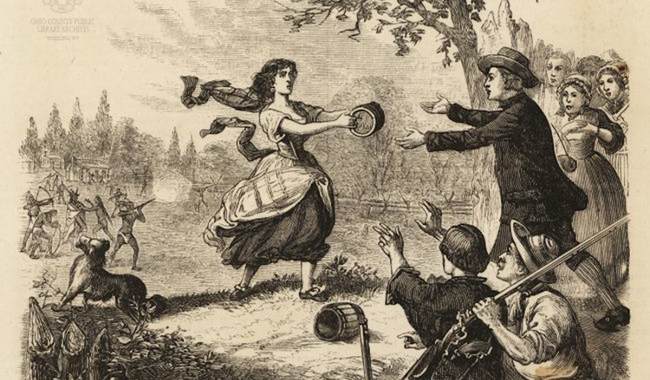
Ebenezer Zane announced they were short of gunpowder and asked for a volunteer to run to the fort. It was a high-risk mission and one that didn’t have a lot of hope of success but the alternative was damned bleak. Betty Zane volunteered. Ebenezer vetoed the idea saying that it was a man’s job. Betty retorted that if a man made the run and was killed that the Zane house lost a defender. If she didn’t make it, it was no big deal. That sealed the argument. Apparently, Betty was famous locally for being fleet of foot and very attractive. She tied her long hair up into a knot, stripped off her dress, and clad only in her thin shift lit out for the fort covered by the fire from the Zane house. The Indians were dumbfounded at the sight and didn’t fire.
In Fort Henry, she commandeered a tablecloth and ordered a keg of powder poured into it. She tied the corners of the tablecloth together and, at a signal from the Zane house, she sprinted back.
Forty yards.
This time she was met with a hail of gunfire instead of guffaws. Undaunted, she tumbled through the blockhouse door followed by a hail of musket balls slapping against the logs and chinking. Now Ebenezer Zane’s tiny garrison had enough gunpowder to continue the fight.
The next morning, Indian scouts sighted a relief party of about 70 frontiersmen lead by Colonel Andrew Swearingen coming to relieve Fort Henry. They took stock of their losses and their ammunition supply and decided that fighting wasn’t a great choice. They slaughtered the livestock that hadn’t been gathered into Fort Henry, cut down fruit trees, and burned everything in sight and then headed back for the Ohio Country.
The rest of Betty Zane’s life was uneventful. She had an out-of-wedlock child with noted frontiersman Captain Van Swearingen in 1784. Two years later married Ephraim McLaughlin. When he died in 1799 she married again. She died in 1823 survived by eight children. She is buried in what is now the Walnut Grove Pioneer Cemetery in Martins Ferry, Ohio, directly across the Ohio River from the scene of her run for powder. Her exploit might have drifted away had she not had a great-great-nephew named Zane Grey who self-published a novel about the event in 1903. That novel not only preserved her place in history but launched him on a very successful career. Each year her heroism is honored during Betty Zane Pioneer Days in Martins Ferry.
Sometimes a man’s job doesn’t need a man, it just needs a 17-year-old girl who can run like the wind.