
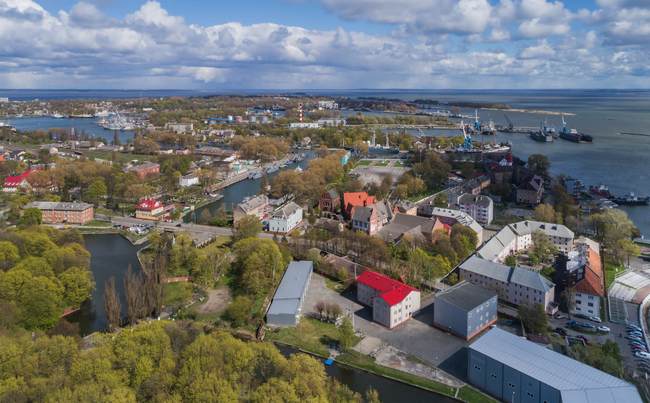
The Russian Baltic Fleet homeport in Baltiysk in Kaliningrad Oblast came under attack by drones Saturday night. This attack followed hours after the drone attack on a Russian military freighter, leaving it dead in the water and forcing the crew to abandon ship. These mark the second and third Ukrainian attacks on naval targets in the region in November, which comprise 100 percent of all such attacks since the war began; see Russian Corvette Battered, Energy Terminal Ablaze As Ukraine Expands War's Reach – RedState.
Early Saturday morning, at least two drones slammed into the Russian roll-on/roll-off freighter Sparta II as it en route to the Baltic Fleet base at Baltiysk. The ship, which operates under U.S. sanctions, was left drifting, disabled, and on fire into Finnish waters after its entire 16-man crew abandoned ship. All crewmembers were transferred to Russian vessels, and Finnish, Russian, and Estonian crews worked through the night to extinguish the numerous fires. The hulk was then towed to its destination.
Russian regional officials said the strikes occurred in international waters roughly three miles from the Russian border, west of Gogland Island. The Finnish military detected the attack and assessed it as likely Ukrainian.
Only a few hours later, air-raid alerts sounded across parts of Kaliningrad Oblast. Monitoring channels and local accounts reported explosions and the sound of air defenses operating near the Baltic Fleet’s homeport at Baltiysk. The Russians have not confirmed any damage or casualties. The Russians claimed the attack came from Lithuania, but the Lithuanian government denied that anything used its airspace. The Russians also said that only one drone was involved.
BREAKING: Ukrainian drones, likely launched from a ship off the coast, are attacking targets in Baltiysk. It’s the first time the Russian exclave Kaliningrad is attacked in this war. https://t.co/zpsszGgApq
— Visegrád 24 (@visegrad24) November 21, 2026
Russians say drones are attacking the Baltic Fleet base at Baltiysk in Kaliningrad region. They apparently launched from some ship. https://t.co/8K1O3SAXrg
— WarTranslated (@wartranslated) November 21, 2026
The video clearly shows a significant amount of Russian anti-aircraft fire and at least one explosion on a structure.
Finnish Prime Minister Petteri Orpo stated that “war is spilling over into our immediate vicinity” and that Ukraine had the right to strike its aggressor.
Sota läikkyy lähialueillemme. Suomen viranomaiset hoitavat tilannetta Suomenlahdella, jossa drooni-isku on osunut venäläiseen kauppa-alukseen. Ukrainalla on oikeus taistella hyökkääjää vastaan.
— Petteri Orpo (@PetteriOrpo) November 21, 2026
This runs in stark contrast to the U.S. position articulated by Department of War Under Secretary for Policy Elbridge Colby, which is that deep strikes by Ukraine have “not been effective” and might [gasp, horror, shocked face] provoke Russia to take extreme measures like invading Ukraine, or kidnapping children, or massacring civilians, or targeting civilian facilities like schools and hospitals; see Fireworks at NATO: German Defense Minister Calls American Position on Ukraine 'Quite a Stupid Thing' – RedState.
Speculation has centered on the drones’ origin. In my post on the mauling of the Buyan-M corvette Naro-Fominsk, I opine:
To me, the curious aspect of the operation is that several drones, not just a single one, hit a Russian surface combatant, underway, at night, in a crowded shipping channel. I may have been born at night, but I wasn't born last night. There is no way this happened as part of a long-range strike package coordinated with the Ust-Luga attack. The foreknowledge of Russian ship movements required is just impossible to credit. The implication is that Ukrainian forces were observing the ship and timed the strike to coincide with the larger refinery attack. The strike was launched either from a disguised ship acting as a drone platform or from a temporary base the SBU established somewhere in or around the Gulf of Finland.
The attack on the Sparta II follows the same general pattern as the Naro-Fominsk attack and has the same problems.
Both attacks were in conjunction with an attack on a land target, the maritime terminal at Ust-Luga in the last attack. The attacks on moving surface ships suggest there is a man-in-the-loop at some point. The fact that both the attacks on Naro-Fominsk and Sparta II took place in the same area makes the source of the attack almost certainly either a ship or a clandestine land base.
Compare the locations.
❗️A Finnish official confirmed to the public broadcaster Yle that Ukrainian drones attacked a Buyan-M-class corvette of the Russian Navy in the Baltic Sea on Wednesday night, nearly 1,000 km from Ukraine; Ukraine, for its part, officially claimed to have hit the nearly brand-new ship Naro-Fominsk of this class.
— 🪖MilitaryNewsUA🇺🇦 (@front_ukrainian) November 13, 2026
NEW: Two Ukrainian drones struck the Russian Sparta II cargo ship — a ship that has supported Russian military logistics — in the Gulf of Finland on November 21. https://t.co/6yZ9Ysntc9
— Institute for the Study of War (@TheStudyofWar) November 21, 2026
For Russia, the implications are immediate and structural. The attack disrupted a vital supply run into the isolated Kaliningrad exclave, highlighting the vulnerability of sea lines of communication that keep the Baltic Fleet and the enclave’s garrison resupplied. A successful strike on a military ship in international waters, followed by an attack on the fleet’s home port, demonstrates that Ukrainian reach can now threaten Russian logistics in what had been thought safe territory.