
As I noted last week, November, according to the Department of the Interior, is National Native American Heritage Month. I didn’t know such a thing existed. I think it is long overdue that we honor Native Americans after so much time has been spent honoring, to paraphrase the words of Secretary of War Pete Hegseth, fatties, trannies, beardos, weirdos, wimps, and radicals. Originally, I’d said this series would last days, possibly even dragging into 2027 or later. I've decided that this work is too important to stop, and I will make a point of regularly acknowledging Native Americans who personify the fact that America was conquered, not stolen, and that America was built despite, not because of, chattel slavery; see Native American Month Focus: Sam Brady, the Baby in the Fire, and Brady's Leap – RedState.
As always, it is only appropriate to start with a land acknowledgment statement.
Land Acknowledgment Statement
My home sets on land first explored by English and Scots-Irish freemen who had migrated from their homeland in search of freedom and opportunity or sometimes on the run from the law. The land was settled primarily by Germans from the Palatinate, who, through their industry, created farms, pastures, and orchards where only unproductive, fallow wilderness had existed. These men and women held savage tribes at bay and together created a nation that has been the beacon of hope to the world for over two hundred years. Their rifle became a symbol of American freedom. This land was conquered, not stolen, and any acknowledgment we make is owed to those who, with axe and musket, created the most powerful nation in the history of the world and we don’t owe a damn thing to anybody for being proud of their accomplishment.
Now cue up the background music and enjoy.
Lewis Wetzel (1763–1808) was one of the most formidable and controversial figures on the late-eighteenth-century American frontier. He was born in Lancaster County, Pennsylvania, but in the wake of the British victory in the French and Indian War, his family moved to hotly contested land near what is today Wheeling, West Virginia.
Wetzel was famous for two key attributes. He had trained himself to reload his rifle at a dead run, which eventually earned him his nickname; more about that later. Second, when General Phil Sheridan said, “The only good Indians I ever saw were dead," he might have been thinking about Wetzel because he lived that philosophy to the maximum every day of his life.
Wetzel cut a striking figure. He was at least five feet ten inches, which made him about two inches taller than the average American man of the period. He was heavily muscled and had long black hair that reached his calves (he said he expected to be scalped some day and wanted that lucky man to have a worthwhile trophy). A childhood bout of smallpox left his skin pockmarked.
Wetzel became a legend among settlers for his marksmanship, endurance, and willingness, indeed his preference, to operate alone deep in Indian country. Yet his reputation was always double-edged. To many frontier families, he was a necessary protector. At the same time, colonial and British officials and some later historians considered him a remorseless killer who targeted Indians regardless of whether they were hostile warriors or men seeking peace. The usefulness of the both/and construction over the either/or option shows that both were right.
His intense hatred of Indians did not arise from abstract ideology. It was forged in personal trauma and the brutal realities of border warfare from the end of the French and Indian War until after the Revolutionary War.
Around 1778, when Lewis was about thirteen or fourteen, a small party of Wyandot warriors raided the family homestead. Nothing personal, just business. Lewis was wounded by a musket ball, which creased his chest from side to side, and he and his younger brother Jacob, who was about eleven years old, were taken prisoner. The rest of his family escaped.
In best Indian fashion, he was given some rudimentary treatment for his wound. He and his brother were stripped of their shoes and marched north, probably toward a destination around Sandusky, Ohio, which was the center of Wyandot country. The accounts of the time are noted for omitting details, but it would not have been shocking if the boys had been stripped naked as further insurance against escape.
Even at that age, they knew that if you were captured by Indians and showed any sign of weakness, or inability to keep up, or attempted to leave a sign for a pursuing band of frontiersmen, you would be tomahawked as sure as if they were Elizabeth Warren. Only your scalp would be making the rest of the journey.
After a couple of nights on the trail, the war party got sloppy. The boys were tired and physically beaten down by the killing pace they had kept without shoes. The Indians didn’t tie the boys all that tight as they settled in for a good night’s sleep, thinking them too tired and too far away from home to escape. In the infantry, we would call this an “assumption.” That means when you “assume” anything, you end up making an “ass” of “u” and “me.”
The following excerpt is from a 1919 book titled "Boys' Book of Frontier Fighters."
When all was quiet and the Indians were breathing deeply, Lewis sat up. It was bright moonlight, and he could see plainly. He could see Jacob, and the forms of the Indians stretched around. He moved more. Nobody else stirred, not a breath was interrupted. Then, to find out if the Indians were playing ’possum, he stood on his feet.
Not an Indian even so much as turned over. He began to walk about, treading carelessly, to test them out. He was a wise boy; he spent an hour, experimenting, while his heart beat more and more hopefully. He might have stolen off, but of course he had to take Jacob.
Jacob was asleep. Lewis crept to him and touched him and woke him.
“Come on,” he whispered. “We’re going.”
Jacob shook his head, afraid.
“No.”
“Yes.”
Jacob’s eyes widened.
“We’ll be caught.”
“No, we won’t. They’re asleep. Listen? I know they’re asleep. Hurry up.”
Jacob was only twelve. Lewis was his bigger brother, whom he admired. So he got up, staring—took long breath, and he holding to Lewis’s hand, into the moonlit timber they scooted with never a backward look.
“We can follow our own trail back to the river,” said Lewis. “It’ll be easy.”
“Ouch!” And Jacob began to limp.
Lewis stopped.
“You wait here. I’ll get some moccasins.”
“No, Lewis! They’ll catch you.”
“No, they won’t. We’ve got to have moccasins.”
Lewis scudded for the camp. In a minute he had found moccasins and had brought them. That was better. Now they might travel faster. But Lewis halted again.
“Wait. I’m going to get father a gun!”
“No, Lewis! Let’s hurry. We don’t want a gun.”
“Yes, we do. Maybe we’ll have to defend ourselves or kill meat. You wait right here.”
Think about it. He went back into the camp once to steal moccasins. I don’t know how stripped down Indian warriors got at bedtime while on an operation, but I know that I’ve gone for weeks sleeping in my boots because the last thing I wanted to do in the middle of an attack at night was put on my boots. Also, the rifle was going to be very close to a warrior because if you need your weapon in the middle of the night, you want to be able to grab it.
Lewis had only reached Jacob when the Indians awoke and figured out crap was amiss. Long story short, Lewis led Jacob back home to Wheeling, evading their enraged former captors.
Most folks who study Wetzel agree that this is the moment when his hatred of Indians crystallized. From here on out, he basically killed any Indian he met on sight without worrying about who he worked for or what he might be doing.
He devoted himself to mastering frontier survival skills: accurate shooting, knife and tomahawk work, tracking, and the rare ability to load, prime, and fire while running at full speed.
Around June 1782, shortly after surviving the disastrous Crawford Expedition, he was involved in a brief skirmish that set his reputation forever.
Wetzel and two companions were surprised by a large war party. One of his companions was killed almost immediately, leaving Wetzel and a teenage boy fleeing for their lives. As the pursuers closed in, Wetzel turned and shot one of them. This brought out extra energy on the part of the remainder because they assumed he was unarmed.
There’s that word again.
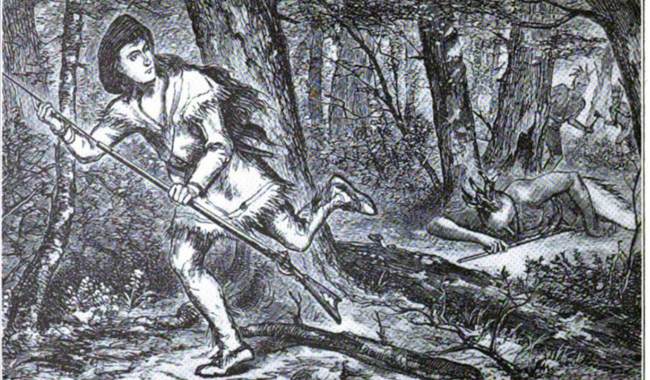
Instead of stopping to reload, he continued running while pouring powder, seating the ball, and priming the pan. He then turned, fired at one of the pursuing warriors, knocking him on his back, and resumed his flight. The rest stopped, and one said, "Oh, so that's what Sarge meant when he kept harping on assume." He reportedly killed three pursuers in rapid succession while retreating. This convinced the other that chasing Wetzel was a very poor evolutionary choice. The attackers abandoned the chase. From this encounter, he earned the nickname “Deathwind.”
This is sorta what it looked like, but a lot faster and smoother.
As someone who's spent a lot of perfectly good time reading on this subject, I’d add a few points of critique. From what I’ve read, longhunters tended to carry their powder horns around their solar plexus because it is the most efficient place to reach it. If it is on your hip, it isn't convenient all the time. When he digs into his bullet pouch for the first reload, he would have probably pulled out four or five balls. He would have spit one down the barrel and popped the others into his cheek (the one on his face, not the other one). This cuts down one step in the next reload cycle. Finally, he may not have dicked around with the ramrod because the ball is not patched. Even British line infantry kept the pace of fire in firefights by slapping the butt of the musket on the ground after loading the ball instead of ramming it. There was no great need for long-range accuracy when the other guy is nearly within tomahawk-strike of your back.
Life on the frontier quickly turned Wetzel’s deep-seated dislike of Indians into a lifelong, anything-goes private vendetta.
The incident that cemented his reputation as a remorseless killer took place while he was serving as a U.S. Army scout in 1788. Wetzel had a… problematic… relationship with the Army. While he liked the work and the pay, he didn’t like discipline, taking orders, or any of that other army stuff.
In 1788, he was working out of Fort Harmar at what is now Marietta, Ohio. The Senecas had seen which way the wind was blowing and were trying to cement a “MOU”… I mean a peace treaty to stop the bleeding. A respected chief named Tegunteh traveled to Fort Harmar to negotiate. Unfortunately for him, he met Deathwind before he got there. Wetzel ambushed, shot, and scalped him before he got there. The chief lived long enough to describe his attacker in detail. A furious General Harmar arrested Wetzel. He freely admitted the killing, and is said to have declared that he would shoot Indians “like the worthless dogs they are” for as long as he lived.
He was as much trouble for the Army jailers as he was for the Wyandots when he was fourteen. He escaped custody more than once — once by leaping a fort wall and hiding under a log while pursuers passed over him, later by clubbing a jailer with his chains. When he was finally brought toward Fort Washington, now Cincinnati, a large crowd of settlers led by figures such as Simon Kenton (who would be a featured Native American in the future) threatened force unless he was released. Unwilling to risk a popular uprising, the authorities let him go. Harmar and other officers may have viewed the act as the murder of a man engaging in peace negotiations and traveling under the Army's pledge of protection, largely because it was; many settlers saw it as consistent with how they had learned to deal with Indians after a century of frontier warfare, and they preferred more Wetzels and fewer Indians.
Wetzel never married, never took up land, and never held ordinary employment. He lived as a hunter and scout, appearing at shooting matches or taverns where he played the fiddle, then vanishing into the woods. After the relative peace of the mid-1790s, he drifted west, spent time in Spanish New Orleans — including a prison term for counterfeiting — and died in 1808 near Natchez, Mississippi, at the home of a relative. His remains were later reinterred in the McCreary Cemetery in Limestone, Marshall County, West Virginia.
To my surprise, Wetzel County, WV, which is named after him, kept the name despite the George Floyd Memorial Mostly Peaceful Riots and Shoplifting Festival in the summer of 2020. Statues of American heroes were being pulled down at a pace that would have made Thomas Cromwell envious at the height of his iconoclast phase. My gosh, I thought, if they are going to rename Fort Bragg and toss Thomas Jefferson and Theodore Roosevelt, what chance does poor old Wetzel have? As it turned out, he survived.
He probably made it because of the pig ignorance of the people destroying our history. Still, I’d like to think that every time one of those nasty little fascist thought about changing the county’s name, that he/she/whatever felt hot breath on his neck, their hair tugged, and a fine scratch, sort of like what the blade of a scalping knife might make, along their hairline, and then thought better of the idea.
Lewis Wetzel.
Love him or hate him, he was a Native American.