
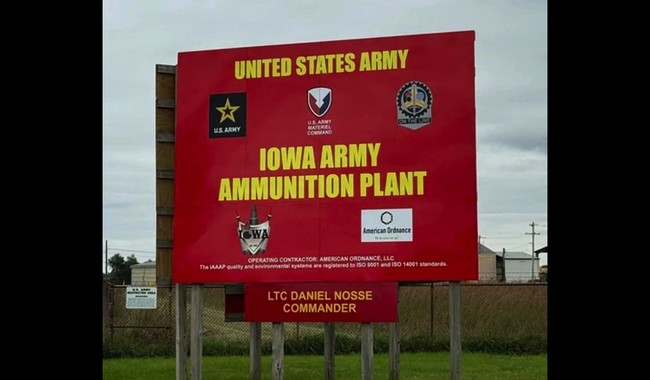
A federal appeals court has cleared a major legal obstacle to the U.S. Army's plan to dispose of nearly 10,000 pounds of deteriorating explosives at an Iowa ammunition plant. But whether the operation will proceed immediately is another question, particularly after President Donald Trump personally intervened.
On Monday, the 8th Circuit Court of Appeals denied an emergency request by the Iowa Environmental Council and Sierra Club to block the planned detonation of 68 drums of lead azide at the Iowa Army Ammunition Plant in Middletown.
The panel also lifted a temporary stay issued Friday, allowing the Army to proceed under an emergency permit from the Environmental Protection Agency (EPA).
And the court's reasoning comes down to a sobering reality: The alternative to a controlled explosion could be an uncontrolled one.
Lead azide is an explosive compound used to detonate other explosives. In March, the Army discovered that material stored at the facility for more than two decades had deteriorated, becoming dangerously sensitive to shock and friction. Army experts determined that moving the drums could trigger an accidental explosion.
The Environmental Protection Agency (EPA) issued an emergency permit on November 13 authorizing two controlled detonations inside the storage magazines.
Environmental groups challenged the plan, warning that the explosions would disperse toxic lead particles into surrounding communities, potentially contaminating homes, farmland, and waterways. They also questioned whether the EPA adequately considered alternatives and provided sufficient opportunity for public comment.
Ultimately, though, the 8th Circuit wasn't persuaded.
In its November 23 ruling, the panel found that the EPA had considered alternative disposal methods and reasonably relied on the Army's explosives experts. It also noted safeguards addressing weather conditions, containment, public notification, environmental monitoring, and cleanup.
As for the environmental groups' demand for a full 45-day public-comment period, the court concluded that such a requirement could undermine the purpose of emergency permitting.
The panel summed up the dilemma like this:
Here we are faced with a situation in which the risk is between a controlled detonation and an unplanned explosion, not between the risk of a controlled detonation and no explosion at all.
Falling temperatures, the court noted, could further destabilize the material, increasing the risk of an accidental explosion without advance warnings or protective measures.
But there's another wrinkle.
As Ward Clark previously reported, earlier on Monday, President Trump intervened, directing the Army to hold off on the detonation until the 8th Circuit ruled on the matter. He also made clear that the operation would be contingent on approval from Iowa's incoming governor, Democrat Rob Sand.
With Monday's appellate ruling, the first of those conditions has now been satisfied.
That leaves Sand, whose agreement Trump expressly required before the Army could proceed.
Sand posted the following to X shortly after the 8th Circuit ruling issued:
The Administration should make this decision based on the information they have from the people they brought in to do the job months ago and have been on the ground in Middletown for weeks. Everyday Iowans are entitled to know how Middletown came to this situation, and learn why the administration believes this is the best path forward. That means they should have the same access to the information I’ve received in briefings from the administration, straight from the source. I’ve asked the federal government to share that information with the public as soon as possible.
— Rob Sand (@RobSandIA) November 23, 2026
The Administration should make this decision based on the information they have from the people they brought in to do the job months ago and have been on the ground in Middletown for weeks.
Everyday Iowans are entitled to know how Middletown came to this situation, and learn why the administration believes this is the best path forward.
That means they should have the same access to the information I’ve received in briefings from the administration, straight from the source. I’ve asked the federal government to share that information with the public as soon as possible.
So, the 8th Circuit has weighed in. Sand, meanwhile, has stopped short of giving the approval Trump requested, instead pointing back to the administration and calling for more information to be made public. That leaves the Army's next move uncertain, even with the judicial roadblock now removed. And with temperatures dropping and the explosives becoming increasingly unstable, it's a decision that may not lend itself to much more delay.