
A week ago, I wrote about the dumb "dummymander" narrative that was emerging from some of our supposed intellectual betters on the Left and in the MSM (but I repeat myself) that went along the lines of how red states that participated in mid-decade redistricting screwed themselves over and caused themselves to lose seats in the process after all the dust had settled from November 3.
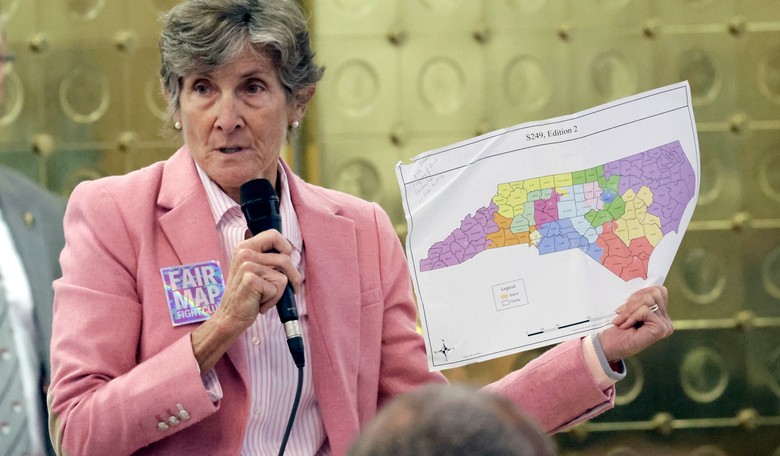
As I noted at the time, barring an (unlikely) change resulting from recounts in two congressional races in North Carolina, Democrats flipped the script on the delegation composition here, taking the 10R-4D GOP advantage and changing it to 11D-3R. In essence, several districts that had previously been reliably red flipped to blue because of the blue tsunami, not mid-decade redistricting. There was only one real "dummymander," if one could even call it that, with the 2025 redraws of NC-01 and NC-03 resulting in Democrats holding on to District 1 and flipping District 3 (which had been diluted by the 2025 redraw in hopes of picking up NC-01) by under 300 votes.
Greg Murphy likely would have kept the NC-03 seat had his old district lines been in place and had this been a typical midterm swing and not a tsunami. But even under the newer map, he likely would have won had it not been for what Western Carolina University Political Science Professor Chris Cooper described as a "100-year flood electoral environment."
Prof. Cooper has also speculated, as yours truly already had, that 2028 is unlikely to be like 2026 in part because of prior redistricting, and in terms of mid-decade redistricting on the whole, that is a view that seems to be shared by Votebeat Managing Editor Nathaniel Rakich, whose previous work was as a former senior editor and senior elections analyst at FiveThirtyEight.
Rakich wrote that "a Votebeat analysis suggests Republicans won several more House seats than they would have under the 2024 congressional maps" while adding that "cries of 'dummymander' ignore the fact that the maps could very well yet give Republicans their desired outcomes in future elections." Further, he noted:
But just because their gambit failed in 2026 doesn’t necessarily mean North Carolina’s gerrymander was a dumb move for the GOP in the long term. That’s because the map would probably favor Republicans in all but the most Democratic of political environments. If you subtract just 5 points from Democrats’ margins in every House race — approximating a still-dominant 9-point Democratic national popular vote win — the GOP would have won 10 of North Carolina’s 14 seats.
Anything is possible, but odds are that Democrats will not match their 2026 numbers in the 2028 and 2030 elections — which will also take place under this map. So even though North Carolina’s Republican gerrymander backfired in 2026, it may also be a boon to their future efforts to take back the House.
His full analysis can be read here, and it applies not just to North Carolina but other red states that redistricted recently, including Texas.
In the immediate aftermath of elections, we get a lot of hot takes and narratives that are pushed before all the facts are known and before all the data has been crunched and analyzed. Some end up bearing out while others ultimately crash and burn.
This is another reminder that it's always good to take such things with a grain of salt because, as they say, the devil is in the details - and the details indicate that Republicans will have a good opportunity to turn things around in two years, based in part on the fact that they played hardball on the issue of redistricting, in part because Democrats will inevitably overplay their hand, and in part because there is likely to be top-of-the-ticket enthusiasm in a presidential election year that will trickle down to down-ballot races in terms of voter motivation.