
With one week left before Election Day and in-person early voting underway across the country, a question I see asked a lot by people overwhelmed by the flood of information is: "Which races should I focus on the most on Election Night?"
First and foremost, you want to be tuned into what's going on in your local and state contests for obvious reasons. But if you want to know which Senate race is most likely to inform us about the likelihood of whether the upper chamber will stay in Republican hands, keep your eyes on Michigan, for reasons explained below.
Among the Democrat-held Senate seats Republicans have been vying to flip, Michigan has been the one that stands out as the "most flippable" due to some unusual features you don't often find in purple-state Senate battles.
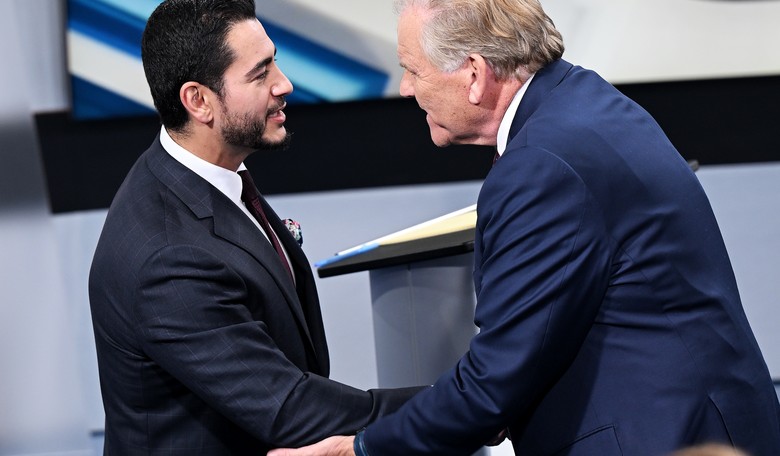
You've got GOP nominee Mike Rogers, an Army veteran, former FBI agent, and former House Intelligence Committee Chairman, against Democrat nominee Abdul El-Sayed, a DSA-backed radically left-wing candidate who, as Rogers has correctly pointed out, is a dangerous conman whose allegiances are with America's enemies and not the people of Michigan.
What makes this race somewhat unique is that Rogers has had some big post-primary opportunities to make inroads with certain groups of voters who have traditionally voted for the Democrat candidate: Jewish voters and black voters. Why? As we've extensively reported, a not-so-small faction of Jewish voters in the Great Lakes State are deeply uncomfortable with El-Sayed's anti-Israelism and pro-Hamas extremism to the extent that some have held fundraisers for and appeared in ads with Rogers.
Similarly, El-Sayed's problems with black voters have been well-documented, stemming in part from longstanding trust issues between the Arab community in Dearborn and black voters in Detroit. The NY Times, for instance, noted that "for some black voters, no surrogate would prove powerful enough to overcome grievances rooted in personal experiences at gas stations and grocery stores."
With all of that in mind, we turn to not only why this race is so critical for both parties, but also to what to look for Election Night as returns come in - the things that would give us clues one way or another ahead of the race being called.
NBC News' chief data analyst Steve Kornacki did a "data dive" into the Michigan Senate battle and provided invaluable insight:
For Republicans, Michigan is the state that changes their Senate majority math on election night.
The Senate map overall favors the GOP, so the party is on offense in just a handful of states critical to control. Michigan offers the rare Democratic-held seat that Republicans have a chance to notch despite the tough national political climate. Their hope is that Abdul El-Sayed, the Democratic nominee, will prove to be too far to the left and too controversial for an electorate that sided with Donald Trump in two of his three presidential campaigns.
Democrats need a net gain of four Senate seats to gain control of the chamber, which requires them to win in at least two states that Trump carried by double digits in 2024. An El-Sayed loss to Republican Mike Rogers would increase those numbers, forcing Democrats to post a net gain of five seats elsewhere, at least three of them in double-digit Trump states.
Kornacki's analysis was similar to what Decision Desk HQ has previously written about the Michigan Senate race:
Yet El-Sayed only leads 48%-46% in DDHQ’s polling average, and knowing no other results, our forecast projects that a Democratic loss in Michigan would give the GOP nearly a 4 in 5 shot of preserving its Senate majority.
Among the states Trump carried by double digits in 2024 were Texas, Alaska, Iowa, Kansas, and Ohio. All five have competitive Senate races involving Republican-held seats the GOP is defending.
Kornacki also compared the Michigan 2026 race to the 2024 Senate race between Rogers and then-Democrat Rep. Elissa Slotkin (MI-07), where Rogers narrowly lost by less than 20,000 votes (0.34 percent) among the over 5.5 million cast in that race, and on a night that was otherwise great for Republicans nationally.
What cost Rogers, Kornacki shared, was that there were some Trump voters who split the ticket and voted for Slotkin over him. There were also Trump voters who left the Senate options blank. One of the counties where Rogers underperformed Trump in 2024, St. Clair County, was where Trump visited at his most recent Michigan campaign rally.
As for El-Sayed, Kornacki wrote that there is one area where the Democrat is poised to do better than Kamala Harris did in 2024: among Arab American and Muslim voters, who in 2024 weren't enthused with the Biden-Harris administration's position on the Israel-Hamas war.
But El-Sayed's problems with Jewish, black, and more moderate Democrat voters persist. And because of that, Kornacki suggested looking to Oakland County for clues as to how the night might ultimately play out for Rogers and El-Sayed:
– The question is particularly acute in Oakland County, which is to the north of Detroit and produces more votes than any county in the state outside of Wayne. Oakland includes a number of higher-income bedroom communities where the locals once voted Republican on pocketbook issues but have increasingly become Democratic voters on cultural grounds — and in protest of Trump. Critically, it is also estimated to have the largest Jewish population in the state, a group that typically votes heavily Democratic.
[...]
Slotkin carried Oakland by 12 points over Rogers two years ago when she eked out the win that sent her to Washington. That number will serve as a valuable benchmark as the results come in on election night.
If El-Sayed is winning the county by less, and especially if his margin dips into single digits, then Rogers should be feeling good about his chances of a statewide victory. But if El-Sayed matches that Slotkin margin, and especially if he builds on it, he’ll be in strong shape to prevail.
RedState, of course, will be around Election Day and Night and will be monitoring the results as they come in. As always, stay tuned.