
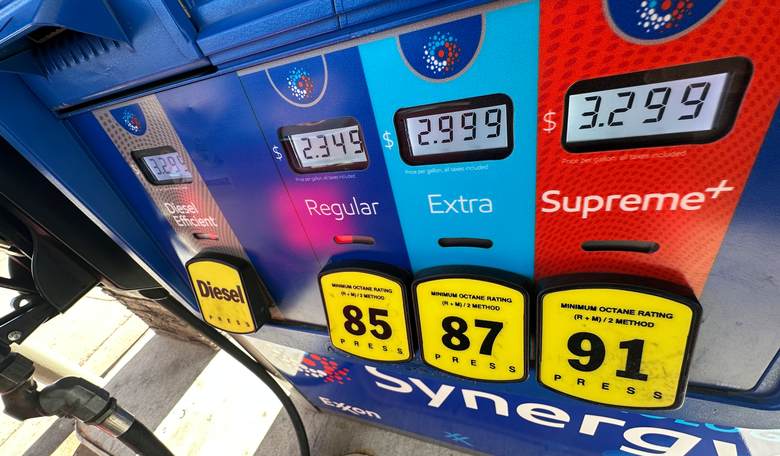
Around America, drivers are feeling the pinch at the pump. But Michiganders and others across the Rust Belt have it worse than most, with prices far above the national average. One factor that can more easily be dealt with than others to reduce fuel prices is the Renewable Fuel Standard (RFS), a federal program managed by the Environmental Protection Agency (EPA) that requires transportation fuel sold in America to contain a minimum amount of renewable fuels such as ethanol. The concern is straightforward: another federal compliance cost in a market where families can least afford one.
The RFS is estimated to cost each Michigander $190.23 every year. At today’s fuel prices, that would cover more than a tank and a half of gas for the average SUV — the most popular vehicle type in Michigan. While consumers might notice that cost most directly at the gas station, we’re paying it in far more situations. Since RFS applies both to regular gas and diesel fuel, farmers, truckers, and other businesses who need to transport everyday goods to the consumer are seeing their costs increase as well, and that winds up in our prices for groceries and other goods at the store.
According to RealClearPolicy, the EPA has estimated the cost to consumers to be around $20 billion in 2026 and 2027, while other organizations have that number closer to $66 billion or even $70 billion. As writer Taylor Millard puts it, “Whichever way you cut it, the bottom line is, the RFS is expensive for refiners and consumers.”
No one can promise that fuel prices will fall quickly. The cost of diesel has been higher than that of standard fuel for more than 20 years, but that gap has widened in 2026 due to global refinery disruptions, export restrictions, and low inventory. That makes it all the more important to scrutinize costs Washington can actually control. And this policy is one that deserves the most scrutiny, as it’s widely considered to be a failed policy.
The question is — why are we keeping a policy that makes fuel more expensive, especially when it’s a political liability? Some legislators are not only trying to keep it, but they’re trying to make it stick year-round through the farm bill currently in the Senate. Before expanding these requirements, lawmakers should explain what consumers stand to gain and what they will be asked to pay.
Michigan is a key battleground for the Senate in 2026, and the race is tight. With so many tight Senate races, it’s hard to say which party will have control in 2027. Each one matters, and high prices are a wedge issue that can help people decide. RedState has correctly identified high fuel prices and RFS as a political liability for Republicans. Writer Ward Clark states, “What it all adds up to is this: Gasoline prices are too darn high, and anything that can be done to bring them down before November will help Republicans in what is increasingly looking like an uphill battle to hold the Senate and the House of Representatives.”
Millard asks, “Will the current political map be enough to finally force Congress and the administration to jettison the RFS? Hope springs eternal, with that route providing the only real pathway to real relief to Americans.”
Michigan families have absorbed enough higher costs, particularly from D.C. The EPA and Congress should put affordability ahead of the failed ethanol mandate and pursue reforms that deliver measurable relief. That would be good policy for Michigan and a stronger answer to voters worried about the price of everyday life.
Amelia Hamilton is a writer and communications professional from Michigan with more than a decade of experience in messaging to promote liberty. Through her work with different organizations and publications, she knows how to craft the right message for each audience to help them connect with policy issues. Amelia has undergraduate and master’s degrees in both English and 18th-century history from the University of St. Andrews in Scotland