
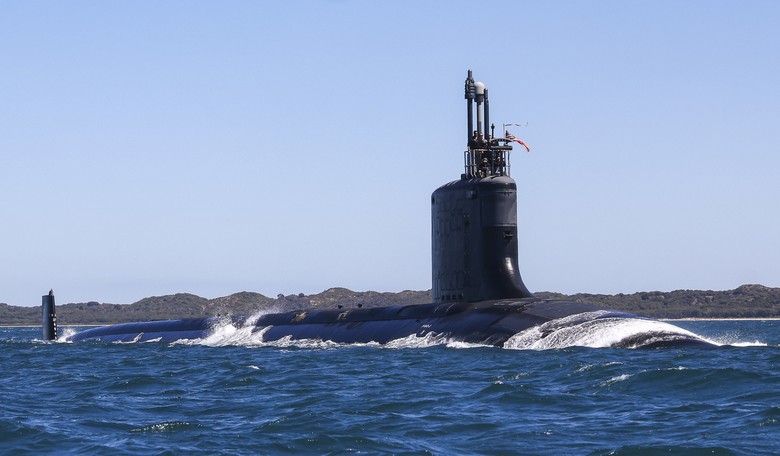
The Baltimore, Maryland area is now reportedly slated to gain a bunch of new shipbuilding jobs, or more properly, as Navy types may put it, boatbuilding jobs. On Tuesday, the Navy announced plans to partner with shipbuilder Anduril in a $6.6 billion investment in a new yard to build components for the new Virginia-class nuclear fast-attack boats.
The Navy will pick up $2.9 billion of the tab, with Anduril covering the balance.
The Navy has awarded Anduril a contract worth up to $2.9 billion to support the effort, according to a press release from the contractor. The firm plans to invest $3.7 billion of its own funding to help stand up the facility, grow the workforce, and add new tech and other capabilities that will be required for the project.
“The United States Navy, together with Anduril Industries, will invest $6.6 billion to create a new facility in Baltimore County, Maryland, which will manufacture critical components for the Virginia-class submarine. This delivers on President Trump’s promise to bolster America’s defense industrial base while revitalizing our manufacturing industry, creating over 13,000 direct and indirect jobs, and driving $2 billion in annual economic output,” White House Principal Deputy Press Secretary Anna Kelly said in a call with reporters Tuesday.
The facility, dubbed Arsenal-2, will be constructed at Tradepoint Atlantic in Baltimore County.
The Virginia-class boats are among the newest additions to the Navy's undersea fleet, with a maximum submerged speed of 34 knots, a crew of 135, and they are capable of carrying Tomahawk cruise missiles in vertical modules in addition to having four tubes capable of launching either Mk-48 torpedoes or Harpoon missiles. This class of attack boat first entered the fleet in 2004, and they aren't cheap, with a sticker price of about $2.8 billion. And that price doesn't even include the Corinthian leather seats.
The new facility looks like it will be a state-of-the-art, software-driven (AI?) facility.
Anduril’s industrial software platform, called ArsenalOS, will provide the “digital backbone” for the facility and its production systems, according to the press release.
“It will connect fabrication workflows, outfitting sequences, material movement, inspection protocols, and documentation requirements in a single system, giving workers and managers real-time visibility into the state of production. Digital work instructions, embedded quality controls, modern sensing, and automation will support the expertise of welders, pipefitters, electricians, shipfitters, inspectors, and other skilled trades. By making production requirements more visible and processes more consistent, ArsenalOS will help new workers train faster while preserving the technical rigor, judgment, and quality required for submarine construction,” per the release.
Anduril has quite the portfolio, in land, sea and air applications, which makes this an interesting development.
Submarines are liable to play a major role in any future, large-scale maritime conflict, and in this, the United States has a considerable advantage already. As of this writing, the United States has 50 nuclear attack subs and 21 ballistic missile subs, while Russia has 28 nuclear attack subs (more or less) and 10 missile subs (again, more less) while China is thought to have 32 nuclear attack subs and 10 ballistic missile subs. At the present the United States has the edge technologically and numerically, but China is certainly looking to catch up. That makes improving our production capacity all the more important. If we were tasked with, for example, closing the Taiwan Strait, submarines would be a primary weapon employed to do just that.
There's another aspect: The jobs, in a city that is, frankly, struggling, with the new facility expected to produce nine million hours of labor a year. Assuming 2,000 hours per year per full-time employee, that's right around 4,500 jobs.
And, no, we're not tired of winning yet. If you want to see more of this, well, then, on election day, you know what to do.